How long did the carving take Battles of Grunwald?
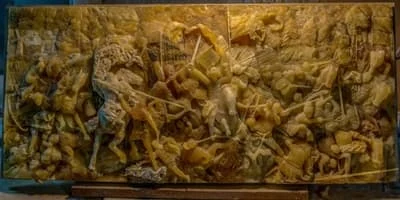
Przemysław Kuś Almost a year, several hours a day, six days a week. The result is a relief measuring 110 x 60 cm – the largest amber item created in our workshop to date. It weighs about 10 kg, but we used over 20 kg of amber to make it.
Where did the idea to make this come from of this image in amber?
PK: That was the idea of Mr Marian Kellar, who is our client. At the beginning it was very difficult, I was a bit worried whether I would be up to the task. But when I started seeing the first results, my doubts disappeared and I got more motivation.
I saw this painting in real life and compared it with a photograph of the painting – it makes an impression.
Wiesław KuśAnd that was the assumption. After all – especially with today's amber prices – nobody would commission an unshowy piece, because it wouldn't be financially viable.
PK: Here, the effect is built by spatial and openwork forms; a great deal is happening on this bas-relief. If I had made an amber picture, that effect would no longer be there.
WK: The art lies in the multitude of details and the most faithful possible representation of reality.
Was it difficult?
PKAt one point, the worst thing for me was the feeling that I'd been working on this relief for so long and still had to keep looking at it (laughter). But I tried to banish those thoughts and the irritation so as not to get upset, because then nothing would have worked out for me.
WK: In this job you cannot get agitated, it requires immense precision: as soon as your hand trembles, something might break, get damaged or be poorly ground. You have to be very calm.
PK: Probably the most tedious stage is matching the amber colour shades to ensure smooth transitions and avoid contrasts where they are not needed. At the beginning, I would lay out the lumps from which a given fragment of the relief was to be made and consider how they could be joined together so that they best matched each other in terms of colour and size. I constantly compared it with the painting, determined the distance and space, and wondered how best to reflect in amber what can be seen in Matejko's painting. I started by mounting 3-4 lumps, choosing the rest later. Gluing them all on at once is too big a risk. For after removing the outer layer, it may turn out that the lump inside is completely different from what we expected, or that it has some previously invisible flaw. It has happened more than once that we had to rack our brains over how to use this defect so that it turned out to be an asset. That is why we have learned to work slowly and carefully – both when selecting the lumps and in the method of carving. This is the result of many years of practice: now we always give ourselves a chance to react quickly if necessary.
WK: However, contrasts are sometimes necessary. We had to wait for a sufficient amount of white amber to be gathered for Ulrich von Jungingen's robe. It had to stand out like in a painting, so that all the elements wouldn't merge together in colour.
The idea of executing works of famous masters in amber is not new – Lucjan Myrta is famous for this, although his realisations are usually much larger than the original. Do you compare yourselves with him?
PK: We do not compare ourselves with anyone, we simply carry out orders to the best of our ability.
WK: Myrta is in a different league, though. In his workshop, he has gathered the very best amber artisans. Yet I dare say that we are practically second to none compared to him. Just like him, we pay great attention to quality and detail. We have the skills, but unfortunately we don't have such wonderful raw material facilities.
A masterfully crafted amber sculpture is now a luxury. How many amber sculptors are there in Poland?
PK: It is hard to say, but you can certainly count them on the fingers of one hand.
WK: A good sculptor should above all have spatial imagination, in order to see what can best be made from a given piece of amber. It must also be crafted in such a way that there is as little waste as possible, and the finished item is as striking as can be.
PK: Stone generally tells you itself what should be made from it. Sometimes it happens that a block sits on the workbench and waits – I walk past it many times and nothing. Until suddenly one day – eureka. And you already know what will be created from it.
How long have you been carving amber?
WK: The Art Amber Kuś company has been around for 13 years, but we have been carving in general for much longer. It's just that previously we carved… in wood. And as a child, our son practiced carving in potatoes and soap (laughterAs it happened, we got into amber: a client who came for a commissioned wooden sculpture asked if I would like to try working with amber. I had no experience, but I decided to give it a go. It turned out we were rather good at it, so we kept getting more and more commissions. And so it remained.
Is this a difficult job?
WK: The risk is quite high because you never know how a given piece of amber is going to behave and what secrets the lump conceals inside – it may turn out that its colour on the inside is completely different from the outside, which often ruins our plans. And it is a real tragedy when the lump, and God forbid a carving, falls. Wood can take a lot, amber shatters.
PK: A few years ago I carved a beautiful, highly detailed bee. Unfortunately, while polishing it, I pressed it too hard against the polisher – in a split second the bee „flew away” and smashed against the wall (laughter).
WK: There is also the issue of waste: it can generally be stated that the more labour-intensive the sculpture, the greater the waste will be. On average, however, one must expect 40-50% of waste, which, given current prices, results in a truly considerable cost that has to be compensated for somewhere after all.
PK: Besides, not every amber is suitable for carving. Young amber, dating back some 20 million years, is too soft, details cannot be carved into it, and sometimes it cannot even be polished. But fortunately this is obvious as soon as one starts working with such a piece. In jewellery it would be easier to find a use for it, as that is not quite so demanding: it would be enough to shape it gently and set it.
You specialise in carving paintings by famous master painters and sculptors. Which ones are you most proud of?
PK: One of the better ones, in my opinion, was the work Four continents, depicting a scene from the Baroque work by Peter Paul Rubens under the same title. It was made from a piece of amber with an initial weight of one and a half kilograms, and the finished piece weighed just under half as much less. We also made an amber version Girls with a Pearl and Johannes Vermeer's Lady with an Ermine Leonardo da Vinci, which is currently on display at the Amber Museum in Kraków. It was also Pietà of Michelangelo and The Last Supper Leonardo da Vinci.
WK: Once we carved a Statue of Liberty in amber – it was bought by the American Polonia, who then presented it to George Bush.
Few people have heard of you because you do not sell your work under your own name.
PK: For several years we have had regular clients for whom we work. On the one hand, this is quite convenient for us, as we do not have to chase after orders, worry about where to get raw materials, or who to sell the finished products to. On the other hand, we dream of having our own gallery where we could offer our handmade products. We have many original ideas for sculpture, but for now we do not have time to realise them, because orders take up all our working time. And for some time it will probably remain that way.