A journey full of surprises
Between the Danube and the Adriatic coast, the amber trail has no current state borders; it has repeatedly crossed the Austrian-Hungarian border. No wonder, because the current border was established only in 1918 and has an rather artificial course. In ancient times, the area was home to the Roman province of Pannonia, which, despite its peripheral location, played a huge role in the functioning of the late empire. First and foremost, it served as Rome’s granary – the lands of the Great Hungarian Lowland are extremely fertile and in the past supplied the vast territories of the Empire with food. As a consequence, trade developed and many estates were established. It is no wonder that Hungarian Pannonia is rich in magnificent monuments from ancient times; the trade routes here, due to their importance, were very well maintained. To such an extent that many sections of ancient tracts have survived in excellent condition to this day – which can be fascinating if we realize how quickly road infrastructure built in modern times deteriorates.
A trip to Panonia is first and foremost an adventure, during which many of us will be surprised. Who of us would expect to see an authentic Roman stone road right in the heart of Central Europe? Even greater positive surprise awaits us at the Archaeological Museum of the city of Sopron (read: Szopron), where there are numerous exhibits presenting the life, customs, and culture of the Romans, the Bronze Age peoples, Celtic tribes, and other communities inhabiting the territories of present-day Western Hungary.
Something else will also surprise us positively: first of all, Sopron and Szombathely are completely different Hungary from the ones we are used to. You will admit that Sopron is not one of the places in Hungary known to Poles; much more popular are Budapest, Eger, Balaton or Hajduszoboszlo. However, it is precisely this city that is the best preserved and most historic city in Hungary. According to estimated sources, as many as one-third of Hungary’s medieval monuments are located in this city. This is due to the fact that Sopron, as one of the few cities in today’s Hungary, avoided the Turkish destruction that devastated almost the entire country. And while in Budapest and most other Hungarian cities the monuments are relatively young (the construction of the capital’s center is mostly of the 19th century), in Sopron and Szombathely we can feel as if we were transported to times if not ancient, then at least medieval, with a touch of Renaissance and Baroque.
Sopron – the amber capital of Hungary
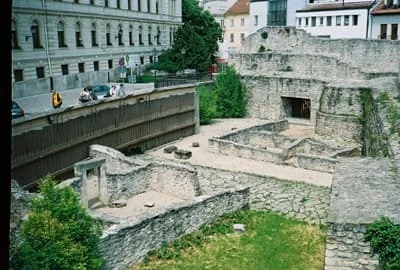
In ancient times, the site of today’s Sopron was home to the Roman settlement of Scarbantia, which was first mentioned by Pliny the Elder. Scarbantia received city rights at the end of the 1st century AD and rapidly developed into a commercial city. The remains of Scarbantia are not particularly extensive, but they are still worth seeing. First of all, there is the already mentioned section of the amber trail. Meanwhile, movable artifacts from ancient times are on display in the adjacent Museum of the City of Sopron. Among the most important finds are the statues of Juno, Jupiter, and Minerva in white marble, dating from the 2nd century AD.
Sopron Old Town is one of the most beautiful in Hungary. Most of the tenement houses have retained their original facades, and inside they house the headquarters of many municipal museums. The city also boasts excellent cuisine and relatively low prices – a good dinner can be had for as little as 7 euros. Due to its proximity to Austria, it is easiest to communicate in German here, and most shops and restaurants accept payment in euros.
A characteristic feature of Sopron is its location – in a semi-enclave surrounded on three sides by the territory of Austria. Sopron was the natural center of today’s Burgenland, which until 1919 belonged to Hungary and after the First World War fell to Austria. However, in a referendum, the residents of Sopron and its surroundings decided, unlike other residents of the region, to be part of Hungary – hence the strange course of the border. Due to these traditions and geographical location, Sopron is worth visiting „in a package” together with neighboring Burgenland, where particularly noteworthy are: the capital of the country Eisenstadt (60 km from Sopron), the huge Lake Neusiedl, the ancient Villa Rustica and the amber exhibition in the many-speaking town of Bernstein.
Roman monuments are everywhere
Following the amber trail south, we reach Szombathely – a city of 90,000 inhabitants today, similar to Sopron located not far from Austria. Szombathely was founded in the year 43 AD by Emperor Claudius I as Savaria. The most important ancient monument is the Romkert, or Ruin Garden. It is here that you can find, among other things, the intersection of roads from Roman times, including the amber trail we are interested in. It is also worth seeing the remains of the ancient temple of Isis and also the small relics of the early Christian basilica of St. Quirinus.
Although Sopron and Szombathely are undoubtedly icons of the Hungarian amber trail, the ancient monuments in these cities do not end there. Roman relics can be found virtually throughout the entire territory of Hungary, including in the capital city of Budapest. It is also worth noting that the amber trail had many branches, and one of them also led through the area of today’s Budapest and then through present-day central Slovakia and Kraków.
The Greenways amber trail, which connects Budapest with Krakow, passes through Bańska Bystrzyca and Orava. This initiative is more focused on promoting cycling tourism and agrotourism than on activities strictly related to amber, but it is nevertheless worth noting – those interested can visit the website: www.szlakbursztynowy.pl