A city on the edge of civilisation
Bratislava has every prerequisite to be one of the most recognisable cities on the Amber Road and to build its image around amber, among other things. How is this possible, given that the Slovak capital is not really associated with the gold of the North? The answer lies in the very essence of the Amber Road, whose uniqueness lies in the fact that it harmoniously connects the traditions of the Roman South and the barbarian North—that is, the two components of Europe's cultural heritage. Meanwhile, the Bratislava conurbation lies right on the border of these two opposing worlds—and it is largely this fact that has determined the character of the city.
In ancient times, the Danube was the border of the Roman Empire. On the right bank of this great river lay Roman border fortifications, the ruins of which have survived to this day. One of these is Carnuntum near modern-day Hainburg, but Roman fortifications can also be visited within present-day Bratislava (the Rusovce district near the border with Austria and Hungary). Bratislava would not exist today were it not for the strategic importance of two Danubian elevations upon which Celtic and subsequently Slavic hillforts arose: Devin and the stronghold on the site of the present-day Bratislava Castle, around which the town later grew. They were established to guard and control an important ford across the Danube, which the Romans used for trade with the North. This strategic crossing was nothing less than an integral part of the Amber Road, and the castles of present-day Bratislava were the first settlements and economic and military centres on the „barbarian” side. They were built in a place where the Amber Road not only crossed the border of two civilisations, but also intersected with the equally important river route of the Danube. The beginnings of settlement in the area of present-day Bratislava are therefore closely linked to Rome's trade with the North, and the driving force behind this trade was, amongst other things, amber.
Nothing has changed
The Amber Road had many branches, but the „Bratislava” variant was among the most important. Of course, by using the term „Bratislava” in relation to the reality of centuries ago, I am using a mental shortcut and mean the area of present-day Bratislava within its current administrative boundaries, as the name „Bratislava” itself has only been in use for just over a hundred years. This route crossed the Danube near the present-day Bratislava Castle and branched into two paths here. The more important one turned north-west, passed Devín and led further through Moravia into the territory of present-day Poland, while the second went north, along the Little Carpathians, then up the Váh and Kysuca valleys, to reach current Polish lands through the Jablunkov Pass, or via the vicinity of present-day Zwardoń or Orava.
What is astonishing in all of this is the fact that the route of the primitive track from two millennia ago is almost identical to the current layout of the 6th Trans-European Transport Corridor and the motorways (including those under construction and planned) and main railway lines that make up it. Just like the ancient highway, the present-day Baltic–Adriatic transport corridor branches out around Bratislava and Vienna into two parallel threads: the Moravian and the Slovak ones, which then converge in Silesia to reach the Baltic. Today, too, this corridor is referred to by the moniker „amber”: people speak of the „amber motorway” (A1) or even of the „new Amber Road”. Unfortunately, both in the modern version of the „amber trunk route” and in the modern marketing of cities and regions based on amber traditions, almost exclusively the western variant of this route is mentioned—through the Czech Moravia. The amber heritage of the Slovak Kysuce, the Váh Valley and Bratislava itself remains somewhere in the shadow of the Czech Republic, which on the one hand is caused by insufficient awareness of these traditions among Slovaks themselves, and on the other—by a lack of interest on the part of Polish promoters of the amber brand in reminding Slovaks of these traditions.
Forgotten city, stolen history
Why is Bratislava, which grew along the amber road, not currently recognised as an „amber city”, ceding these traditions to the Czechs? Actually, there is nothing strange about this if one considers the problems Bratislava has with its history, or rather with its popularisation in the world.
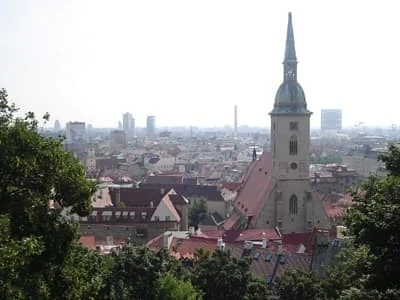
I wonder how many readers of the amber.com.pl portal know that for several centuries Bratislava was the capital and largest city of Greater Hungary, the coronation site of Hungarian kings, and for a time the second most important city of the Habsburg Empire. Bratislava Castle and St Martin's Cathedral played roughly the same role in Hungarian history as Wawel and Kraków as a whole did in Polish history. At a time when Budapest, or rather the separate cities of Buda and Pest, were insignificant centres, Bratislava flourished economically and culturally, as evidenced by the magnificent architecture of the Old Town, full of palaces and wealthy townhouses.
Bratislava did, however, have one „flaw”: right after the First World War, it was so cosmopolitan that it bore much more resemblance to Venice or the Free City of Danzig than to a centre of Slovak statehood. Right up until the 1920s, almost every resident of Bratislava spoke three languages fluently: German, Hungarian and Slovak, and the then-controversial incorporation of the city into Czechoslovakia was not welcomed by the locals. The residents of Bratislava demanded that the Entente create a separate state out of their city and the surrounding area, citing the precedent of the Free City of Danzig, whose situation was incidentally remarkably similar to that of Bratislava at the time (cosmopolitanism, a cultural melting pot, a city on the borderlands of cultures). Alongside the traditions of amber, this is a very important argument that should prompt the authorities of Gdańsk to seriously consider establishing closer ties with the Slovak capital.
Bratislava only really became Slovak during the interwar period and after the Second World War. However, the period following its incorporation into Czechoslovakia brought a certain marginalisation for Bratislava, which had hitherto always been multicultural and did not quite fit into the new state. Bratislava was most troublesome for the communists, who made every effort to erase from memory the Hungarian and Habsburg traditions that had constituted the place's splendour. It was therefore forbidden to speak aloud of the fact that Bratislava (Pozsony) had been the capital of Hungary, a city of kings and aristocratic palaces swimming in opulence, and that Europe's first municipal park (Sad Janka Kráľa) – the brainchild of the „bourgeois” Maria Theresa – had been created right here. The communists therefore built a huge district, a socialist prefabricated housing estate – Petržalka, demolished a small part of the Old Town, and built an expressway beneath the castle. From then on, Bratislava was to be exclusively a „city of the working people”, with its symbol becoming the socialist housing estates. As can be seen, this image strategy proved extraordinarily effective: nowadays in Poland very few people know about Bratislava's rich history, and the city remains in the shadow of Prague, Vienna and Budapest, functioning in the public consciousness merely as a cheap place to stay and a base for trips to Vienna, rather than as an attractive Central European metropolis for tourists.
Will amber enliven Bratislava?
Currently, the Slovak capital is seeking its place on the tourist map of Europe by once again invoking its glorious traditions, which for years were forbidden to be spoken about. However, one cannot help but notice that Bratislava's marketing strategy is somewhat chaotic and completely misses Polish audiences, who still know nothing specific about the city.
The blame for this lies with Slovakia's tourism policy, which in countries such as Poland or Ukraine promotes only the Tatras and water parks in the north of the country. This is evident at tourism fairs, where an equals sign is drawn between Slovakia and a holiday in the mountains. There is no longer any room for a presentation of the capital, and anyway, the Bratislava city council itself takes Polish tourists somewhat lightly, directing its marketing activities almost exclusively at the markets of the Czech Republic, Austria and Western Europe.
However, private tourism entrepreneurs, as well as representatives of non-governmental organisations and the media, criticise the promotional strategy of Slovakia and Bratislava. They dislike the fact that Bratislava remains in the shadow of other Central European metropolises, even though it could be just as much of a tourist hit as Prague or Kraków. And it is from them, rather than from the city, that various interesting initiatives originate to present the Slovak capital in a new light, including those utilising the amber brand.
„Bratislava lies on the historic Amber Road, halfway between Gdańsk and Rome, on the Blue Danube, which connects 10 European countries. Unfortunately, although Bratislava's amber traditions are widely known in Slovak society, this asset is not yet widely used in the promotional strategy of our region. Therefore, I would like to propose that you organise a conference or thematic meeting at our hotel in Bratislava, dedicated to the use of the Baltic amber brand in the promotion of Gdańsk and Slovak cities and regions,” wrote the director of one of Bratislava's hotels in a letter to Gdańsk Mayor Paweł Adamowicz.
Amber themes will certainly interest many residents of Bratislava, who have no idea how much their city has in common with Baltic amber and Gdańsk (such as the aforementioned multiculturalism). However, they need a little help with this by reaching out to the inhabitants of the Slovak capital with a presentation on amber and explaining to them how the Amber Road can be used to promote the city's tourism.