
Ambersafari is a journey in search of amber. Where did this passion come from? And why did you choose amber as your subject of study?
I think it resulted from childhood memories, from holidays on the Baltic Sea, fleeting images of collecting amber grains on a sunny beach. These memories were intensified here in America, fueled by conversations with a Gdańsk amber merchant about various aspects of his profession. I became interested and searched the Internet for amber. It turned out that the world of fossilized organisms is very rich!
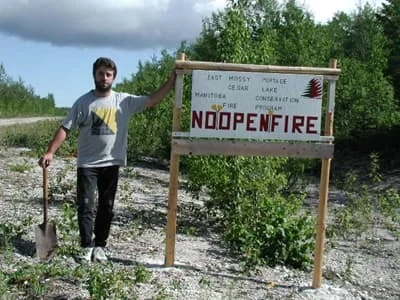
Shortly thereafter, like a treasure hunter, I began planning an expedition to a place considered forever lost to science. It was the amber beach of Cedar Lake in the Canadian province of Manitoba, flooded with several meters of water in the 1960s after the construction of a hydroelectric power plant there. I hoped that the amber would still be washed away by the waves of the lake there. And so it was: it is not lying in a one-meter-thick layer of sediment mixture like it used to be, but it is still there!
After returning from this expedition, I started looking for a name for my website: I settled on Ambersafari. Conversations with the Indians who had been displaced from the areas around Cedar Lake made me aware not only of amber itself, but also of the people associated with it. Both there in Canada and later in Lebanon and the Dominican Republic.
In which places did you look for amber? What specimens were found?
I have visited Canada several times in two well-known places of amber occurrence: Cedar Lake and Grassy Lake. The latter is where the exceptionally large, for amber, fragment of a sopla from the PAN Museum in Warsaw is located. I managed to obtain exceptionally nice specimens of amber in its native rock in Lebanon as well. The smallest of all seems to come from Nebraska: a tiny bead of resin still embedded in a shale rock. Then there was Dominica, from where last year I brought back an impressive specimen of amber with a strong blue fluorescence, weighing over 500 grams, and a mine from the vicinity of Cotui.
However, I would like to emphasize that Ambersafari is not just about personal trips to interesting places, but also about online and personal contacts with amber enthusiasts from all over the world. It was from them that I received or purchased many fascinating specimens – some of them are currently on display at the PAN Earth Museum. These are: m.in. Resins from Australia, New Zealand, Borneo, Sumatra, as well as Denmark and Colombia. Among them is a nearly five-kilogram figure that adorns the permanent exhibition in the Earth Museum. But please imagine the figure I heard about from Borneo, the size of a 200-liter barrel. Or the figures from Sumatra about a sop with a diameter of 75 cm and a length of 2.5 meters!
Were there also resins among these findings that had not previously been described by anyone?
In times when most places where fossil resins previously existed or could have existed are no longer accessible, the chances – especially for the amateur enthusiast – are unfortunately slim. So far, I have not been able to discover anything unique in the world of fossil resins. But I believe that this is an open topic.
You are happy to share your discoveries – many of your specimens are gifts for museum institutions in Poland.
That is true. Many of the exhibits on display at the Gdańsk Amber Museum are described with my name and surname, and many of them are already listed as the museum’s own collections. The same is true of the Inkluzja Museum in Gdańsk and the Natural History Museum in Krakow, as well as the Kaliningrad Amber Museum and the private collection of Gabriela Gierłowska. The Earth Museum in Warsaw is a geological institution, and in their collections the mineral resins of the world are a valuable scientific collection, not just an interesting addition to the topic of Baltic amber.
I certainly do not want to diminish the role of collections other than scientific ones. They are important and perfectly illustrate the concept of „mineralized fossil material”. I myself initiated such a didactic collection of mineralized fossil material at the North-Masovian Museum in Łomża, in order to bring information about how many types of „amber” there are in the world and why the Kurpiowski amber and the traditions associated with it are even more unique. I think that was a good idea. And it was appreciated, since I was awarded the Bursztynowy Kierzec award, which the North-Masovian Museum awards to particularly dedicated individuals for their activities at the institution.
Specimens from my collection of fossilized resins were often made available to scientists working on their physicochemical properties. I received numerous thanks from Prof. Barbara Kosmowska-Ceranowicz for making samples available for research using the IRS technique and for photographs for published materials and books. Dr Aniela Matuszewska and Prof. Eugenio Ragazzi from Padua also worked on the samples for me. And the Gdańsk University of Technology, to which I also donated samples, received specimens for its museum collection from Dr Wolfgang Weitschat from Hamburg.
And that is actually the essence of the success of my interest in fossilized organisms: the possibility of sharing specimens and exchanging information with other people – both scientists and collectors, as well as artists.
On November 18, a special exhibition of gifts donated by Mr. Pan to the Museum of the Earth will be opened there. What will we see on it?
I am not entirely sure about that. Perhaps the entire collection will be shown, and perhaps only selected samples. Some may still be temporarily exhibited in other museums. The format of the exhibition depends on the decision of the researchers from the Amber Department. My list of original works includes nearly two hundred items, but that of course does not mean two hundred specimens – a sample can consist of hundreds or even thousands of pieces, as is the case with Canadian resins.
The latest curiosity I have for the PAN Museum of Earth is the collection of specimens from the southern part of the island of Sumatra: 9 pieces of various sizes and colors with a total mass of nearly 18 kg. These are specimens with colors ranging from yellow, through brown, red, black, to bright green. The black specimen exhibits strongly blue fluorescence in ultraviolet light. Unfortunately, they did not survive the journey around the world without damage – but thanks to this, we can see the beautiful interior of these unique specimens.