
Although less and less so, museum exhibitions are still often associated with boredom. What idea does the Malbork Castle Museum have to spark visitors' interest in amber?
At the „Amber Contexts” exhibition, there is no question of boredom. It is dynamic, visually appealing and tailored to the demands of the modern viewer – both the tourist and the specialist. The interior arrangement is modern, with special display cases having been created for the purpose. The exhibits are not crowded together, which makes them easier to view. The viewer can choose between two sightseeing paths: a shorter one and a more detailed one.
Amber is presented here in various contexts, including natural, archaeological and artistic. In the introductory space of the exhibition, visitors will view an animation of the amber forest, then in the blink of an eye trace the millions-of-years-long history of the transformation of resin into the gold of the North, i.e. amber washed up by sea waves. Subsequent darkened interiors, which reveal artistic artefacts from the Stone Age to the most recent times, are arranged for the 21st century: perfectly directed light draws objects made of amber out of the darkness.
In the archaeological section, a trench has also been arranged, showing what excavation work looks like when searching for artefacts. In turn, in the medieval hall, we have a reconstruction of a former amber workshop with working tools and finished ornaments, as well as a multimedia presentation of the castles that played an important role in the storage and trade of this material by the Teutonic Knights. The most valuable items in the Malbork collection – caskets and other objects from the 17th and 18th centuries – can be admired both in display cases and by examining their elusive details on enlarged illustrations on touch screens. The exhibition is also accompanied by a film presentation.
Which exhibits in the „Amber Contexts” exhibition would you particularly recommend?
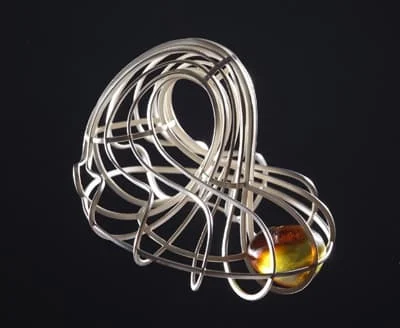
The Malbork collection, which forms the core of this exhibition, is famous above all for its outstanding works of craftsmanship dating from the 17th and 18th centuries. It is therefore impossible not to linger for a while over the works of Michel Redlin, the casket by Christoph Maucher, or the cabinet that once belonged to Stanisław August Poniatowski. It is also worth spending a moment by the display case showcasing the splendour of dining culture in former times or the ways in which works were juxtaposed in the early modern period cabinet of curiosities. Equally breathtaking are the achievements of contemporary creators showcased at the exhibition in various locations, both at the end of the chronological tour and in juxtaposition with works of the past or creations of nature. The exhibition also offers a unique opportunity to see works from other museums in Poland and abroad.
So what will we see?
Extremely rare artefacts that had not previously been shown in Poland, yet are closely connected to this region, were borrowed primarily from foreign museums. This is the case, among other things, with the chandelier of Queen Sophia of Bavaria, which was intended to be a diplomatic gift from Konrad von Jungingen. The situation is similar with the Dohna collection from Słobity, which, deposited in warehouses in Berlin, was inaccessible to visitors. Meanwhile, the Dohna family was an extremely important dynasty of collectors operating in the territory of former Prussia.
For the first time at this exhibition, the latest acquisitions of the Castle Museum will also be presented. Recently, the museum has enriched its collection with extremely interesting inclusions in amber, a 17th-century statuette of Saint John, and works by outstanding contemporary artists working in amber. These include Paulina Binek, Sławomir Fijałkowski, Giedymin Jabłoński, Jarosław Westermark, and Arek Wolski, among others. The key criterion for their selection was, above all, the high artistic quality of the works.
The celebration of the 50th anniversary of the MN took place on a rather grand scale and in an extraordinarily modern way – will this now become the standard for future exhibitions?
This is the assumption of the Castle Museum Directorate. Modern permanent exhibition arrangements require a huge amount of work and funds, yet the safety of historical artefacts as well as the comfort and satisfaction of visitors are of the utmost importance to us. Therefore, the collections that are particularly frequently visited and are the pride of the Museum should be and will be exhibited in 21st-century conditions.