
When I think of amber…
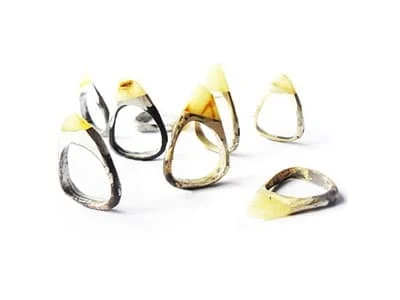
Amber evokes mixed feelings. On the one hand, it is a very interesting stone; it has many wonderful properties, many varieties, and can be easily worked with; on the other hand, it evokes associations with the immortal corals, jewelry, and tourist trinkets that have remained unchanged for decades and still surround us. Therefore, many people consider this stone boring. When I started working with amber, I had exactly this „bancony” stereotype in front of my eyes; I had to first break through this stereotype. Only when I could directly touch the raw material did I realize how many interesting effects can be achieved with it. I learned to approach it in an unconventional way and utilize its natural properties. Understanding the nature of amber is very helpful in design.
Sometimes I have doubts about whether it’s even worth rejuvenating this amber… After all, there are so many other beautiful stones, and in this case you have to fight against strongly entrenched stereotypes and convince people of its worth. Do young designers consider their adventure with amber as a mission?
I think this isn’t about rejuvenating amber, but rather a different approach to it. Jewelry as a product is constantly evolving. Its design is changing, so why should amber stay in one place? In fact, there are many other beautiful stones, but very few have such a diverse character and interesting properties as amber. It is also strongly associated with Poland, so why give up on that? Every country has its national treasure (laughter). There are more and more interesting designs on the market that bear no resemblance to „traditional” patterns. They are created by large companies as well as by independent creators – as you can see, there are many different ways to look at it.
In my opinion, designing jewelry with amber is not a mission, but simply meeting the needs of the customers. There is great interest in this stone; customers are asking for it. They are looking for amber jewelry, but they expect something unusual and fresh. I hear this kind of feedback from customers who buy my jewelry in online galleries and at various trade shows. Thanks to this, I know that it’s worth doing something unusual.
Do modern customers buy jewelry for amber, or rather for the design itself? Does it really matter to them which stone we put in the piece?
These days, even trinkets for so-called tourists and Chinese people should present themselves in a more sophisticated way. The modern customer is a conscious consumer who is fed up with standard thinking. And it’s not just about having everything fashionable and designer-style now. He often pays attention to details, such as where the product comes from, what materials it’s made of, who produced it, and where it came from. He values authenticity and the product’s quality more than the fact that it just looks „nice” and is trendy. This doesn’t just apply to amber, but practically every field from furniture to food products. The customer wants to know what they’re buying, and they’re more educated than ever before. Access to information on many topics is very easy: just 5 minutes and an internet connection to find what interests them.
Design is of course crucial. Amber itself won’t sell itself. There will certainly be those who will buy anything as long as it’s amber – but they are individual customers. There are clients who specifically look for this stone, but form is always important to them. Amber has the advantage over other stones in that it’s easy to work with and can be shaped virtually in any way. It’s worth taking advantage of this. It’s really not enough for a cognac color and a shell to sell a product anymore. The modern customer is already saturated by this sight – for a long time.
So what should be the modern amber jewelry that will satisfy the conscious customer? And to what extent should it be linked to trends?
Trends are always a starting point. Naturally, jewelry is tied to fashion and appears in the context of a specific style. Forms change in every field that design touches. Manufacturers and designers should be aware of how the modern market functions and keep up with what is happening in the world. Trends seem trivial because they usually boil down to determining which colors will be fashionable in the next season – and that’s not what it’s about at all! Trends are just key words; the final product is made up of many other factors, such as the brand’s character, the environment, and the recipient. And that doesn’t mean the product has to change every season.
The style of jewelry is changing. For example, the diamond is no longer served as it used to be: new forms and ways of presentation are being sought, thanks to which the product with this stone remains attractive and desirable. It subtly refers to current trends, but nevertheless it is a timeless product. The same applies to amber.
How do you apply these principles in practice?
I work in two ways. On the one hand, I create projects on commission; on the other hand, I develop my own brand of jewelry non-commercially. My most important project I am working on is establishing and developing my own original jewelry brand. I decided from the very beginning that the product is meant to reach an individual customer who is looking for unusual jewelry, that is, not so much a well-known brand as a unique and interesting form. I created the foundation on which the brand is to be based: my jewelry is niche, predatory in nature. In my products I combine traditional materials, such as amber or silver, with modern materials. I use traditional jewelry techniques, which I sometimes modify for the needs of a given project. The brand is also, in a way, a response to the market’s demand. I can already see that it is working and growing. I have the comfort of direct contact with the customer, which allows me to see how high the demand for individual, fresh designs is.
Do you also participate in fashion fairs – does this world appeal to you? Is that where you look for an audience?
It's true, I often participate in various kinds of fairs. They are mainly typical fashion fairs, but I also participate in jewelry fairs. I wouldn't say that the fashion world tempts me, but for now, fashion fairs are the only places that promote young Polish brands. Alongside the shows, exhibitions are also organized. showrooms independent designers. These are places where customers can directly meet brands known from the Internet. The trade shows, of course, serve not only sales but also promotion and networking. By necessity, in order to develop my brand, I have to participate in events like these. The more so, because jewelry will always be closely linked to the world of fashion.
Modern amber design is increasingly featured in fashion magazines – a great success, because no one else has shown this „old” design before. How long do young designers need to rejuvenate the image of amber and combat stereotypes? And what are the chances that this will succeed?
Young designers, as well as some larger companies, have been working for a long time towards rejuvenating the image of amber. They focus on fresh design and strive for a high level of their products – it makes sense. Cool designs are emerging continuously and are starting to be appreciated – creative people have never been lacking in this industry. Designers establish and develop small companies, and find the right customers for their products. Thanks to this, amber can be rediscovered. The market has long been ready for this change.
In theory, everything is very simple, however, reality looks a little different. The general image of amber is not created by individual designers, but by producers who release tens of kilograms of products onto the market. A young designer, without a name and a track record, if he or she does end up at such a company, really has nothing to say. He or she rarely actually designs; the main focus is on transferring drawings into 3D programs, or wondering how to use the available stock in a thousand new ways. It happens quite often that any expressions of creativity are perceived as frivolous artistic creations of the imagination, which have no place in a serious company. The mass product ends up on the market; the customer sees it, sees the same things, and the stereotype deepens. The cycle closes. However, this is a separate topic.
For this change in the image of amber to take place, the young designer needs not time, but support and willingness. Personally, I am an optimist and I believe that amber still has a chance. I have found my niche in the market and am successfully developing my own brand. This is my contribution to breaking the amber stereotypes and the stale order of the amber world.