
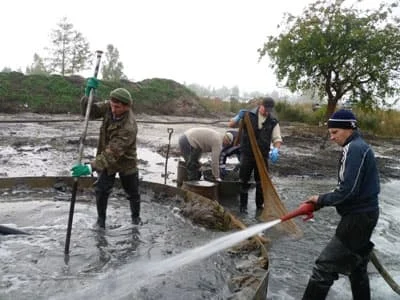
Amber fever recently swept over the Sobieszewskie Islands – a lot of amber could be found there?
Actually, not at all. The dredging machine has been working at this location for the last few years, so even if there was once amber there, it’s no longer there. And the fact that one or two amber stones were found by chance on the beach does not make the Isle of Amber an eldorado. It was one of the restaurateurs from here who wanted to attract amber seekers to the beach and to his restaurant… This is, after all, the umpteenth time that the media are creating unnecessary fuss by writing about amber.
And how do you react to the next media reports about illegal mining? No one is reporting on the legal side; so it might seem that amber is mined only and exclusively under the cover of darkness and in violation of the law, and the amber industry is just one big grey area, not one of the more important branches of the Polish economy...
I even understand a little bit about these illegal miners… They extract amber illegally because they really have no other place to work. I’m sure that if they had a choice, most of them would choose to work during the day and legally. But the problem is that the authorities responsible for making the land available for the search and extraction of amber do not give them this choice.
Do you justify them?
No, by no means. But I know very well what it means to encounter official reluctance. I am merely saying that I understand their desperation. If they were given municipal plots of land, they probably wouldn’t have to illegally dig. They would have a job on land that is owned by the city, which is or will be earmarked for investment projects, where they would certainly not harm anyone. The Gdańsk Mayor’s decree regulating the rules for leasing municipal plots of land for the purpose of prospecting for amber was signed in July 2007 and since then only one tender has taken place. More tenders were promised, but nothing has happened. Why? Individual discussions and attempts to lease the plot of land from the city have also been in vain.
Was the gentleman at the office?
Yes. I wasted unnecessary time.
Plots of land can be leased not only from the city, but also from private owners.
Yes, we mainly work on this type of project because there are no other options. We negotiate the terms of lease with the owner: it is either a specific amount paid once or monthly, or a percentage of the proceeds. However, not all owners agree; sometimes they are afraid that we will leave the plot of land littered with potholes, as on the Sobieszewska Island. Therefore, as a security measure, they require a deposit for the reclamation of the land – and that is fine; after all, one never knows what will happen in the meantime. The obligation to reclaim the land is stipulated in the geological project, which must be submitted each time to the environmental protection department of the Marshal’s Office. This is one of the most important stages of the work: the entire layer of fertile soil must be removed, depending on the terrain, about 40-60 cm using heavy equipment. It is compacted, and after the extraction is completed, it is re-planted and protected; sometimes grass is also sown.
How do you know which sites are worth looking for amber in?
Based on various works unrelated to previous extraction, e.g. drilling for gas or oil, larger construction projects or ditch reclamation. There is always a chance that there is more of it there, so it’s worth checking.
What methods are used to extract amber?
Either exploratory – in the case of amber deposits at a shallow depth beneath the Earth’s surface – or hydraulic, used in cases where it deposits at greater depths. I use the latter method. It involves injecting water under high pressure into the ground. What emerges is searched for for amber.
Is it worth it?
It all depends on the amount of amber extracted. Because the workload is practically always the same. So far, it has always paid off for me, even if I have invested a lot in searching for it – that is, in fact, the most expensive stage of extraction. These amounts of amber that are currently being extracted were still unprofitable 10 years ago. But since the price of amber, especially the coarser fraction, went up by about 500 percent in that time, it pays off to dig even with a yield of 2-3 kilograms. At least for me, because I’m sure not everyone will be happy with such a product. Today, amber is extracted from deeper deposits that were once left untouched because they were unprofitable and no one wanted to risk damaging the equipment. Today, this risk is taken more and more often.
Do you pay taxes?
Yes, even twice. First, the amount of extracted raw material according to the statutory rate of PLN 10.40 per kilogram of amber: PLN 60% for the municipality and PLN 40% for the National Fund for Environmental Protection. The second time, when I sell the amber on the market – PLN 23% according to the statutory rate.
If you were extracting illegally, you wouldn’t have to pay anything…
Of course, it just doesn’t pay off for me. The companies that buy raw material from me need an invoice – I couldn’t give them one if I were extracting amber illegally. Besides, I pride myself on working quietly during the day in my own company. I don’t need any extra adrenaline.
Is digging amber a difficult job?
First and foremost, it’s very physically exhausting. You really have to love this „digging in the mud” all day, regardless of the weather – otherwise it wouldn’t be possible to do it. It used to be more financially rewarding than it is now – but the mere sight of the income isn’t enough; you have to actually like it. Otherwise, you can’t work at -10 degrees when the ground is frozen. We used to do that, but today we don’t dig at such low temperatures anymore. From spring to autumn, we have to earn enough to survive the winter. Which isn’t always that easy, because you never know if and how much amber we’ll find during the season.
Do you like your job?
I have spent my entire life so far on the Sobieszewska Island, and I have been engaged in the search and extraction of amber for over 20 years. I was 7 years old when my father took me out early in the morning to collect amber. I got involved. Two years later I found a 20-gram amber nugget – I remember how excited I was at that time. The largest piece I dug myself was 750 grams. In Polish amber, such a nugget is a rarity. Of course, I still have it to this day.
How many people are currently involved in the search for amber?
I estimate that there are about 10-15 brigades in the area of Trójmiasto that legally search for amber and make a living from it. These are usually professional teams that have been working together for a long time. There are practically no newcomers in this profession. It is too hard work that requires immense experience, a lot of luck, and a nose for what is good. Where a seasoned seeker finds 3 kg of amber, a novice will only find a maximum of half a kilo. Experience is gained after about a year. Today, this is a dying profession; hardly anyone takes up this work. It is all the more a shame that it is so little respected.