
For many years you have been talking about the role of design in jewellery and arguing that without good design there is no future. Have your efforts produced visible results?
Recently, the word design has become heavily devalued. Everything today is designed or tuned, and design itself seems to have started being treated more as a function of entertainment than as a serious activity aimed at designing and implementing innovative solutions that change our environment. In the field of jewellery design, the matter is even more complicated. For several years we have been dealing with stagnation caused, on the one hand, by the constant prediction of crisis, and on the other, by the rise in prices of precious metals – which happens to be a real confirmation of this mythical crisis. An additional factor is the noticeable change in consumer habits: for today's female wearers, jewellery has ceased to be a necessary image element. All this means that good-quality products, made of precious materials and unconstrained by seasonal fashion, have become too expensive and unappealing compared with other ways of spending comparable amounts of money. Perhaps this is the cause of the most disturbing phenomenon, which is the disappearance of the consumer „middle” – the market now features only either pseudo-exclusive brands with senselessly overpriced logos, or cheap fancy goods. In both cases, neither design nor the quality parameter matter at all. Although I am not as uncritically certain of this as I was a few years ago, I still believe that design has a future – including in jewellery – which is why it is worth training designers, systematically educating consumers, and showing good examples of wise, future-oriented design. It is also necessary to conduct a critical dialogue with the existing tradition – also for educational reasons – by expanding strictly industry-specific and often outdated evaluation criteria and by comparing the achievements of jewellery designers in the context of product design in general.
The Trendbook, which you authored, is also intended to fulfil such broadly defined educational functions. What is the aim behind this publication? To what extent can jewellery manufacturers benefit from it?
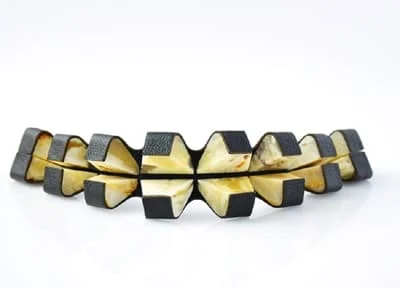
Jewellery manufacturers can take a close look at the creative potential of individual designers and recruit them to work for their companies. Just a few years ago, this would have sounded like a good joke, but one of the very first graduates in jewellery design from the Gdańsk Academy of Fine Arts, who featured prominently in last year’s publication, is currently a designer at one of the Tri-City’s companies, whilst several others are preparing to launch their own design businesses or are continuing their studies at universities in the Netherlands and the UK. Of course, I am aware of the expectation within parts of the industry that the publication should provide free designs for our lazy manufacturers to plagiarise at no cost, so from the perspective of such short-term needs, it may well be of no use to them. The target audience for the album – assuming it is intended to promote contemporary design featuring amber – comprises galleries, design-related institutions, journalists writing about design (and not just jewellery), leading product designers who set the quality standards in this field, and academic centres in Poland, Europe and selected locations around the world. In this way, we aim to reach opinion-forming circles outside the closed, industry-specific world, demonstrating that amber is not merely common beads and pebbles wrapped in metal tape, but that it is also used to create unique, original, image-driven products that fit in with contemporary design trends. To ensure the picture is not misleading – after all, 90 per cent of Polish amber production consists precisely of beads and nuggets with a safety pin attached – we invited leading Tri-City companies and studios to collaborate on the creation of prototypes by students at the Gdańsk Academy of Fine Arts, hoping – not without hopes already confirmed in practice – that we would thus succeed in creating a self-sustaining mechanism for collaboration between designers and manufacturers. Until now, there has been a great deal of misunderstanding on both sides: manufacturers had rather service-oriented expectations of designers regarding „patterns” rather than design, whilst designers adopted a strongly demanding attitude. I hope that this sort of experiment will enable both sides to work out the principles of mutual cooperation and understand each other’s needs, whilst also allowing manufacturers to become familiar with new materials and contemporary digital prototyping technologies, and teaching students the art of compromise. I anticipate that the result of such cooperation will be an annually expanding collection of amber jewellery, which will begin to contribute to the systematic development of a new image for amber, unburdened by the stereotype of tacky folklore. The „Trendbook” serves precisely as a pretext for the Tri-City to finally begin producing modern products featuring amber, whilst also acting as a message that is comprehensible to design professionals worldwide.
The tacky image of amber is slowly modernising, although it will be hard to eradicate the stereotypes, and on both sides. Buyers, who associate it badly for many reasons, and producers, who doggedly „promote” it as a magic stone.
And that is precisely what bold design is needed for. I truly believe in education. The patient promotion of contemporary stylistic solutions in amber jewellery is the only way to overcome associations with cheap, mass-produced items aimed at the „60+” target demographic. Stubbornly promoting amber for amber's sake and its supposed magical properties is pointless, especially abroad. The legend of amber is just as fascinating as that of the emerald, sapphire, tourmaline, bamboo, cotton, bananas, and a million other things. If the promotion of amber is not backed by a modern, decently designed, high-quality product, all these legends will merely be folk tales from Mariacka Street – which admittedly has its own charm right there, but unfortunately only there. If, however, amber craftsmanship is not to be reduced to mere tourist trinkets, we need wise promotion that goes beyond the associations of a crumb-attracting magic pebble and adopts a slightly longer-term perspective for development than just the here and now.
To what extent are Academy of Fine Arts graduates prepared to think about jewellery design in the context of a broader audience? Undoubtedly, a lot has changed in this field, but it is hard to shake the impression that for them, designing unique pieces remains the highest value.
Here I can draw upon the three-year experience of the Jewellery Design Studio at the Academy of Fine Arts in Gdańsk. The studio is part of the Faculty of Architecture and Design, so it naturally prepares students to operate within market categories. This also has its downsides, because a designer focused solely on commercial services is rarely creative; therefore, „one-offs” or conceptual design connected with art are an important aspect of education, allowing students to break away from standards and enabling the implementation of true innovations. Such a path seems more attractive to students, but today's graduates of the Gdańsk Academy of Fine Arts will certainly also manage well in the field of serial design. Rapid prototyping technologies, which are currently the basic tool for implementing prototypes, are a skill possessed by every graduate, and since it is merely a tool, the design methodology remains constantly the most important experience. And that is why it is still worth studying at the Academy of Fine Arts, which is quite an optimistic conclusion to the initial question: „Does design have a future?”
The opening of the „Amber Trends 2012” exhibition, presenting a collection of amber jewellery by students of the Academy of Fine Arts in Gdańsk, is planned for 22.03.2012 during the fair Amberif.
Recommended:
Stylistic trends in Trendbook 2012+
Amber is part of global design – an interview with Sławomir Fijałkowski