Amber museums
Since 2006, it has been operating Amber Museum A branch of the Historical Museum of the City of Gdańsk. Modern exhibitions display natural history collections (including a lizard's inclusion in amber), traditional crafts, a collection of art by Gdańsk masters from the 16th–18th centuries, and contemporary artistic works.
Museum of Inclusion in Amber The University of Gdańsk has already amassed over 14,000 inclusions of animals and plants from palaeogene amber-bearing forests, some of which are shown in the permanent exhibition.
Four smaller amber museums, including three private ones, are located in Stegna, Jantar and Słupsk. The youngest of them is The Amber Museum in Cracow, whose ambition is not only to showcase the natural beauty of amber but also to provide broad education (the museum has a spectrometer and undertakes the service of issuing certificates for product examination).
Masterpieces of amber craftsmanship
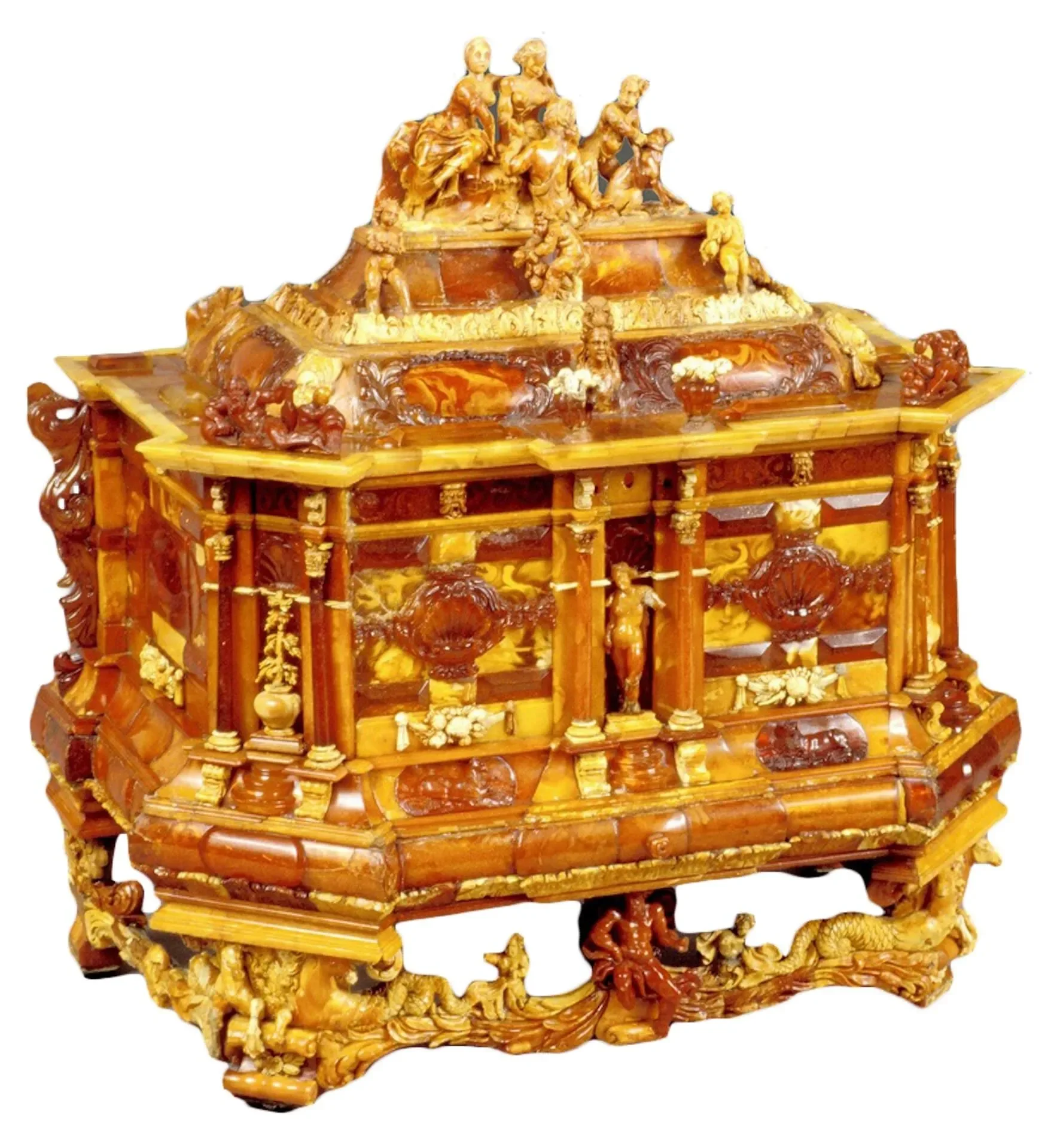
Malbork Castle Museum Since 1961, it has been gathering antique amber artworks (350), as well as contemporary ones (900) and natural specimens (750). Some are on display in the exhibition. Amber contexts – among them: an altar from 1687, caskets from 18th-century Gdańsk amber craftsmen, and the cabinet of Stanisław August.
At the Czartoryski Museum in Puławy, one can view the 16th-century amber goblet of Charles V.
In Krakow, at the National Art Collections in Wawel, there is a chessboard with amber elements (17th century) and an amber cup, and in the Cathedral Museum – an amber rattle (17th century) and a medallion with a portrait of King Stephen Báthory.
Contemporary art jewellery
In the Museum of Goldsmithing Art, a branch of the Vistula Museum in Kazimierz Dolny, there is a collection of silver amber jewellery by 28 artists, created between 1960 and 1980, and over 300 „etudes” (jewellery pieces) and „goldsmithing illustrations” made of amber combined with silver and/or other materials in 2001 by 70 artists.
Artistic amber jewellery – contemporary and from the late 20th century – is also held in the collections of, among others, the Regional Museum in Konin, the Copper Museum in Legnica, the Museum in Gliwice, the Museum of the Mazovian Nobility in Ciechanów, and the National Museum in Warsaw.
Archaeological collections, amber treasures, reconstructions
W Archaeological Museum of the City of Gdańsk Since 1997, a permanent exhibition with a catalogue has been on display. Amber through the millennia. In addition to archaeological artefacts, the exhibition presents the genesis of Baltic amber; amber therapy; Polish folk amber traditions; and a selection of contemporary artistic amber creations. At the „Błękitny Lew” Archaeological Education Centre, the Museum showcases, among other things, a medieval amber craftsman's workshop.
In the collection of the National Archaeological Museum in Warsaw, on display The Prehistory of the Polish Lands amber beads from the Neolithic period from Złota, from Bronze Age and early Iron Age sites, turned beads from the Roman period, including those from Basonia, as well as early medieval beads, pendants, and crosses are found.
The Archaeological and Historical Museum in Elbląg is exhibiting, among other items, beads from Gothic cemeteries dating from the Roman influence period, as well as an „imported” wine-drinking set from the early 3rd century AD found in Weklice. At the exhibition dedicated to the early medieval (9th–10th century) emporium of Truso, you can see amber playing pieces for the game of Hnefatafl. Furthermore, within the reconstruction of an old amber workshop, a treasure is on display – approximately 10 kg of amber nuggets.
The Archaeological Reserve of the I-V Century CE Trading Settlement in Pruszcz Gdański is a complex of houses with a amber craftsman's workshop.
At the National Museum in Szczecin, the Neolithic amulet – a figurine of a bear cub found near Słupsk – is particularly noteworthy, its post-war history culminating in its return to its original location.
A portion of amber from the Partynice hoard, dating to the 1st century BCE, is on display at the Archaeological Museum in Wrocław.
„The ”Amber Treasure" from the 2nd century AD is held in the collection of the Museum of the Puck Land in Puck.
The Archaeological Museum in Toruń has Neolithic amber artefacts from the Roman and medieval periods, while Neolithic ones are held in the collections of the Toruń District Museum.
The Podlaskie Museum in Białystok has a large collection of Baltic and Przeworsk culture artefacts.
The Kalisz Region Museum in Kalisz showcases amber in its permanent exhibitions in Kaliszu and at the Archaeological Reserve in Zawodzie.
The Konin Regional Museum has been conducting archaeological field research for years – some of the amber finds can be viewed at the „Amber Route” site. Konin is identified with Setidava from Ptolemy's map.
A sword bead made of amber with almandine from the 5th century AD is among other amber artifacts in the Archaeological Museum in Krakow. A reconstruction of an amber workshop from the Bronze Age is presented at the Archaeological Open-Air Museum in Trzcinica, known as Carpathian Troy (a branch of the Podkarpackie Museum in Krosno).
Polish folk amber traditions
W The North Masovian Museum in Łomża The Amber Department houses a regional collection of 1300 objects assembled by Adam Chętnik. The meticulous ethnographic collections of this eminent ethnographer, systematically supplemented, document the presence of amber in the Narew river area – a vast selection of forms, varieties, samples of amber-bearing earth, tools for searching and extracting, amber processing workshops, a wealth of Kurpie costume embellishments, and cottage interiors. The collection is complemented by fossil resins and items made from them from outside the Narew basin, modern resins, imitations, and unique archival materials.
The Museum of Kurpie Culture in Ostrołęka, with its branch in Kadzidło, and the private Kurpie Museum in Wach have developed a joint programme for showcasing Kurpie amber products, demonstrations of amber extraction, and traditional Kurpie amber processing techniques. The Centre for Ethnographic Cultural and Natural Heritage of Kurpie in Lelis conducts similar activities.
The National Museum of Ethnography in Warsaw has gathered amber artefacts from the Kurpie, Łowicz, and Sanniki regions, as well as archival materials, including Dr. Piotr Szacki's works on amber in Kurpie and Sicily.
The Museum in Łowicz displays amber necklaces and elements of Łowicz traditional costumes.
Kashubian amber artefacts are held in the collections of, among others, the Puck Land Museum in Puck, the Kashubian Museum in Kartuzy, the National Museum in Gdańsk and the Polish Academy of Sciences Earth Museum in Warsaw, which added to its collection a gift of a necklace made of typical disc-shaped beads by Jerzy Budnik, exhibited alongside double necklaces.
Amber collections in natural history and university museums
Amber in Museum of the Earth of the Polish Academy of Sciences In Warsaw, assembled since 1951, there are 26.7 thousand inventory numbers, which translates to well over 30,000 specimens. These include plant and animal inclusions, archaeological and modern artefacts, and specimens of regional provenance from Poland and around the world. The collections are accompanied by a rich library of amber literature.
The Natural History Museum of the Institute of Systematics and Evolution of Animals, Polish Academy of Sciences in Krakow, has in its collections: organic inclusions in amber, natural forms and varieties of amber, archaeological objects, and contemporary amber jewellery.
The Museum of Natural History at Nicolaus Copernicus University in Toruń exhibits the historical collection of Professor Jan Zabłocki – varieties of Baltic amber and microscopic preparations with organic inclusions. The collection of Professor Jan Koteja – 1100 cochineal inclusions in amber – is held in the collections of the Department of Zoology at the University of Silesia in Katowice.
The collections of three museums at the University of Wrocław contain amber specimens from the H.R. Goeppert collection – in the Geological Museum, the Mineralogical Museum, and the Natural History Museum.
Poland's location in the „amber-bearing North” has influenced the presence of amber in our lives and those of our ancestors, as evidenced by the collections in Polish museums (Gierłowska 2005; Kosmowska-Ceranowicz 1982; Kosmowska-Ceranowicz, Popiołek 1981; Kosmowska-Ceranowicz, Pietrzak 1985; Pielińska 2011; Pielińska, Gronuś-Dutko 2009).
The article was published in a summary publication of the International Symposium of Amber Researchers „Deposits – Collections – Market” during the Amberif 2013 fair.