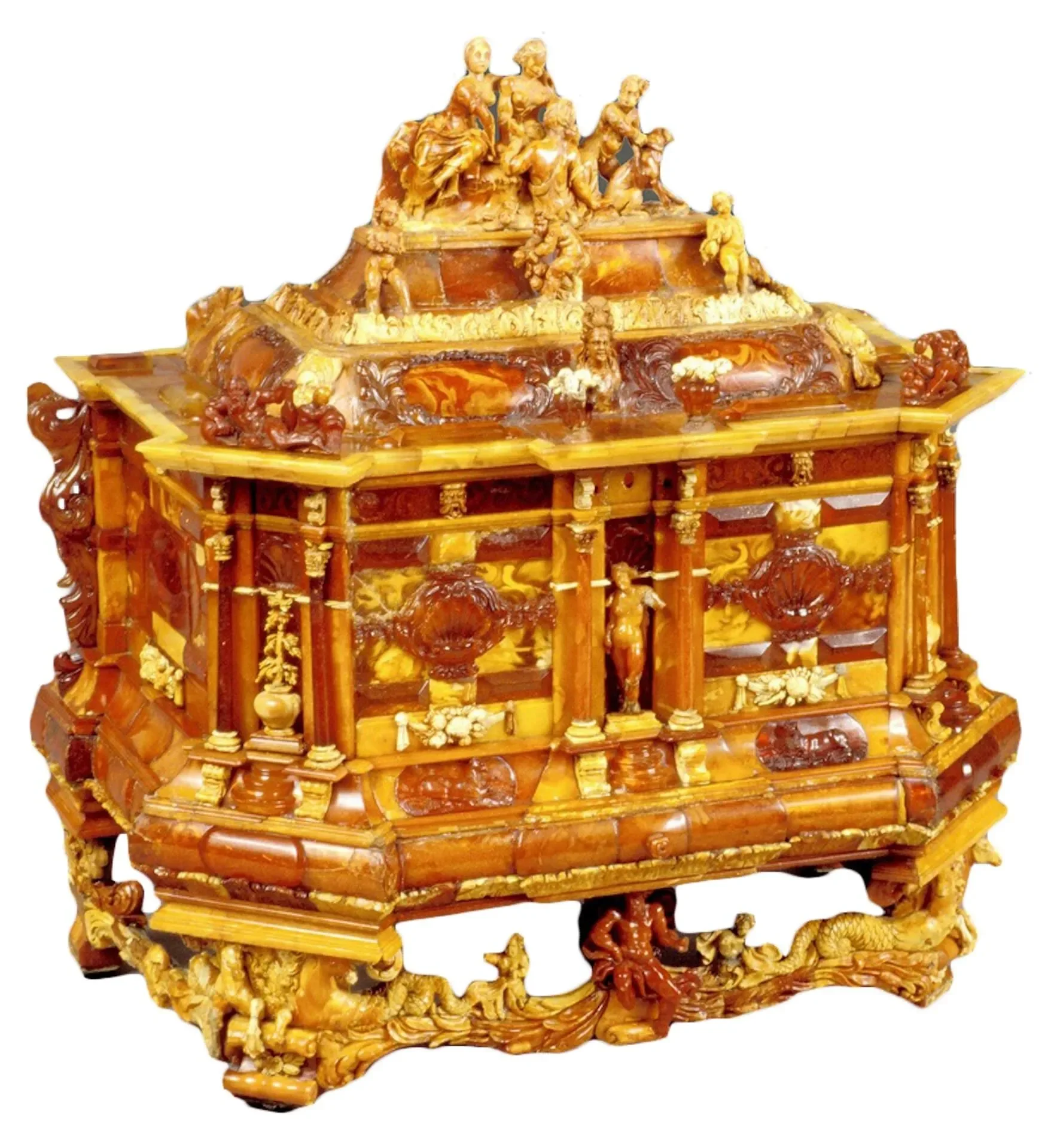
The traditions of amber processing in our lands date back to ancient times of the Stone Age, and artistic amber craftsmanship played a significant role in the history of Polish craftsmanship. Unfortunately, due to the fragility of the material, improper storage of objects, as well as numerous wars and historical cataclysms, few amber artefacts have survived to our times. The biggest problem, therefore, was to acquire exhibits from past eras in order to present visitors with the history of amber art as fully as possible, from the earliest times to the present day. The oldest objects in the collection come mainly from excavations. These are Neolithic artefacts from the Żuławy region, obtained through archaeological research conducted by the Institute of Archaeology of the University of Warsaw, funded by the museum. The most valuable modern exhibits (17th-18th centuries) in the collection, i.e. from the golden age of European amber craftsmanship, come mainly from purchases made at the Parisian antique shop of Franciszek Studziński and from the former collections of the National Museum in Warsaw, transferred to Malbork by decision of the Minister of Culture and Art. One of the most valuable objects in the collection – the cabinet of Stanisław August Poniatowski – is a gift from Lady Barbara Carmont from Scotland.
Through painstaking, multi-year searches and purchases on the antiques market in Poland and abroad, a collection of approximately two thousand exhibits has been amassed in Malbork. In addition to historical objects, natural amber in the form of nuggets of various sizes, shapes, colours, and degrees of transparency, as well as specimens with organic inclusions, has been acquired since the beginning. The Malbork museum began collecting works of contemporary jewellery art using amber when visual artists became interested in this raw material, i.e. from the early 1970s. The opening of an exhibition in Malbork illustrating the long-lasting and rich tradition of amber processing in Polish lands certainly contributed significantly to the initiation of this trend in our artistic adornment. Perceived as a native stone, amber has become one of the most frequently used materials in jewellery, and foreign recipients instinctively associate it with Poland.
The most valuable artefacts in the Malbork collection are:
- Neolithic artefacts from 3,500 years ago (Rzucewo culture) from the Żuławy region
from locations described as the largest ancient centre for amber extraction and processing; - A figurine of Hermes, a miniature copy of the bronze statue by Lysippos;
- unique examples of late Renaissance jewellery: a carved man's necklace
beads and the necklace of the Silesian Duchess, Sibylla Dorothea; - Early Baroque Gdańsk casket made of multi-coloured, translucent amber.;
- 17th-century cutlery with carved amber handles;
- A casket from the workshop of Michel Redlin (c.1680), decorated with engraved medallions, topped with a lid featuring a full-figure statuette of the goddess of plenty, Ceres;
- Home shrine with a figurine of the Madonna and Child, decorated with bone plaques
ivory; - an altar with an architectural structure, multi-layered, decorated with ivory plaques depicting scenes from the Old and New Testaments;
- A casket made by the famous Gdańsk amber craftsman Christoph Maucher, baroque, richly decorated with mythological sculpture related to the goddess Venus.;
- A casket traditionally associated with King Stanisław Leszczyński, made of wood, covered with amber, with decorative elements made using the églomisé technique;
- The cabinet of Stanisław August Poniatowski, a miniature cupboard with a figurine of the Madonna in a niche, containing engraved figural scenes and inscriptions concerning the most important events of the king's reign, including the little-known episode of the monarch's abduction by the Bar Confederation.;
- 17th- and 18th-century trinkets, parlour games, and interior furnishings, e.g. perfume boxes, snuff boxes, chess sets, small candlesticks, writing desk sets, bobbin lace-making kits;
- Examples of folk amber carving from the Kurpie region;
- A collection of XIX pipes and cigarillos made of silver and meerschaum with amber mouthpieces, and mouthpieces for Eastern water pipes, so-called hookahs.
Amber artefacts began to be collected at Malbork Castle shortly after the museum was established there (1961), and a permanent exhibition called “The History of Amber” was opened four years later, in July 1965. The idea was innovative and ambitious, especially given that the objects then available on the market were mainly mass-produced items from the Amber Production Factory in Gdańsk-Wrzeszcz and small souvenirs sold through Cepelia.
The traditions of amber processing in our lands date back to ancient times of the Stone Age, and artistic amber craftsmanship played a significant role in the history of Polish craftsmanship. Unfortunately, due to the fragility of the material, improper storage of objects, as well as numerous wars and historical cataclysms, few amber artefacts have survived to our times. The biggest problem, therefore, was to acquire exhibits from past eras in order to present visitors with the history of amber art as fully as possible, from the earliest times to the present day. The oldest objects in the collection come mainly from excavations. These are Neolithic artefacts from the Żuławy region, obtained through archaeological research conducted by the Institute of Archaeology of the University of Warsaw, funded by the museum. The most valuable modern exhibits (17th-18th centuries) in the collection, i.e. from the golden age of European amber craftsmanship, come mainly from purchases made at the Parisian antique shop of Franciszek Studziński and from the former collections of the National Museum in Warsaw, transferred to Malbork by decision of the Minister of Culture and Art. One of the most valuable objects in the collection – the cabinet of Stanisław August Poniatowski – is a gift from Lady Barbara Carmont from Scotland.
The creation of a collection (and exhibition) in Malbork dedicated solely to amber has made tangible the role of this raw material in the history of artistic craftsmanship in Europe, a role which is still little known and often overlooked, even in art history textbooks. Showcasing selected items from our collections abroad also serves this ambitious aim. Over the last quarter-century, we have presented them in numerous European countries, as well as in the USA and Japan. The popularisation activities carried out by the Malbork Castle Museum – through numerous publications about our collections (catalogues of foreign exhibitions, a catalogue of selected items from the collection, a richly illustrated album published on the museum’s 40th anniversary) – have significantly contributed to the well-deserved acclaim that this unique collection enjoys, not only in Poland.
Malbork Castle Museum
19 Starościńska Street, 82-200 Malbork
tel: +48 55 647-08-00, fax: +48 55 647-08-03
www.zamek.malbork.pl