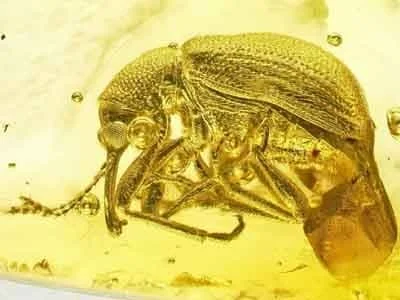
We collected Baltic amber both along the shores of the North Sea and the Baltic Sea, as well as in the Bitterfeld mine. After a period of intensive collecting of all amber specimens, which included inclusions, we decided to focus precisely on the fascinating world of inclusions. It was then that we became infected with amber fever, otherwise known as Paranoia succinosa. A fever that persists to this day. Our entire amber collection can be divided into six groups: art objects, amber from various deposits around the world, derived resins, natural forms, colour varieties and, of course, inclusions.
Collection of inclusions
The collection of inclusions includes plant and animal specimens in Baltic and Bitterfeld amber, as well as a few specimens in Dominican, Ukrainian, Canadian, Spanish and Lebanese amber. The inclusions are stored in special 36 plastic boxes. Each contains specimens, in separate numbered pouches, labelled only to the family level - awaiting further work in the future.
The amber nuggets for the scientific study were prepared by hand and embedded in polyester resin (Hoffeins 2011). To protect the larger amber nuggets from weathering effects, they were varnished. About 80% of the developed inclusions are embedded in synthetic resin. The main part of the collection was collected by hand and this material was used in a statistical study on the frequency of inclusions in unselected Baltic and Bitterfeld amber (Hoffeins & Hoffeins 2003).
Our collection (code: CCHH) contains 216 holotypes (10 plant and 206 animal, including 196 insects), with material still under study. The insect collection will be deposited at the end of 2014 at the Senckenberg Deutches Entomologisches Institut in Müncheberg (SDEI) as part of the amber collection there. Plant and animal inclusions: spiders, whipworms, snails, equi-pods and vertebrates will be deposited after the negotiations at the public museum.
The collection of plant inclusions, including fungi, represents approximately 1530 nuggets with leaves of both conifers, e.g. pine, cypress, and deciduous trees, flowers and buds, single stamens, pollen and seeds, twig fragments, wood, bark, plant fibres, liverworts and mosses, ferns, fungi and mycelial hyphae, bacteria and unidentified appendages. Exceptional specimens include pieces of wood impregnated and covered with resin, the first identified orchid seeds (in preparation), as well as a fungus with spores Aspergillum collembolorium Dorfelt & Schmidt, 2005. plant inclusions are partly studied at the University of Göttingen at the Courant Research Centre in the Department of Geobiology.
|
Plant inclusions |
number |
Holotypes |
|
leaves, needles |
130 | |
|
flowers, fruits, stamens |
90 | |
|
pollen |
260 | |
|
seeds |
23 | |
|
wood, plant fragments |
538 | |
|
cypresses |
57 | |
|
liverworts |
45 |
3 |
|
mosses |
54 |
5 |
|
lichens, ferns |
90 |
1 |
|
fungi, mycelial hyphae, bacteria |
243 |
1 |
|
SUMA |
1530 |
10 |
The collection of animal inclusions consists of more than 14,300 nuggets, mainly containing insects, spiders and mites, wrigglers, equids. In the collection, vertebrates are represented by lizard fragments, bird feathers and mammal hair, molluscs by snails, and „worms” by nematodes and ring-like organisms. Insect inclusions represent 90% of animal inclusions. Arachnid inclusions include spiders (Araneae), corsairs (Opilionida), laggards (Pseudoscorpionida) and mites (Acari) - the latter accounting for 52% of the entire arachnid collection. Mites are ubiquitous in amber and occur as synclusions in virtually every other nugget, hence the exact number of mites in the entire collection is even higher. The mite collection represents one of the largest collections of both rare and common genera and is comparable in volume and composition to the collections of the world's renowned museums (E. Sidorchuk, unpubl.) Particular specimens are lizard remains with preserved bones (currently under study) and a snail Propupa hoffeinsorum Stworzewicz & Pokryszko, 2006.
|
Animal inclusions |
number |
holotypes |
|
arachnids |
1214 |
10 |
|
insects |
13 006 |
198 |
|
swirls |
37 | |
|
crustaceans |
14 | |
|
snails |
6 |
1 |
|
vertebrates |
40 | |
|
nematodes and annelids |
13 | |
|
SUMA |
14 330 |
206 |
|
Insect inclusions |
number |
holotypes |
|
flies |
6694 |
892 |
|
beetles |
864 |
38 |
|
Hymenoptera |
751 |
11 |
|
bugs |
666 |
14 |
|
jumpers |
272 | |
|
crunchies |
158 | 1 |
|
butterflies |
133 |
1 |
|
bites |
130 | |
|
thrips |
96 |
34 |
|
other |
3243 |
7 |
|
SUMA |
13 006 |
198 |
The insect collection contains more than 13,000 nuggets, mainly of flies (Diptera), gristmills (Coleoptera), blonde winged (Hymenoptera), bugs (Hemiptera) and jumpingtails (Collembola).
The fly collection is almost 6,700 nuggets containing 85 types (May 2014). The main focus of the collection is on long-bodied flies, such as fungus flies (Mycetophilidae, Kreoplatidae), marsupials (Scatopsidae), mesquite (Similiidae) and Cretaceous (Limoniidae), as well as short-bodied flies such as flash flies (Dolichopodidae), uncles (Empididae: Hybotidae) and sclerotia (Phoridae).
The most important part of the fly collection is - the world's largest collection of unique inclusions of the group Acalyptratae - the higher flies. It contains more than 700 specimens from 34 families, including numerous new and undescribed genera, species and families (Tschirnhaus & Hoffeins 2009).
Exceptional specimens are the types Numphomylidae, Nymphomyia succina Wagner, Hoffeins & Hoffeins, 2000 (Hoffeins 1995), an archaic fly family discovered and described from the Hoffeins collection, as well as a unique specimen of Calyptrate, a fly of the family Anthomyiidae, Protanthomyia minuta Michelsen, 2000.
The article appeared in the publication summarising the International Amber Researchers Symposium Deposits - collections - market during the fair Amberif 2013 Figures updated – as at May 2014.
Consultation: Dr Elizabeth Sontag, University of Gdansk, Department of Invertebrate Zoology and Parasitology