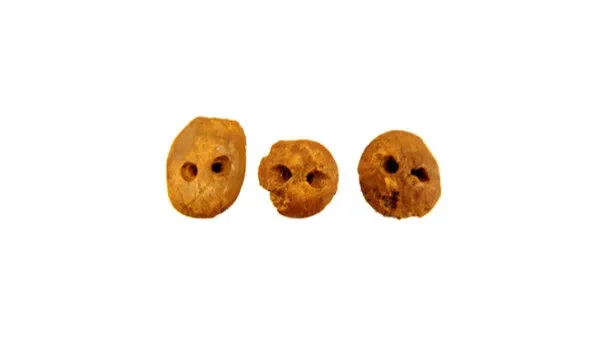
Amber ornaments, pottery fragments and flint artefacts were found in the cultural layer of a settlement dating to the Neolithic-Eneolithic, which was red in colour at the site where the amber artefacts were discovered. It is likely that the ornaments came from a grave or graves.
There was a perception in the literature that N. K. Repich's collection was lost after the 1917 revolution. Most scholars used only the archival materials of the Institute of the History of Material Culture of the RAN, which contained all the papers delivered up to 1917. N. Repich's collection was handed over to the State Hermitage collection in the early 1930s. Its transfer was made thanks to the brother and sister of the aforementioned researcher: B. Rerich and E. Ozerova. The collection found its way into the Hermitage collection in 1934. Since then it has been protected and displayed in permanent and temporary exhibitions.
It contains, in addition to pottery fragments and flint wares, 215 whole amber ornaments and their parts, as well as several dozen fragments difficult to identify. These are mainly nodular beads, 148 specimens in number, and pendants, 63 specimens. The amber is very weathered, covered with an opaque rather thick layer, some of the artefacts have been preserved with an unidentified substance. Some are unfortunately unidentifiable due to fragmentation and state of preservation. All wares are finished forms or fragments of them, some (16 specimens) were repaired by additional drilling, which did not in every case have the desired effect.
The most commonly used amber raw material was of the opaque yellow and light yellow variety, with no transparent variety. The number of ornaments in the collection allows one to conclude that in this collection the selection of varieties of raw amber material is not random. The ornaments were made of succinite, which was confirmed by instrumental infrared light testing (IRS in KBr tablet). Detailed research is currently being conducted to compare the amber material with age-analogous material from Polish and other Baltic lands.
O. V. Lazarievich, V. I. Molodin, P. P. Labetskiy: N. K. Repich - archaeologist. Novosibirsk 2002, pp. 19-21, fig. 2