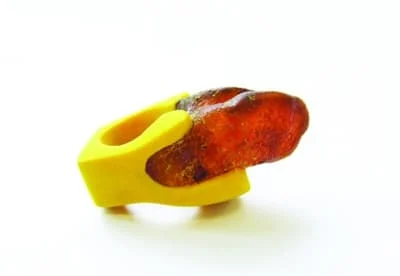
In the ring that won 1st prize in the Amberif Design Award competition, at least several aspects of playfulness can be found. Which of these are most important to you as a designer?
In the design process, contact with the material is the most important thing for me. It is this factor that brings me the most pleasure from work, as well as suggesting new, unconventional solutions. In my opinion, the joy of creation has a significant impact on the final form of the object and its relationship with the recipient. An inverted perspective – the relationship of the object with the recipient, rather than the recipient with the object – allows us to better capture this phenomenal connection. The starting point for me was playing with the value of the material: a natural combination of precious stone with a raw and irregular surface with ignoble but regularly shaped resin. Amber is not replaceable. The enticing idea of modifying an object by the recipient works much more often in design than in authorial jewellery.
JWhat materials do you value most as a designer? And what place does amber hold among them?
For around two years now, porcelain has been my definite favourite. In a given cycle or theme, one material always plays a key role, while the others generally serve a supporting function. What fascinates me most is playing with value, which involves bringing out the beauty in less noble materials that can be described as waste. And vice versa – using noble materials in a raw form. I've only recently started working with amber, and it's this fact that allows me to maintain a lightness in my search for fresh solutions. Designing amber objects is a significant challenge due to the rather strong stereotype surrounding both the raw material itself and the methods of its processing. My strongest motivation is the desire to move beyond the established canon. I don't mind admitting that attractive competitions and their associated events are also a strong stimulus.
I was on a scholarship in Finland – how did that influence your thinking about jewellery and design? How do these two countries differ in their approach to design?
I decided to focus on jewellery before the scholarship. The trip to Finland brought many new experiences and confirmed my choice was the right one. I wouldn't want to generalise about design approaches, as good and bad strategies can be found everywhere. Everything depends on the place, time, and people. In most universities in Europe, you can find both adherents of tradition and proponents of more daring solutions.
Why jewellery in particular?
The most fascinating aspect of contemporary jewellery for me is the ambiguity of the phenomenon and the need to constantly redefine it. I also very much like the scale and, as I've mentioned before, the opportunity to work with materials. In the near future, I intend to set up my own studio. I don't rule out working on commercial jewellery.