Let's start at the end, because the exhibition „Project: artistic jewellery” at the Centre for Contemporary Art in Toruń is now over. What reactions has it received?
The reactions have been positive, which makes me very happy. I hope that the exhibition has brought the subject of jewellery design closer - both in the context of the creators, but also in a conceptual and social context. The objects shown at the exhibition are stunning in their form, concept and material, while the extensive programme of accompanying events allowed the theme to be explored more deeply. This exhibition is another important story about post-war artistic jewellery - after the exhibition „Co-operative ORNO. Jewellery” at the Museum of Warsaw in 2029, of which I was one of the curators. I am delighted that the subject of jewellery-making cooperatives has attracted so much interest. I hope that now it is time for the next stage: bringing author's jewellery closer - also in the context of an alternative to the ornaments that are flooding the Polish market.
We have really great artists and jewellery designers, meanwhile, Polish women choose mass jewellery from well-known brands.
Jewellery has always had the function of emphasising the status of its owner. This function is fulfilled by objects with a value recognisable to others. Polish artistic jewellery unfortunately does not have this value in the general perception, although for experts it is a brand in itself. Hence the importance of exhibitions dedicated to jewellery, which are intended to raise awareness of its unique beauty, but also to open up space for others, such as galleries, through which it can reach its audience. Now is a good time for this - the material status of Polish society makes it possible to buy good quality Polish artistic jewellery.
The question is whether this is a question of funding, or more a question of being underestimated and undervalued, from which the lack of interest stems?
I think the root cause of this phenomenon may be a strongly ingrained sense of inferiority in Poles. We do not value what is good and Polish, we look for more prestige in foreign products. This attitude began to change a few years ago as a result of the promotion of Polish design during the communist era, but unfortunately this did not extend to jewellery. No wonder, then, that many years ago Polish jewellery makers were more willing to participate in fairs and exhibitions abroad, where they built up a good image for themselves. Or rather, they strengthened it, as Polish jewellery from the communist period was known and highly valued in Germany and France, among others. And here I observe an interesting paradox: the world-renowned SREBRO Festival, dedicated to conceptual jewellery, takes place in Legnica and attracts artists from all over the world every year. Unfortunately, apart from those interested, hardly anyone has heard of it....
Conceptual jewellery is a tricky subject...
In Poland, we do not appreciate this type of jewellery, and we also do not understand it a bit. Personally, I am not an advocate of this trend, but I watch the phenomenon with interest, and from the perspective of art history, I know that it will pass. This is the natural course of things. I can already see the change - it is heralded by a return to craft. I notice that young people are increasingly fascinated by craftsmanship, want to explore traditional techniques and learn about goldsmithing. We may have to wait a few more years for this phenomenon to „explode”, but it is certain that it will happen sooner or later.
What else do you notice when you look at Polish post-war artistic jewellery through the eyes of an art historian?
Jan Bialostocki, a very important figure for art historians, in his book Art More Precious Than Gold, argues that the value of art surpasses material goods, and therefore the materials from which it is made. Art teaches us a deeper understanding of the world and shapes sensibility. In my opinion, this statement also perfectly describes jewellery from the communist period. The name silversmiths also appears in this book in reference to artists creating in silver. And this is very interesting - although, as we know, silver was rationed during the communist era, a phenomenon called the Polish school of silver was created. Another distinguishing feature of this jewellery was the use of generally available materials. At the exhibition, this phenomenon is well illustrated by jewellery made from acorns, but also from paper or pebbles.
Also characteristic is the sensitivity of its makers to various inspirations - both styles in art, e.g. Art Nouveau, and the creation of new aesthetics, e.g. on the occasion of the millennium of the Polish state. Social or political phenomena apparently resonated with jewellery. From a historical perspective, this can be seen very well.
I notice another characteristic motif - that of conscious and creative reference to the past. It is very evident in the Zaremski family jewellery - the sons were very keen to refer to the artistic achievements of their parents: Jadwig and Jerzy, who were forerunners of post-war artistic silver jewellery.
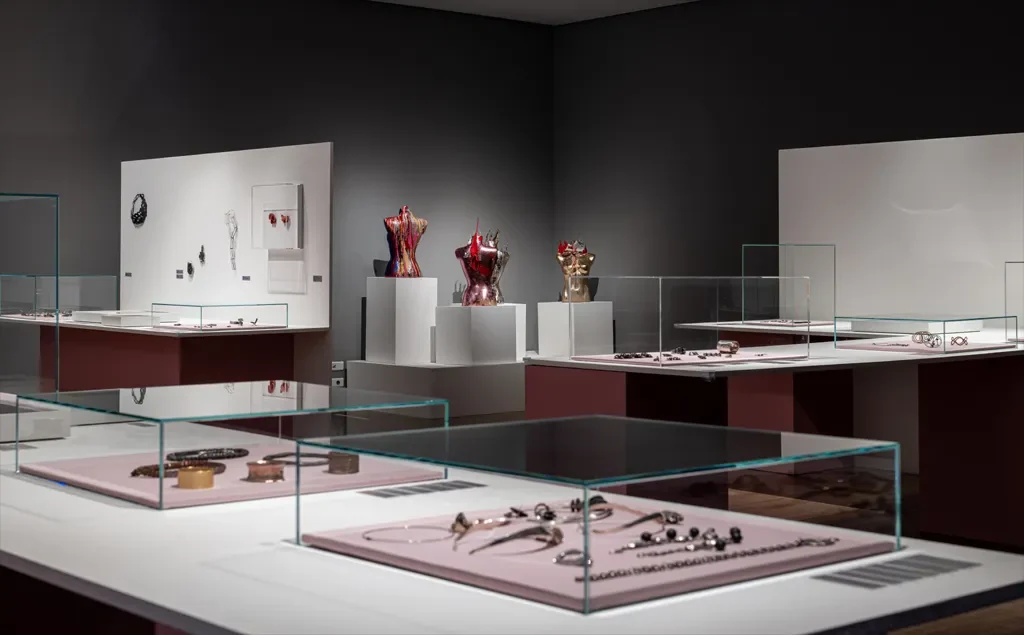
The idea of the exhibition is to show jewellery in different aspects - not only as decoration, but also as a carrier of ideas.
This exhibition was intended to show jewellery in a comprehensive way. It was to raise awareness of the fact that jewellery can serve various functions - not only as decoration, but also as a voice for important social issues. Hence, among other things, the presence of patriotic jewellery - both that connected with the times of the Solidarity movement in the 1980s and that connected with the recent women's strikes or the war in Ukraine. I was also keen to show a creative approach to materials - not only precious metals, but also ordinary materials can produce surprising effects.
A very important strand of the exhibition is to show the jewellery in the context of its makers, with a particular emphasis on the thread of the married couples who formed the artistic duos: Jadwiga and Jerzy Zaremski or Ludmila Ślaska-Suchorzewska and Ryszard Rohn.
There is also a theme of jewellery that has witnessed history in the exhibition. Here, in a central place, is a copy of the brooch by Giedymin Jablonski in which Danuta Wałęsa received the Nobel Peace Prize on behalf of her husband in 1983. The brooch decorated with a black gag was modelled on 19th-century Polish mourning jewellery. Gathering artefacts for this part of the exhibition was an extremely difficult task - some of them probably no longer exist, such as that of Danuta Wałęsa, while others could not be borrowed, such as the earrings in which Olga Tokarczuk received the Nobel Prize for Literature. These efforts to acquire important artefacts for the exhibition also showed me that the owners do not attach much importance to the exhibition - meanwhile, it is almost a national asset. There are many such micro-stories in the exhibition that jewellery tells or remembers - these are very important elements of the whole story of artistic jewellery, and of the people who make or wear it. This world is really insanely fascinating. I hope that the exhibition has brought it at least a little closer.
Are you planning any further exhibitions in the near future? You are an alumna of Prof. Irena Huml - I assume that jewellery is in your blood, so to speak....
No, at the moment I am not planning any further exhibitions dedicated to jewellery. But I am glad that Prof Huml's name was mentioned, because she is the one who got me interested in jewellery: she introduced me to many designers and taught me to look at jewellery in a multi-faceted way. In the exhibition, I also show a brooch that Prof. Huml wore in her jacket lapel and that she was very fond of. It was designed by Marek Nowaczyk - the initiator of the Legnica Author's Jewellery Review, which is now continued as the Legnica SREBRO Festival. This exhibition is therefore such a casket story about jewellery - one object, a few important names, a few fascinating stories. This is something that I think only jewellery can do.
Dr Anna Vishnevskaya - Art and design historian, curator and university lecturer. Winner of the Prof. J. Łoziński Award (2017). Her research encompasses the history of Polish design and object art, with a particular focus on metalwork, jewellery, ceramics, toy-making, souvenirs, as well as the history of Polish artistic cooperatives and the relationship of visual artists with Cepelia. She also pursues her scientific and research interests as a curator of exhibitions. Organised in 2019 at the Museum of Warsaw, the monographic exhibition of the ORNO cooperative, of which she was co-curator, summed up her many years of research on jewellery created in Cepelia cooperatives.
Exhibition „Project: artistic jewellery”
Centre for Contemporary Art in Toruń
until 8 March 2026, curator: Dr Anna Wiszniewska