
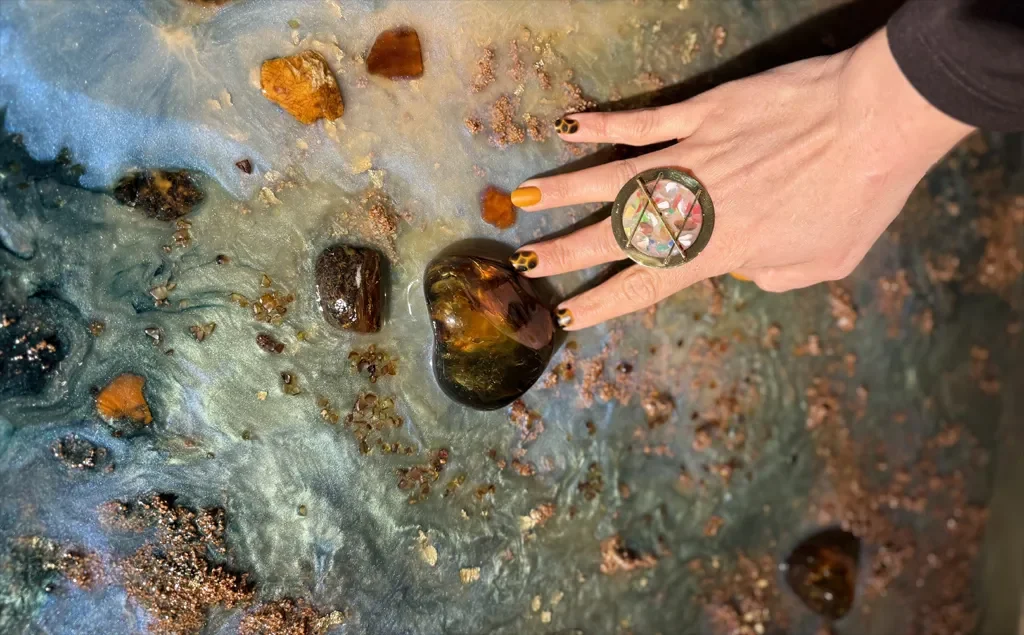
How long has your fascination with amber been going on?
My first taste of amber as an artist was 25 years ago - at that time I was nominated for the international competition The Baltic Sea Fasion Award in Heringsdorf. One of the outfits I designed contained 2 kg of amber - to make this design by hand, I used up all the necklaces of my mother, grandmother and cousins. It was then that I was first inspired by amber with its unique form and colour. The next approach was 8 years ago, when I was gifted with an amber that was no longer suitable for jewellery use. It waited for a long time for the right inspiration, but it lived up to it - I made the first small table top 60 x 60 cm in a technique that was already well known to me. The table represented Poland at the CIIE China International Import Export luxury goods fair in Shanghai in 2019 and made a surprising furore at the national stand. This showed me that amber, which is treated strongly as vintage in our country, can look very modern and arouse interest in the technique in which I used it. Hence, the starting point for my thinking about amber is the opposition between amber as a type of natural resin polymer and artificial polymers, of which man produces an alarming amount in the form of plastic.
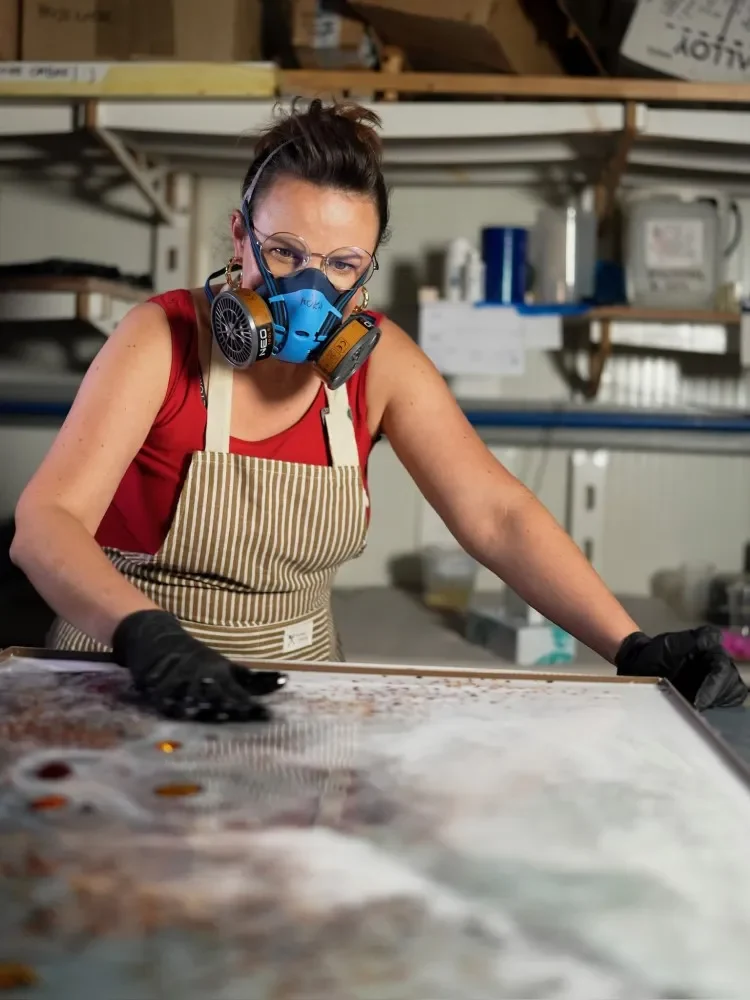
This can be seen well in your exhibition „Amber Chamber” at the National Maritime Museum in Gdansk. In your works you combine amber, which is more than 40 million years old, with „young” waste processed in your workshop.
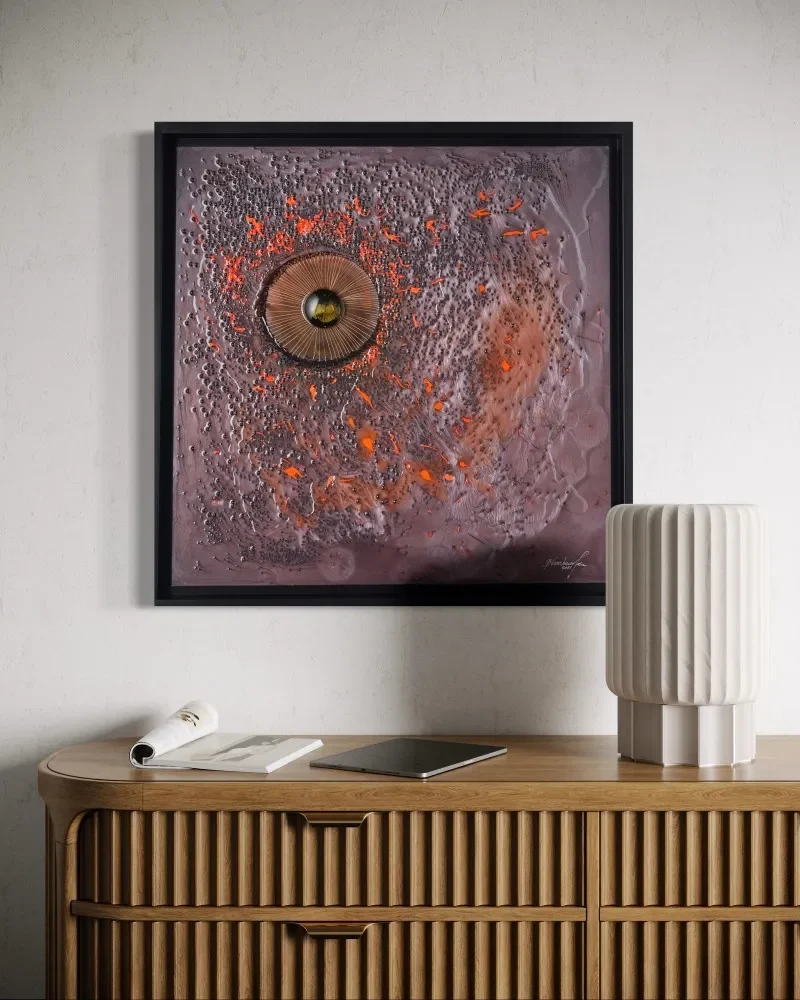
My aim is to draw attention - through upcycling art - to post-consumer waste and the fact that we still pay too little attention to recycling. A painting with the perverse title „It Won't Hurt”, made from syringe caps, illustrates this problem well. Generally, these caps are disposed of in the medical waste bin, although they remain sterile - which already shows our often dormant vigilance with regard to waste management. Amber plays a special role in these images: it is a symbol of quality, it „refines” the waste. It also highlights the dissonance between the short-lived, e.g. the life of a plastic bag, and the long-lived, i.e. the more than 40 million-year-old fossilised resin. It also shows how, as part of a ubiquitous culture of quick pleasures and fast consumption, we don't get caught up in what happens to our rubbish and don't notice how much we produce at every turn. So it is also a story about the legacy we leave behind. There are more such testimonies in this exhibition: in the painting „The Yellow Emperor”, I used an original hand-woven Japanese wedding kimono from the Showa period as an element to express the longing for the permanence of things, to show that instead of buying so many things „for a while”, it would be better to focus on one quality item that will serve us for many years. Hanging next to some of the paintings are menzies with the waste used to create them - to make this message even clearer. There is also a wooden table that has pockets filled with a binder of amber mixed with ground mannequins from the Dominican hall in Gdansk. It is a symbolic work created for this exhibition.
Where did the idea come from to give the exhibition the title „Amber Chamber”?
When I tell people that I combine amber and onion skins, amber and syringe caps and old clothes in my paintings, I can see how difficult it is for the viewers to imagine what I'm talking about until they see them. I like that it feels a bit like a mystery to them, like a riddle to be solved - like the disappearance of the Amber Chamber. It's also an expression of a longing for something undiscovered. I hope that after this exhibition this melancholy will not be satisfied, but further infused with another longing to find quality things that have a unique meaning for us and can create the environment in which we live.
Do you have no problem referring to elements of your paintings as „rubbish”?
The waste I use I very often select myself, and this is waste that for various reasons can no longer be recycled. This means that it basically has to be either disposed of in the form of incineration or some other quite expensive technology, or it will just lie in a landfill for hundreds of years. Many artists use recycling to promote their art. I don't do that, because in my case this art is combined with my professional life at the same time. I am very proud that my Migaloo Home factory recycled almost two thousand kilos of such waste last year. We analysed them ourselves, cleaned them, reworked them and implemented them into new surfaces, which were then beautiful enough to find their way into exhibitions, display cabinets and into the homes of collectors. We got more and more orders for our panels from hotels and restaurants, also from property developers. Before our talk, I collected three bags of ceiling paint lids on site - they were ground up and combined with amber. This will be used to create modern panels that will decorate the staircase of a new residential building in Gdansk. So, as you can see, for me the word rubbish has a completely different context and meaning. Above the door to my studio hangs a sign: „Garbage for some, treasures for others” - this is our philosophy of action.
You have found a completely different use for amber and, with your paintings or table tops, you are changing its perception - you are showing a new, modern and yet quite unobvious use for it.
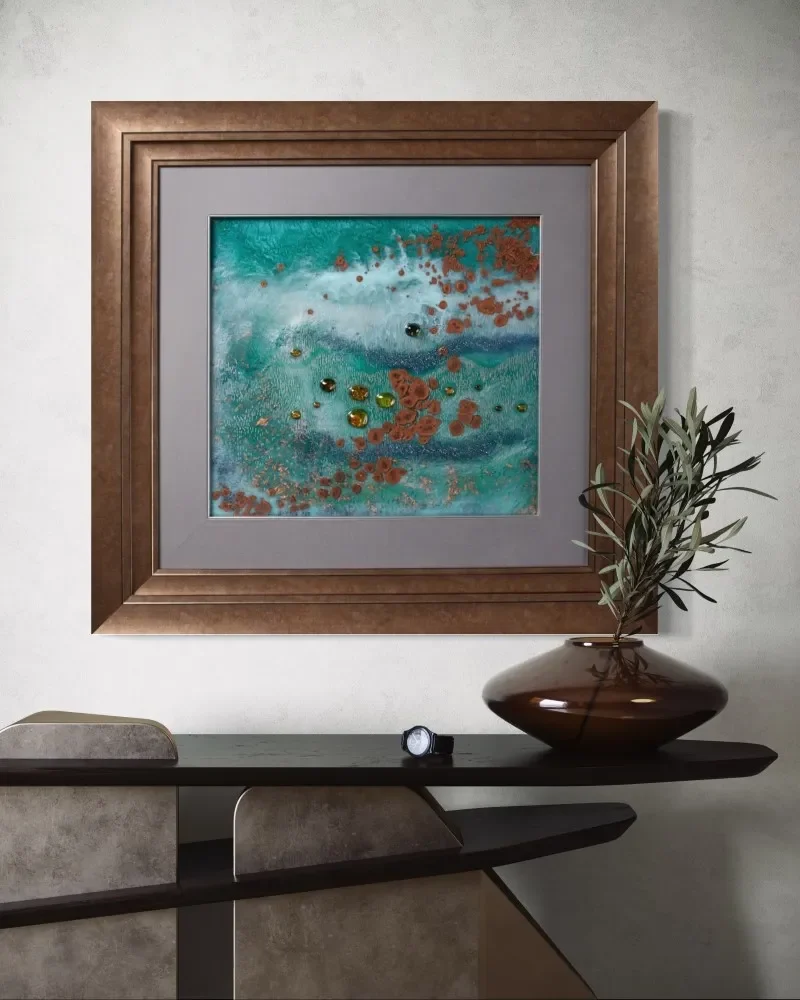
It is not for me to judge. But I hope that one day, maybe a hundred years from now, like Gaudi's path in Barcelona, people will wander around the Tricity and see my realisations with amber. There are already quite a few of them - in hotels, medical clinics, private homes. I can see how they already have an effect on people. Especially those available in public places are beginning to create a modern amber narrative for our identity.
I'm keeping my fingers crossed for the creation of a modern mini amber trail - both amber and Gdansk badly need interesting projects to promote it. Where can you see your realisations?
I think the flagship project is the Rezydencja MERWEDE development at 7 Łamana Street in Gdańsk - it is a building located directly on the beach and promenade. Another is the Iwanek Clinic dental clinic, where amber flexes in the counter, bathrooms and waiting areas. I would also add the staircases in the newly constructed Vantage Rent buildings on Stępkarska Street in Gdańsk, the restaurants: Knieja czarodzieja and Oficyna Gdynia. We are currently working on several new projects, including amber saunas in a hotel development in Łeba and entrance areas in several hotels on the Baltic Coast.
You use amber in paintings, furniture, kitchen worktops and decorative plates. Your placer has also found its way into Tomasz Kargul's hugely successful jewellery collection. Here the options are exhausted, will you surprise us with something else?
Amber dust. I used it as a pigment in one of my projects, where it gave a very distinctive natural straw colour. I think I will develop this theme in my future works, as I am surprised by the effect myself. This project has received the most international publications of all my projects. In addition, I created the Migaloo home ICONS series - these are designer objects, including candle holders, soap dishes and jewellery coasters, made from resin and amber and, of course, partly from waste. In my opinion, this is an interesting example of the modern, responsible use of amber in applied art. As you can see, since my first contact with amber I have not been idle, ideas are constantly born and constantly realised.
Monika Blaszkowska - artist and designer whose work combines amber with the idea of upcycling and modern design. Author of exhibitions and realisations in public spaces and private interiors, creator of a new contemporary amber narrative. Founder of Migaloo Home, where art meets responsible design and craftsmanship.
„Amber Chamber” - exhibition by Monika Blaszkowska
The National Maritime Museum in Gdańsk
10.01 – 1.03. 2026
RECOMMENDED