
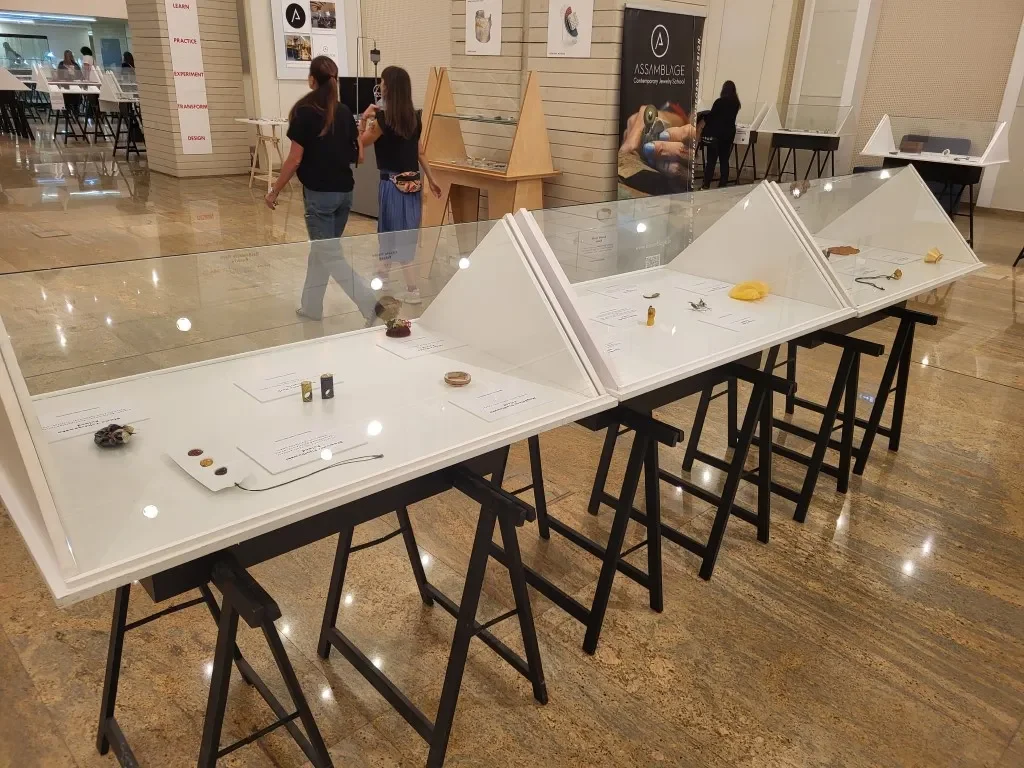
We are going to talk about artistic jewellery, also known as conceptual jewellery. Can you define this phenomenon at the outset? It seems important to me, because in Poland we have several different terms that overlap.
„Artistic” and „conceptual” jewellery are somewhat two different things. But in order not to get into „defining definitions”, let's assume that these are synonyms and their academic precision makes no sense, because the boundaries are blurred and - from a certain point on - subjective. It seems much more important to me to distinguish the intention of creating such objects / artefacts (not only jewellery). I myself am a jewellery designer, also designing commercial jewellery, and in this part of my professional activity no one expects me to fulfil my own artistic ambitions, but to be effective as confirmed by sales statistics. When I pick up a pencil or sit down at a computer, I think in terms of the customer - their needs, their possible spending limit, I compare the competitive environment, I try to understand the purchasing motivations of consumers in individual markets and target groups. This is classic benchmarking - the basis of any design strategy in any field of design. The goal and measure of effectiveness here are business criteria.
Against this background, it is easier to define the boundaries of what is uncompromising, experimental, beyond simple sales calculations, i.e. artistic. What is decisive in this case is the message, the message, the concept, the originality. This is a basic condition, but not sufficient to trigger cultural references - a somewhat broader term than art and perhaps, for educational reasons, also more apt. Beyond the intention to search for authorial distinction, uniqueness, content, even provocation, a much more difficult stage is the level of performance mastery, and it is only these two criteria: message and quality - aesthetic, narrative, technological, craftsmanship - that allow non-culture-related associations to be triggered.
It is worth stipulating straight away that the category of so-called artistic jewellery is not, by definition, something better than commercial jewellery. They are simply two different things, often incomparable - like a sprint and a marathon. This is why a qualitative benchmark is so important - there is both poor and well-designed commercial jewellery and truly unique jewellery and its pseudo-artistic substitute.
Artistic jewellery is a small part of the jewellery market in general and the audience is also quite limited. Why - in times of galloping commercialism - create jewellery at all that has little chance of finding an audience.
For the same reasons that authors write ambitious books, make niche films, create conceptual art, record avant-garde music. It is clear that the audience for their work is much smaller than for pop culture and mass entertainment, but only venues that concentrate such activity can claim to be leaders or trendsetters of specific areas of culture.
Similar mechanisms can, in fact, be seen in the analogy of science - before new drugs reach pharmacies, they require years of laboratory research and testing on a limited audience. This is also the case in industry, before new cars hit the showrooms their concept models undergo multiple styling and functional iterations, undergo crash tests, prototype versions are first presented at car shows.
Without bold, uncompromising, visionary design, it is impossible to launch a process at the end of which the quality of products, services, ideas, including commercial ones, is systematically improved (jewellery is no exception). It is a pity that no one in Poland feels obliged to invest in this very area of „basic research”, laboratory of new ideas, systematic implementation work, ecosystem of institutions supporting creativity and education.
Such a challenge was taken up by Gdansk in the strategy Gdansk - World Amber Capital 2023-2033, and its key element was to become Gdansk Jewellery Week. It seems that you were one of the originators of this event.
The idea had already emerged in 2019 and - due to the pandemic - could not be realised at the time. In the meantime, jewellery weeki started to be organised periodically in: Milan, Florence, Rome, Venice, Budapest, Bucharest, Ljubljana, Antwerp, Brussels, Barcelona, Valencia, Lisbon, Stockholm, Athens, New York, Seoul and invariably since 1959 - it is the oldest and most opinionated event in the world - in Munich. In Poland, by far the most important event focusing attention on artistic jewellery is - and hopefully will continue to be - Legnica.
Last year saw the first edition of Gdansk Jewellery Week. I got the impression that it passed largely unnoticed. Let's wait for the next edition to see the progression. What opportunities do you think Gdansk Jewellery Week has to develop?
There seems to have been a slight inflation of jewellery weekends, so the value of each separate event is diminishing. That's why each successive one would have to have its own original specificity. This is undoubtedly a challenge for the organisers of Gdańsk Jewellery Week. During its first edition I did not notice any qualitative activities addressed to artists, designers, gallery owners, opinion leaders. I even have a disturbing impression - and it is not only my concern - that the event is heading in the opposite direction to the one assumed in the strategy, which was supposed to be building awareness of the uniqueness of amber, as well as encouraging potential designers, goldsmiths, amber workers to patiently acquire the knowledge necessary to process it, increasing the value of the product. Infantile demonstrations of drilling amber with a stick and giving it away for free are hardly conducive to this. Without clear direction Gdańsk Jewellery Week will probably become yet another attraction for locals, random tourists and customers who visit the autumn Amberif anyway. It will not, however, attract a conscious audience interested in the art of goldsmithing, who would like to come to Gdańsk especially for this purpose and appreciate the uniqueness of the jewellery created here.
I don't want - after the first, highly improvised edition - to overly criticise or review the organisers of individual events. I know that it is not easy to get such an event off the ground - it also requires time, determination and patience to build up the trust of communities from all over the world. I believe - and this is what I would particularly like to emphasise - that they can only be encouraged to actively participate in such an event by the quality and conviction that it is an event organised for them, that they are important to the organisers, that they will be able to see not only unique exhibitions not available elsewhere, but also to meet each other, establish personal relationships, discuss issues important to them, exchange experiences. That's the flow in Munich and that's why the whole world comes there.
I will therefore patiently observe further efforts, hoping that the Gdansk festival will begin to develop into a professional and truly „world-class” event, from which creators and recipients of artistic jewellery on a supra-local scale will also derive satisfaction. I keep my fingers crossed and encourage the organisers, coordinators and, in particular, the sponsors, to have a substantive and broadest possible discussion about the programme content of such an expensive event, which could provide an impulse for the development of goldsmithing art, material culture and creative industries in Gdansk in a long-term perspective, and not just be a pretext for discounting the achievements of selected artists, which were created much earlier and did not need Jewellery Week for that.
Since the number of events dedicated to artistic jewellery is growing, it means that interest in this subject and the need to organise meetings for its creators are consistently high. What do you think this is due to?
Quantity rather rarely turns into quality. There is indeed a growing number of events dedicated to artistic jewellery, but only a few have built a reputation beyond local relevance. The truly global event invariably remains Munich - an event created from the bottom up by the makers themselves. The organisers very wisely support all the activities while remaining discreetly in the background themselves, which invariably allows participants to identify with the event as their own. This is the best recipe for success - such energy and lasting trust will not be generated by officials or politicians issuing orders with a feudal conviction of their own infallibility.
Which jewellery weeki are considered the most important and why? How does our home town of Legnica compare to them?
The SILVER Festival in Legnica retains its importance - although this is not a once and for all thing and needs to be updated annually. It is a much smaller event than the Munich prototype, but one that has its undeniable integrative advantages. All the events are concentrated within a small market square, facilitating meetings, conversations and discussions - something invariably emphasised by participants from all over the world who have ever visited Legnica. The event itself maintains a radical/artistic/conceptual message, and the main exhibition has a precisely formulated theme concerning important socio-cultural references, thus clearly distinguishing it from similar reviews of avant-garde goldsmithing.
A different strategy has been adopted by the Italian „jewellery weeki” - especially the largest one, the Milanese one. They are actually more of a fair than an exhibition. A high fee is a condition of participation, which - in my opinion - creates a rigged ranking of participants according to the principle: „you have paid = you are on the list”. Aggressive marketing and the peculiar magic of the place also play a big part in recruiting participants - although it has little to do with art or leading design, it is nevertheless worth visiting Milan once in a lifetime. Jewellery Week in Rome has an even more spectacular setting. The last edition was presented in the Colosseum, surrounded by burning torches in a truly Instagram-like setting. This is a characteristic feature of all Italian events - there is a lot of superficial glamour, for which attendees have to pay a considerable amount, but the content and quality do not stand up to comparison with leading events.
Against this background, the Romanian Jewelry Week in Bucharest is developing very interestingly. Last year I had the honour of being an exhibitor, this year I received an invitation to be part of the jury. The concept of this event, now in its seventh year at the beginning of October, is „an exhibition of exhibitions”. If anyone missed any of the important exhibitions during the year, they can make up for it at Bucharest, which has become a summary of all the most important events organised in a given year across Europe. There is no shortage of Polish accents on it either - so far, these have included the curatorial exhibition Unnecessary Jewellery, the exhibition of amber jewellery Other Criteria organised by the International Amber Association, as well as the presentation of award-winning works from the Legnica SREBRO Festival. The success of the Romanian event was possible thanks to the extraordinary commitment of its organisers, David Sandu and Andrea Popescu, who are everywhere and actively solicit every jewellery maker, leaving them with the conviction that the event is organised in the interests of its participants and they are the focus.
How do you see the immediate future of art jewellery?
Probably the coming time will verify the ranking of individual events. At one time, the same happened with design week festivals, which were held in every other city. After the first wave of their popularity, only two - in Milan and in Eindhoven, the Netherlands - confirmed their leading European role. In Poland, too, there has been a noticeable regression - the design festival in Łódź has suspended its activities, and the second most important event promoting design, Gdynia Design Days, is undergoing changes to its programme, which will hopefully allow the event to regain its inspirational role.
I think that in the years to come, the artistic jewellery scene and the festivals dedicated to it will be similarly structured. I remain hopeful that the Legnica event will not be absent from among them and that it will retain its uncompromising character and its power to attract people from all over the world. The nearest opportunity is in May and it is definitely worth coming there, as the post-competition EVERY BODY exhibition will be one of the most interesting presentations in recent years.
Slawomir Fijałkowski - Graduate of the Academy of Fine Arts in Łódź -Design, complementary studies at the Hochschule für Künstlerische und Industrielle Gestaltung in Linz (Austria) - Produktgestaltung Metall. Scholarship holder of the Ministry of Culture and the Arts, the Batory Foundation, the Vienna Kultur-Kontakt Foundation, the Austrian Ministry of Science. As a lecturer, he has collaborated with the Academy of Fine Arts in Łódź, the Academy of Fine Arts in Gdańsk, the Koszalin University of Technology, the Fachhochschule für Gestaltung in Mainz and the Hong Kong Design Institute. He currently runs the Experimental Design studio at the Faculty of Architecture and Design at the Academy of Fine Arts in Gdansk. He is involved in product and jewellery design in collaboration with renowned manufacturers. His collections have been presented at leading jewellery fairs around the world, including Basel, Vincenza, Munich, Dubai, Paris, Las Vegas, Hong Kong and Beijing.