
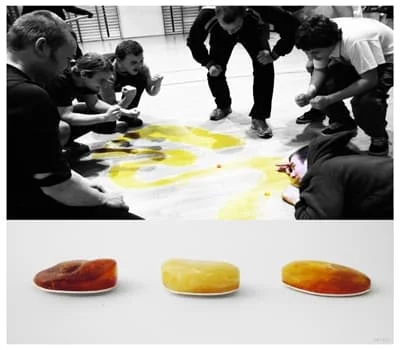
Kids used to play with beer bottle caps, less often with Coca-Cola ones – today, even those are more designer-like. Your concept, which won the Amberif Design Award, is a game of amber caps – where did such an idea come from?
The idea is hidden in the theme of the competition and its description. I tried to capture the joy that can be found in very simple things, despite the crisis. That's where these bottle caps come from – a game that probably every one of us remembers from the playground, which, despite its simplicity, brought a lot of joy. Why not make a luxury version of it? When people have had enough of price increases and constant scaremongering about the crisis, why not take amber and play „bottle caps” with it?
This is probably quite an extravagance... But this competition is certainly also an opportunity for amber – until now associated with grandmother's jewellery, to take on new meanings. How do young designers perceive this „old” stone?
You're right, it's an extravagance, but it's just a concept - an attempt to answer the N:JOY competition. I've been interested in amber for a very long time: even as a teenager, I loved this stone, and one of the most pleasant ways to spend my free time was searching for amber on the beach and imagining what was inside. Shortly after my final exams, I had the opportunity to learn how to process amber and silver, so my desire to know its interior was satisfied. What I saw in it caused me to lose my head over this stone. And what do I think about stereotypes? The label of „grandmother's jewellery” is very unfair. I „spoke” about this at last year's ADA competition, where I used amber to decorate headphones - which is, as far as I know, a completely innovative use of this “grandmotherly” stone. I see amber as a great mystery – each piece is different, each hides certain secrets, each has a beauty and warmth found nowhere else. It's also an ideal material for design work. One of my primary goals is to free amber from stereotypical associations: amber = outdated and unfashionable.
It's surprising that regardless of age, designers value the same qualities in amber: beauty, warmth and mystery. How do you intend to free this stone from stereotypes?
This question is a difficult one, as it forces me to create a vision for an entire process that could take years, and whose path I am only just beginning to tread. Certainly, a good way forward is to showcase diverse, unusual, and modern applications for amber. Much of this is conceptual work, which nonetheless reaches a wide audience – thanks, among other things, to ADA and various publications. A sort of „grassroots work” involves paying attention to what I have the most contact with: the design and creation of jewellery. In the case of amber ornaments, most consumers are accustomed to clichés, the ordinary, a worn-out image. In my work, I try to show something new, something different, which is difficult to find in online jewellery stores. And although I am currently operating on a small scale, I have already had many opportunities to see that attention to design and the charting of new directions yield very good results.
This is the second award in the ADA competition – last year you received the Amber Award. What significance does this have for a young, emerging designer?
Immense! It motivates further work and development, showing that the chosen direction is correct and appreciated. It builds confidence in design and makes you want to create more and more. Thanks to last year's award, I was also invited to participate in the „Designed in Poland” exhibition organised by the Polish Information and Foreign Investment Agency S.A., which is excellent promotion. And from a completely prosaic point of view: thanks to these awards, I gained a semi-finished product necessary for further work. This will allow me to realise more complex projects without worrying if I have enough material – this is a significant limitation when a budding designer's only capital is a head full of ideas. Now I eagerly await the next competition themes, as each one is a fascinating challenge, an attempt to confront one's own thoughts and ideas. Overcoming the next barriers of my own imagination is precisely what I enjoy most about being a designer.