
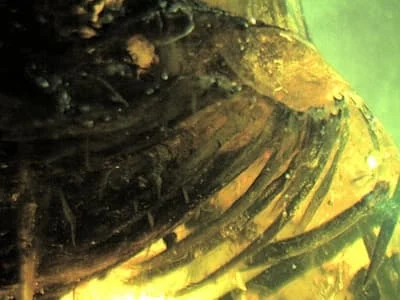
A Warsaw team of scientists is studying a unique infant inclusion preserved in Dominican amber. The specimens studied contain the shells of a bird's egg, the skin of a bird[?], with growing feathers, bones, and claws. These are the remains of an infant that most likely became prey of some predator.
The bead of this amber had a concentric structure, consisting of several layers that were separated during polishing, thanks to which we have five separate parts of different sizes today – the largest weighs 6.7 g, while the smallest is only 1 g. The bead was discovered by Doug Lundberg, a collector of amber from the USA, a member of the International Amber Association, an accredited expert of that organization, as well as a member of the current term World Amber Council. At the urging of Janusz Fudala, an expert from the Ministry of National Defense, the gift presented during the International Amber Fair 2012 was handed over to The Amber Department of the PAN Museum of the Earth for scientific research.
Preliminary results of the inclusion observation were presented at this year’s Amberif 20th anniversary fair during International Symposium of Amber Researchers „Amber. Deposits – Collections – Market””(March 2013).
The structure of the amber lumps turned out to be incredibly interesting; one can see in them an original resin core free of any inclusions and further layers of eggshell fragments, remains of a chick, as well as insects that fed on the fallen egg, causing it to undergo far-reaching destruction. The shell was examined using an electron microscope, which made it possible to unequivocally determine that it belonged to a bird. Detailed mathematical analyses of the shape of the preserved fragments of the egg allowed for an approximate calculation of its size – these analyses are still being improved upon.
For the moment, it seems that by maintaining the feathers, it may be possible to identify the family and perhaps even the species[?] of the bird. „This is a unique inclusion, of species weight not less than the discovery in 1997 of the ‘Gierlowska squirrel’, primarily thanks to its good preservation in the Baltic amber” – says Prof. Barbara Kosmowska-Ceranowicz.
„The diverse remains of a baby that have survived in Dominican amber will probably be the subject of detailed research by scientists for many years to come. I am also pleased that Polish scientists are the first to be able to study them,” emphasized Janusz Fudala.