Your works are quite striking in form and message. What is jewellery to you?
In jewellery, I primarily see one of the oldest forms of communication – a way of expressing emotions, recording traditions and history. We wear it closest to our bodies, which is why it becomes part of our identity. For me, jewellery is a medium through which stories can be told and conversations can be provoked. It's not just about beauty or decoration. I want my work to raise questions: who am I, where am I going, what moves me?
You've had a long professional career – for years you lived in the United States, where you made completely different jewellery than you do now.
In the States, I mainly focused on jewellery production – I had to consider the market, repeatability, and sales. While it provided stability, it also felt restrictive. I felt I was losing touch with what's most important in art: freedom. It wasn't until I returned to Germany in 2015 that a new space opened up for me. Instead of calculating, I could afford to experiment – to create artistic jewellery, without rules. It was the breath of fresh air I needed. I started creating it, as it were, alongside caring for my parents – I had the time and space to tackle subjects that truly interested me. I discovered new materials – because in artistic jewellery there are no limits – and learned to give them the right form. And I fell in love with what I do.
Through jewellery, you tell stories and send messages to the recipients.
Every piece of my work is a story. My pieces are large, expressive, sometimes difficult to interpret – but that's precisely what gives them power. They combine the form of jewellery with emotion. My creative process is always about finding that point where beauty begins to say something more – about us, about the world, about what hurts and fascinates us. In jewellery, I try to combine my inner reality with what's happening externally, to tell stories about my feelings, thoughts, dreams, as well as my fears. I enjoy participating in competitions – the fact that they have a specific theme is incredibly inspiring for me. I love that challenge! Often I reflect on the theme for a long time, developing specific concepts, but sometimes spontaneous inspiration or an association appears, which leads me further. I often hear the question: „Where do you get your ideas from?” It's a process – sometimes very quick, but it also happens that one gets stuck for a long time.
What about the amber? Did the idea for its use come quickly?
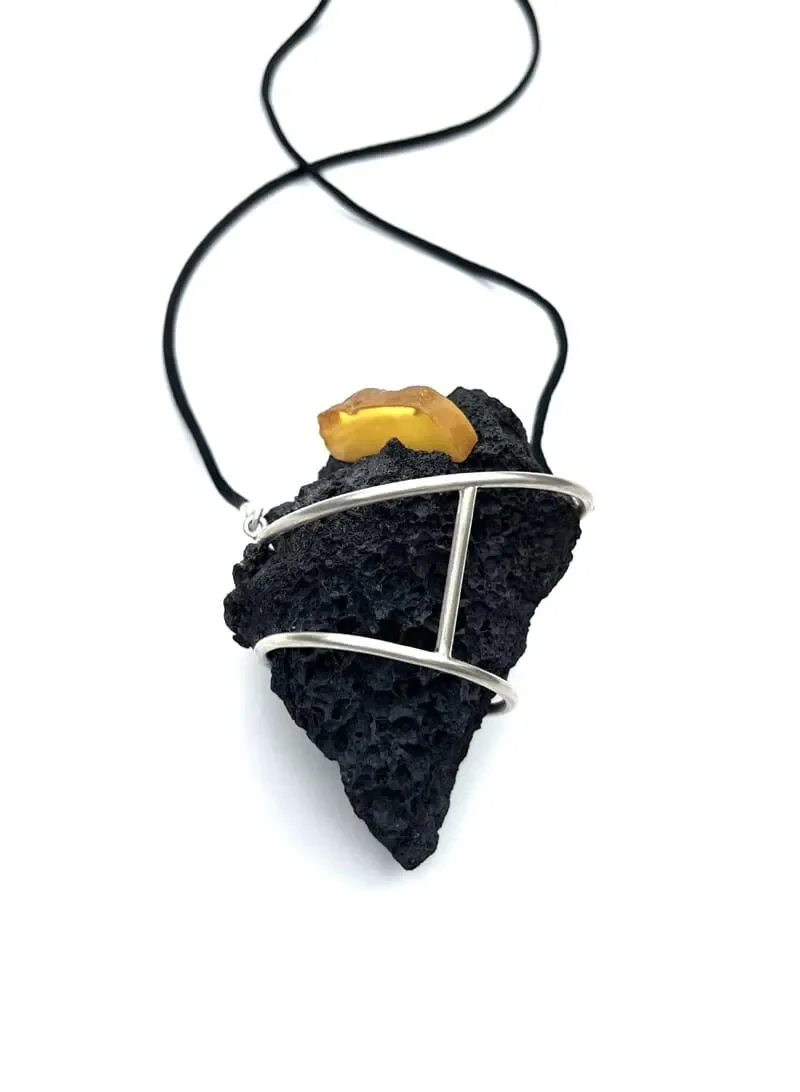
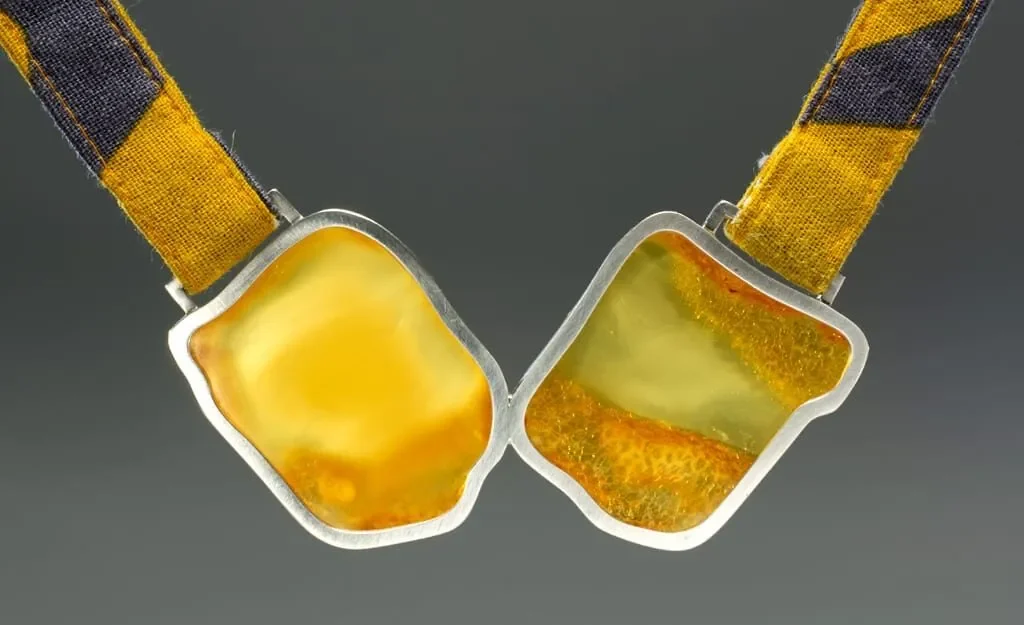
Nuggets of golden amber were my award from the International Amber Association at the International Jewellery Art Competition EMPATHY in Legnica last year. My first encounter with amber will probably remain an unforgettable impression forever. I remember it as if it were today: I took a piece of amber in my hand, cut it, and suddenly smelled the resin from over 40 million years ago. It was an experience that deeply moved me. I felt as though I was touching something bigger than myself. When I started polishing its surface, I saw an entire cosmos inside: planets, nebulae, star systems. Suddenly, this small stone became a universe for me.
This experience became the starting point for your amber collection, which you are presenting at the exhibition „From Cosmic Beginnings to Human Choices”?
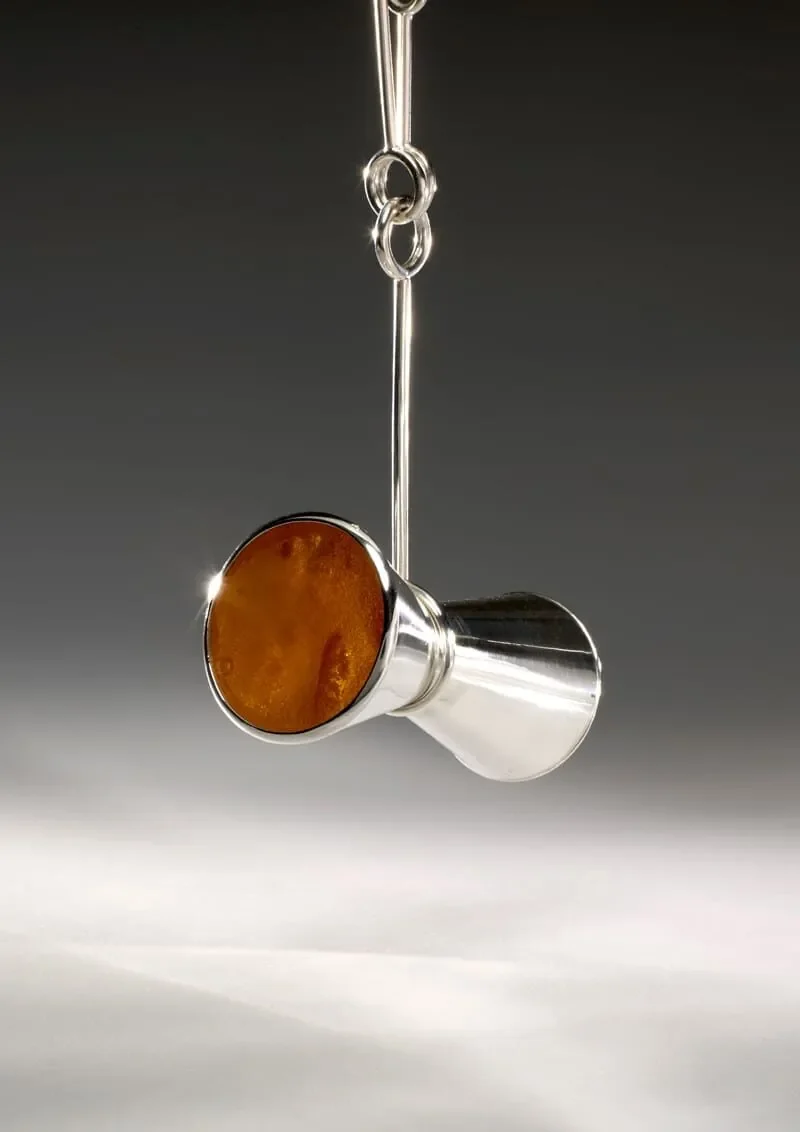
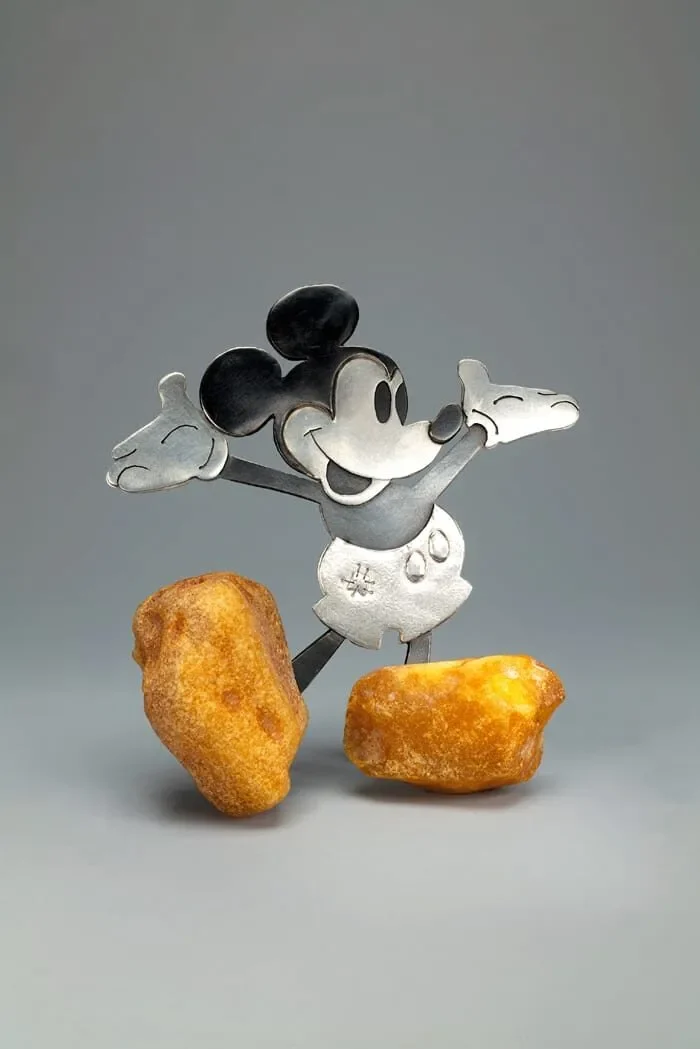
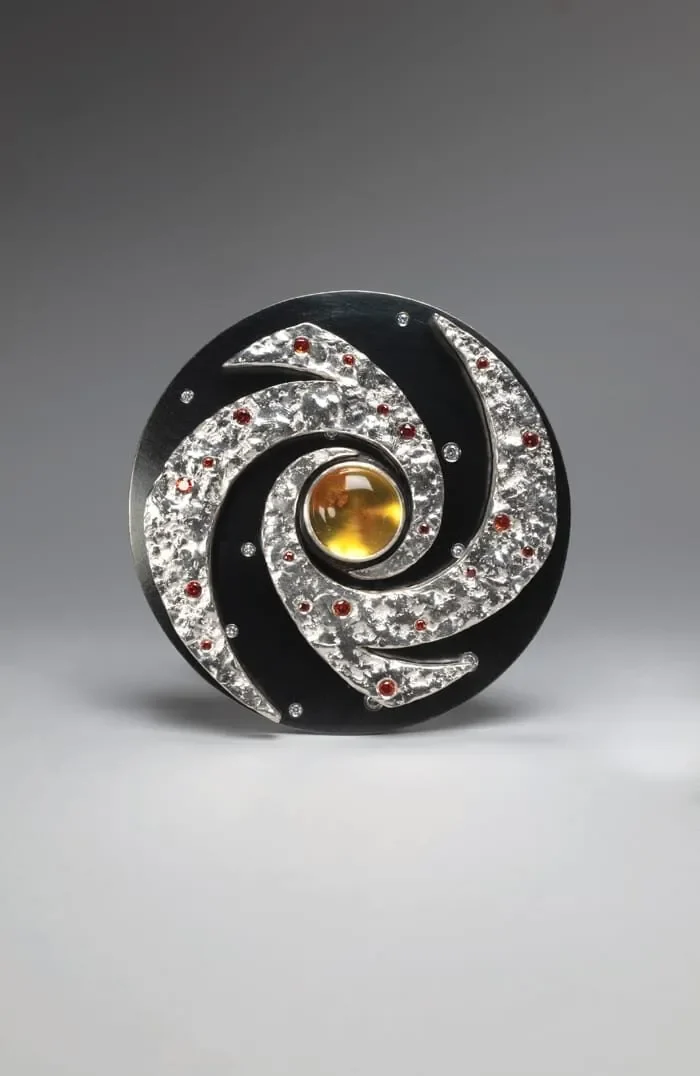
Yes. I started creating objects that resembled our galaxy. In every piece of amber, I saw new worlds. Then the idea came to tell the story of the Earth: from its birth as a fiery, spherical mass, through rains and oceans, to the Eocene epoch when amber was formed. It was a journey through time and space, captured in jewellery. Until I reached the present day, which is represented in this amber collection by three pieces. One of them is Mickey Mouse – I think everyone knows him. For me, he was originally a positive icon, a symbol of optimism and justice, who today has become a symbol of how the pursuit of power and wealth leads people to manipulation, deepening inequality and destruction. So, Mickey Mouse in this story becomes a symbol of everything that is happening in the world: hope colliding with greed and injustice.
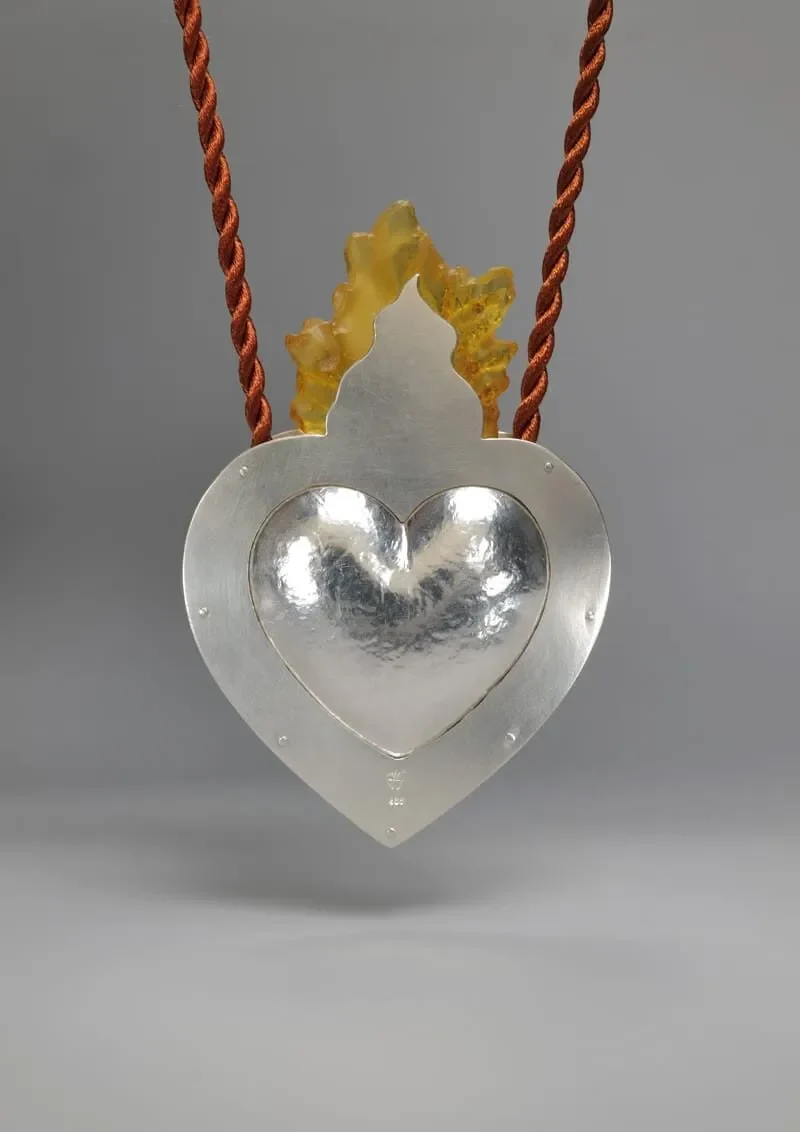
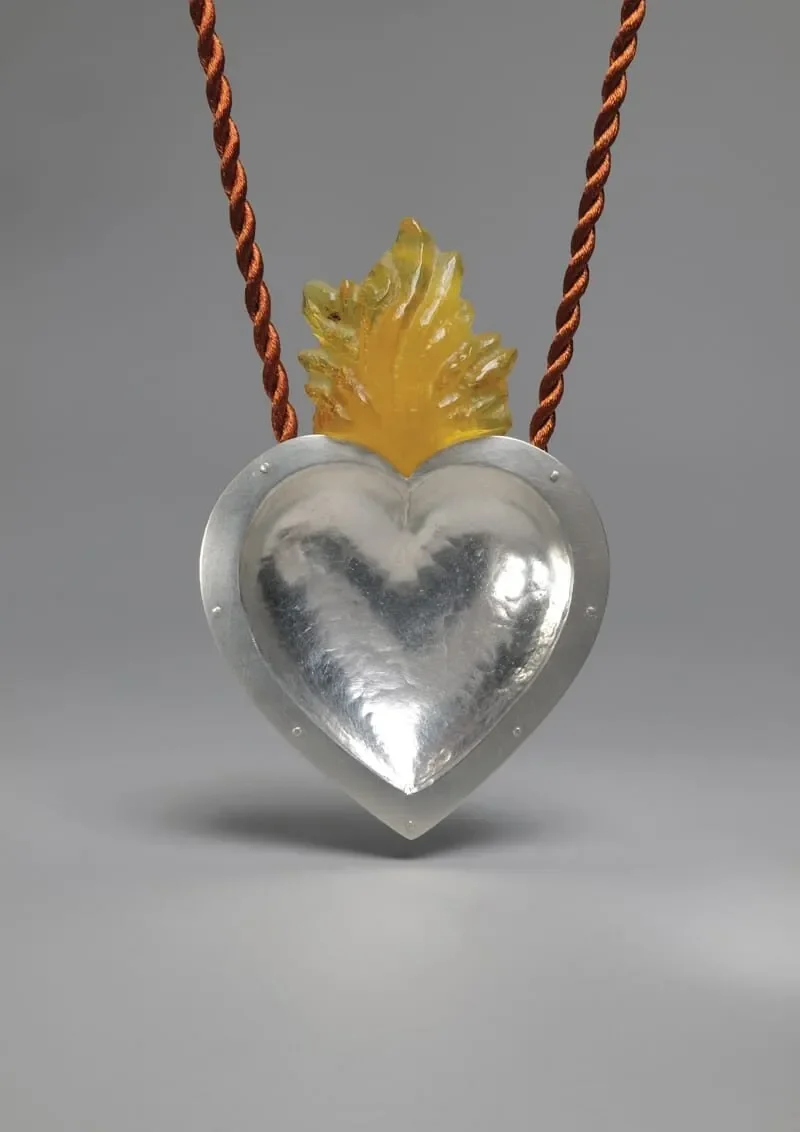
I assume you're an optimist, as another amber piece is based on the heart motif...
I still meet wonderful people who help others and get involved in the community. This shows that we have the capacity for compassion, transformation, and love within us. If we all worked together with open hearts, we could solve so many problems. I deeply believe this, which is why my works are not pessimistic and I don't want the exhibition to end on a downbeat note.
Do you think art jewellery can make people more aware of various issues?
I think so. Anyone who wears such jewellery forms their own relationship with it. I, as the author, also try to tell the stories behind my works. They are not entirely abstract – everyone can interpret them in their own way, but I want my thoughts and message to be visible and understandable to the recipient.
My „Transporter” rings are an example; they earned me an award from the International Amber Association at last year's competition in Legnica. I sculpted farm animals out of wax and then cast them in gold, as they are very precious to me. A specific species adorns one ring, while on the second, I created a „transporter” into which they can be packed, but also released from it. This release was very important to me. With such a ring on your finger, you can start a conversation. People first see the rectangular shape of the transporter – they ask what it is – and then you take it off your finger, thereby releasing a golden piglet, hen, cow, or sheep. You can say, „Now let's put the transporter aside. Look at this wonderful animal that also wants to live.” It is important to me that my works serve as a stimulus for conversation – about how we live, what we desire, what we lose. Jewellery can be beautiful, but if it remains merely a decoration, that is not enough for me. I prefer it when it becomes a question, a provocation, sometimes even a concern.
What do you find most interesting about working with amber?
Mystery. Each piece holds something different within it. You never know what you'll see until you look inside. It's constant surprise – a moment of discovery that evokes both awe and humility. Amber has taught me patience and attentiveness. I don't treat it like a material that needs to be subordinated to a form. It tells me itself how it wants to be shown.
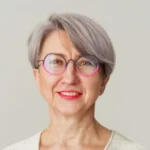
Julia Groos – a German artist who has been delighting audiences for years with her work, combining European tradition with openness to global influences. In 2025, her achievements were recognised by the Academy of Fine Arts in Munich, which awarded her the prestigious honorary distinction Künstlerinnenanerkennung, highlighting the appreciation for the value of an exceptional artistic legacy among female artists.
Polish jewellery enthusiasts know Julia Groos from her participation in the Legnica Silver Festival and the exhibition „In My Opinion...” at the Amber Museum in Gdańsk in 2001. Her works impress not only with their perfect craftsmanship but also with their deep reflections – the artist gladly explores themes related to humanity, nature, and responsibility for the world we live in.
Appreciated and awarded worldwide, including by the International Amber Association, Julia Groos continues to seek new forms of expression, treating jewellery as an artistic medium and a tool for dialogue with the viewer.
Exhibition „From Cosmic Beginnings to Human Choices”
Gallery of the International Amber Association in Gdansk
5.09 – 7.11.2025
Opening: 5 September 2025, 7 p.m.
as part of: Gdańsk Jewellery Week 2025
Free entry