
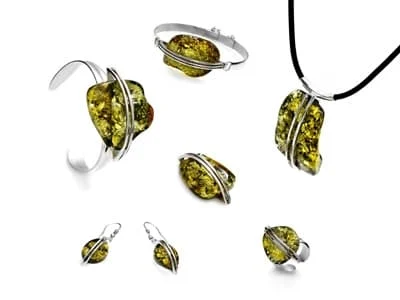
Where does green amber come from? Swamp amber – comes the reply. Meaning the kind that has lain in a swamp, hence the green colouring. Meanwhile, it wasn't swamp conditions at all that created it, but...
...a man, when he sensed the demand for products made of coloured amber, and cherry, brandy and lemon have not exhausted the colour palette. It is worth knowing, however, that natural amber can have a greenish tint – but this is rare. We are then dealing with so-called earth amber, which often contains numerous gas bubbles formed during decay processes, and its colour ranges from brown to almost black, appearing greenish in transparent fragments. And this is likely also the origin of the name bog amber – the only trouble is that it refers to modified amber rather than natural.
How is green amber made? In a few ways. Pieces of amber – usually already cut to the right size – are put into an autoclave for clarification. We can also subject them to a stronger temperature effect – then the top layer must be ground down to reach a lighter colour and leave the darker, uncut bottom. You can also take them out earlier, and paint the bottoms with dark paint. Pieces with bark (i.e. the weathered top layer), which becomes darker after autoclaving and there is no need for painting, are often designated for green amber. The method of controlled heating of only the bottoms of the stones so that they darken, giving the desired visual effect, is also practiced.
But just the green colour is not enough for many: there must be scales so that they shimmer beautifully. Sometimes in green (and cognac too) we see the so-called sugaring effect, resulting from unsuccessful (for various reasons, not just technological) scaling. This visual effect does not have as many fans as the scale, but it is also quite often found in the range of many manufacturers.
As a result of enhancement treatments, green amber is no longer a natural stone. Sometimes we encounter the term doublet – used in jewellery for stones consisting of two parts (amber + lacquer). Most often it is referred to as modified, which from a gemmological point of view is not entirely correct. The correct name should reflect all the treatments the stone has undergone, and be: modified-doublet amber. There are also voices suggesting that such a stone should no longer be called amber at all, but rather an imitation of a green stone – emerald, jade, etc. – made of amber.
But that is not the end of the story of the green stone, which can be made not only from Baltic amber, but also from Colombian copal. It is called – for some unknown reason – Caribbean amber or else Caribbean dream. It is probably meant to have positive connotations, ideally – like Baltic amber – with the sea and holidays, to appeal even more strongly to buyers' emotions… Copal is a much younger resin (it should not be called amber at all!) and much softer, which is why for jewellery purposes it has to be hardened, and several times at that. It is often additionally dyed to intensify its delicate greenish colour. This colour similarity means that it is quite often used to make imitations of Baltic amber, although unfortunately we do not always find the appropriate note on the label. It is much cheaper than amber, which is why the prices of items made with copal are (should be) much lower than those made with Baltic amber. So let's stay alert if green (or any other) amber is bargain-priced.