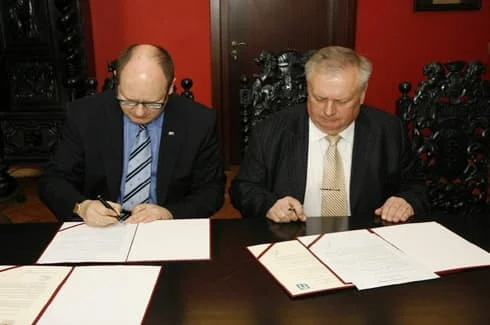
It was signed by the Mayor of Gdańsk, Paweł Adamowicz, and the Mayor of Rivne, Volodymyr Homko. Both sides declare their willingness to cooperate and strengthen good relations: „...conscious of the importance that international cooperation plays in creating and strengthening positive ties between states, nations, and cities; taking into account the similarities and the role that both cities play in their countries, especially in the cultural and economic fields connected with amber; bearing in mind the desire to strengthen the ties between the City of Gdańsk and the City of Rivne, express their will to cooperate in the fields of: utilising amber, as well as ancient and modern amber routes, for the promotion of their cities and regions; developing trade contacts related to the turnover of amber raw material, jewellery, and decorative items made of amber between companies operating within both cities; utilising Euro 2012 as a unique opportunity to establish cooperation and tighten the bonds between both cities and regions.”
Changes in Ukraine
The declaration and cooperation between Gdańsk and Rivne are of huge significance for both the Polish and Ukrainian amber industries, especially since the issues related to its extraction and processing have entered completely new territory. Ukrainians are trying to cope with the problem of illegal extraction of the raw material – in 2009, the Ministry of the Environment there granted the first concession for amber extraction from the Volodymyrets Shydny deposit, where geological surveys are to be conducted for the first three years in parallel with extraction activities. The liberalisation of amber extraction and trade is progressing slowly, and important initiatives are being undertaken, including the „Ukrainian Amber World” project, aimed at presenting Ukrainian amber domestically and internationally as well as promoting a positive image of the country. Part of this is the strategically important „From the State Capital to the Capital of the Amber Region” programme: Rivne is to become the centre for the extraction and artistic processing of Ukrainian amber. A permanent exhibition of Ukrainian amber is being created in the Sofia Cathedral monastery, and in April this year the „Amber of Ukraine” exhibition opened at the State Museum of Natural History.
We should help each other
As can be seen, Ukraine has high ambitions and does not want to be merely a raw material base for the Polish amber industry. As part of the Ukrainian Amber World project, activities are being undertaken to popularise amber among artists there. The tradition of its artistic processing does not have very deep roots in that country, nor does it have well-established trade contacts and markets. Ukraine has amber deposits, but no tradition; Poland has a very rich tradition and business experience, but local extraction does not even come close to satisfying the demand of local processing workshops – it looks like both sides have a lot to offer each other. This was confirmed by the Mayor of Gdańsk in a short speech at a meeting of the World Amber Council: „We want to share our experience and ideas with our friends from Ukraine to support their craft – we should help each other.”.
The first project jointly implemented by both countries is Euro 2012, and hopefully – as the Marshal of the Pomeranian Voivodeship, Mieczysław Struk, said at the Amber Trail Cities Forum – this cooperation will not end in 2012, but will be continued on the basis of amber. And the chances are high, especially since the idea has also gained the support of the first President of Ukraine, Leonid Kravchuk, who was visiting Gdańsk these days. He currently serves as the president of the Rivne Landed Gentry and the head of the Supervisory Board of the Ukrainian Amber World. „Together we will build a new, European Amber Room” – he briefly and metaphorically summarised the goal of this cooperation.