
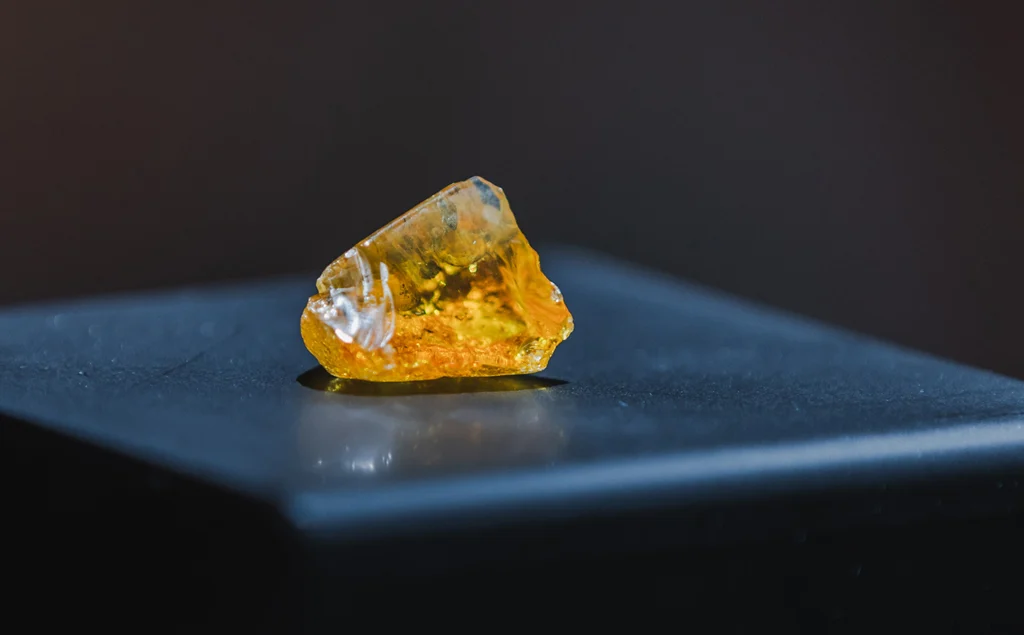
As early as 29 May 2025, a piece of amber from Gdańsk’s Sobieszewo Island will embark on a journey... out of this world. Literally. Together with the IGNIS mission and Polish astronaut Dr Sławosz Uznański-Wiśniewski, it will fly to the International Space Station to become the first amber in history to leave Earth's atmosphere. This event bridges millions of years of history with modern science – and proudly promotes Gdańsk as the World Capital of Amber.
The Sobieszewo Treasure – amber from the beach to the stars
The hero of this mission is a small yet exceptional piece of Baltic amber, found on the beach in Sobieszewo after a storm. Naturally transparent, light yellow, with a mass of 6.27 g – this is the very specimen that will fly into outer space. Its smaller half (4.27 g) remains on Earth, in the collections of the Amber Museum in Gdańsk. After the mission is completed, both parts will be tested and compared – scientists will check whether any changes occurred in the structure of the fossil resin in space.
The project not only promotes Gdańsk as the World Amber Capital, but also has scientific value – emphasises Waldemar Ossowski, Director of the Gdańsk Museum. – In our laboratory, the amber has been examined in detail and we have confirmed that it is authentic Baltic amber. Sending this sample into outer space will allow us to check how fossil resin reacts to the conditions of cosmic radiation and weightlessness. This is valuable knowledge for future research.
Space ambassador of Gdańsk
The idea for amber to join this prestigious mission came from the Marshal of the Pomeranian Voivodeship, Mieczysław Struk. The piece was handed over by Robert Pytlos, the amber officer at the Gdańsk City Hall, who has been promoting the city's amber heritage for years. Thanks to their involvement, the symbol of Gdańsk will find itself in the company of the greatest icons of Polish culture and science: a fragment of Copernicus's work, Chopin's manuscript, Szymborska's poems and... Polish diacritic marks. This is a fantastic form of promotion for Gdańsk, but also a beautiful metaphor – Gdańsk shows that amber, which is part of the city's history and identity, also has a future. Even in space.
Amber – a bridge between generations and planets
Although amber was formed around 40 million years ago, it still holds immense power of influence. For centuries it was a symbol of wealth, an amulet, an ornament and a trade object – in ancient Rome it was valued more than gold. Today it is once again showing its multidimensional face.
Amber has been with us for generations – almost every one of us probably has a piece of it at home, which is why, symbolically, we are all part of this cosmic journey – summarised Lidia Popiel, the Ambassador of Amber. – Amber is not just a beautiful raw material – it is a symbol of history, tradition and modernity that unites us and reminds us that we are a community. This is extremely important in today's world.
From the museum to orbit and back
Before amber set off on its furthest journey, it was thoroughly examined in the laboratory of the Amber Museum in Gdańsk. Spectroscopic analysis confirmed its origin and age – around 40 million years. Sending one of the halves into space is an unprecedented event in the history of museology. Upon return, the two parts will meet again – this time at the permanent exhibition in the Amber Museum, where everyone will be able to see… what amber from the stars looks like.