
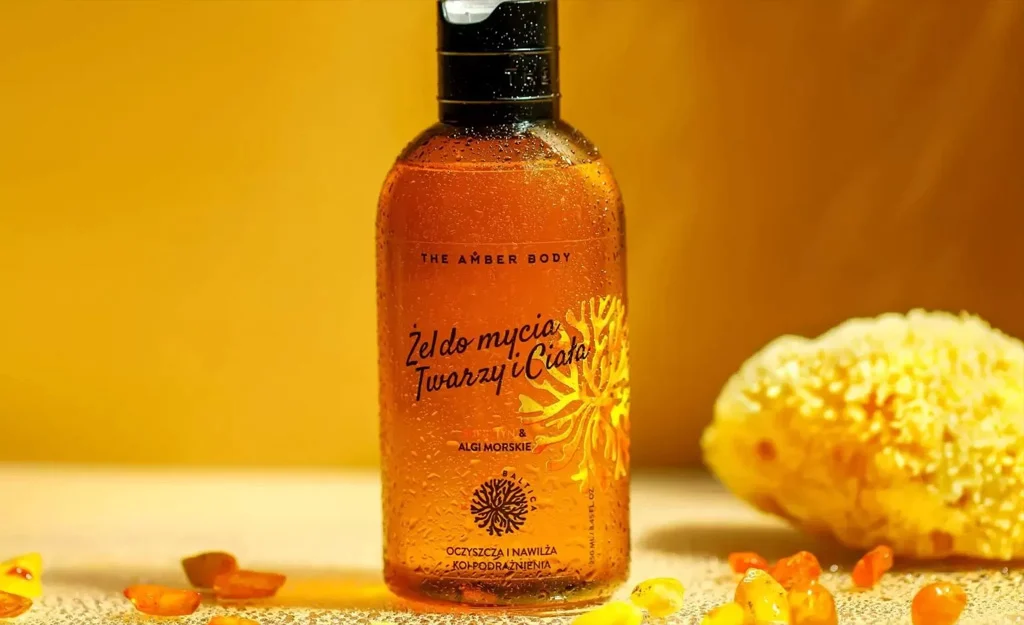
However, not every product advertised as „amber-based” actually contains it – and even if it does, it’s not always in its natural form. It’s therefore worth knowing how to read the ingredients list and what should be included in the INCI (International Nomenclature of Cosmetic Ingredients) to ensure that we’re choosing a truly valuable product.
Why does amber work?
Natural Baltic amber contains:
– amber acid, which has anti-aging and regenerative effects,
– microelements (e.g., calcium, iron, magnesium),
– terpenes and organic acids that support the processes of skin renewal.
In cosmetics, amber acts as a natural antioxidant and catalyst for metabolic processes in the skin – which means that it supports cell regeneration, has anti-inflammatory properties, and protects against the harmful effects of free radicals. Additionally, amber has cleansing and gently brightening properties.
What ingredients indicate the presence of amber in a cosmetic product?
The basis is the INCI list. From it we will find out whether amber was actually used and in what form. It is worth looking for ingredients like:
– Amber Powder – powdered amber, used in scrubs and soaps,
– Amber Extract / Amber Extract – extract from amber, a source of natural minerals,
– Amber Oil / Oleum Succini – amber oil, often combined with vegetable oils,
– Colloidal Amber – amber in a colloidal form, used in advanced skincare formulas,
– Succinum – a less commonly used name for raw amber in the composition.
In addition, Succinic Acid – or amber acid – often appears. Note: it can come from both amber and chemical synthesis (e.g., from petroleum). Only some manufacturers use acid of natural origin – so it’s worth paying attention to the manufacturer’s declaration.
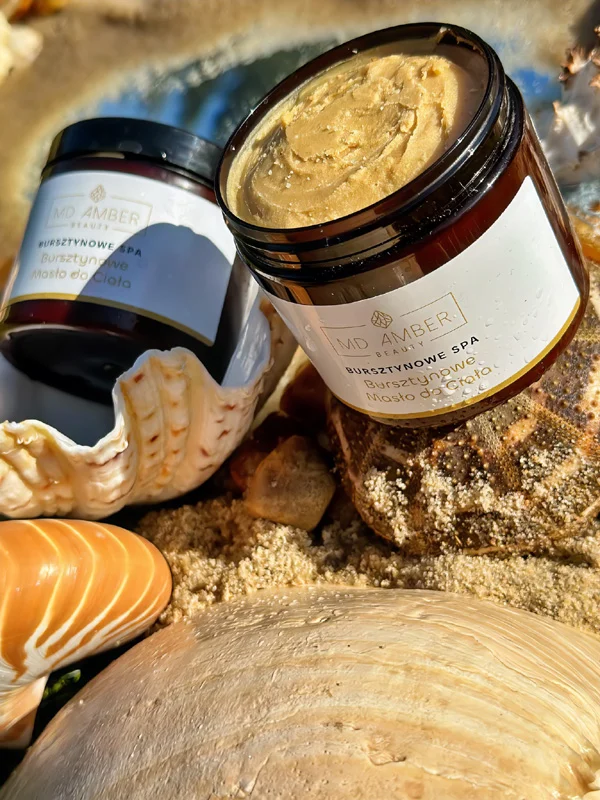
What else should an effective amber cosmetic contain?
Amber itself is just one of the elements of effective skincare. Its effectiveness is enhanced by other active ingredients, often found in creams, balms, or serums. Particularly valuable are:
✔ Vitamin E – a powerful antioxidant that protects against skin aging,
✔ Argan oil, shea butter – natural emollients that protect against moisture loss,
✔ Beta-carotene, panthenol, allantoin – soothe, smooth and promote skin regeneration,
✔ Hyaluronic acid – intensely moisturizes, improves skin elasticity.
When combined with amber, they form a complex that supports mature, sensitive, dry, or stressed skin.
How to recognize a cosmetic that only „pretends to be amber”?
Some cosmetics use the word „amber” in the name or fragrance – and amber itself is not included in the composition. In this case, we are dealing with marketing inspiration, not with the actual action of the ingredient.
Beware of ingredients like Amber Fragrance / Amber Parfum – that just means synthetic amber fragrance. In contrast, the absence of any amber ingredients in the INCI is a sign that the name is merely a marketing gimmick.
Natural or synthetic? A few facts from the market:
- About 40–50% cosmetics containing amber contain ingredients of natural origin,
- Amber acid derived from petroleum is still used in mass cosmetics, mainly due to its low price.,
- High-quality natural products are clearly declared the origin of amber or amber acid.
What else is worth paying attention to?
– The higher the amber component in the INCI list, the more of it there is in the product.
– Natural and vegan products are often labeled with certificates (e.g. Vegan, COSMOS Organic).
– Polish producers are pioneers in using authentic Baltic amber in their skincare products – it is worth supporting them.
Summary
Amber is not only a beautiful stone – it is also a valuable active ingredient in cosmetics. It supports regeneration, has anti-aging effects and improves skin condition. But like any natural ingredient, it requires attention: the composition, quality, and transparency of the manufacturer are crucial.
So before choosing a product containing amber, take a look at the label – and see if you can actually find what you’re looking for there.