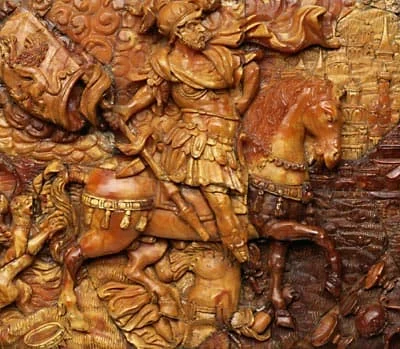
Most of them are held by three departments: Decorative Art, Sculpture, and the Church Treasury, and are presented to the general public only occasionally during special exhibitions, such as the exhibition entitled “Amber for Throne and Altar” running from October 2005 to January 2006.
It is to be hoped that upon completion of the planned construction of the new Decorative Art Department building, the amber artworks held within its collection, such as cabinets, vessels, candlesticks, jewellery items and decorative everyday objects, will leave the storerooms permanently to delight the eyes of visitors.
The Ecclesiastical Treasury has a separate location, which is housed in the Schweizerhof imperial palace buildings, opposite the Imperial Secular Treasury. As part of the permanent exhibition, visitors can admire two amber altars, large and small with a figure of the Mother of God, dating from the time of Ferdinand III. The most distinguished amber exhibit is undoubtedly the two-metre-high large altar from 1645, which arrived in Vienna in 1701 as a diplomatic gift to Emperor Leopold I from Elector Frederick III, who had just been crowned King of Prussia. In addition, the collections of the Ecclesiastical Treasury include numerous small private amber altars, crucifixion scenes, crucifixes, and liturgical vessels used during ordinary Holy Masses or, for example, rosary devotions.
As already mentioned, a large number of secular exhibits are held by the Department of Decorative Art. These include small cabinets, boxes, goblets, candlesticks, statuettes, etc. Most of them originate from the workshops of Königsberg and Gdańsk artists, and arrived in Vienna mostly as gifts for Austrian rulers in the 17th and 18th centuries. Amber gifts were an important tool, particularly of Prussian diplomacy, and frequently came into the possession of Habsburg emperors and archdukes in this way.
Splendid examples of amber craftsmanship gathered by the Vienna Museum of Art History span a total period from the Middle Ages to the Age of Enlightenment, constituting one of the many testimonies to the wealth and diversity of the collections there.