
On January 3rd, the World Amber Museum was officially opened on the Caribbean island of St. Thomas, showcasing rich collections of amber from around the world with a particular focus on Baltic amber.
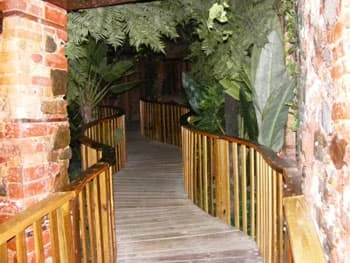
This is the third museum dedicated to amber in the region. Where does this interest in fossilised resin stem from? It's mainly because Dominican amber and Colombian copal are found there, among other places. It's also a very attractive tourist destination – even before the museum was officially opened, it was already being visited by hundreds of people a day. The originator of the idea to create this facility in the Caribbean, in the town of Charlotte Amalie, is Jan Sierżantow from the company Valerio 888. The idea was brought to life in collaboration with Michael Ball, who provided the premises in the historic 1829 hotel. The project was designed and realised by jewellery designer and amber processing specialist Jacek Baron. It is he who is the author of the surprising Amber Waterfall and the Amber Forest. The forest is built from artificial shrubs and trees, from which resin drips (with a detailed description of how amber is formed), while the waterfall is a wall, over 2 metres wide and over 5 metres high, covered with autocalved Colombian copal, down which water flows.

Exhibits
The museum's creators endeavoured to adhere to factual truth as much as scientific literature allows. This is because it turned out that different theories exist depending on the sources. „We used English, Polish and German sources and strove for a compromise. The origin of amber caused the most discrepancies. For me, the comprehensive source of knowledge was the books by Prof. Barbara Kosmowska-Ceranowicz, and I primarily based the project's realisation on them,” emphasises Jacek Baron.
The Amber Museum consists of two rooms – an exhibition presentation room and a shop selling contemporary amber jewellery. In the first room – beautiful and old, where authentic ceiling beams and spotlights illuminating display cases from below provide a unique atmosphere – screens are hung on the walls, displaying labels, films, and photographs. The natural amber section located here contains all types of amber found to date: including Baltic, Japanese, Burmese, as well as fossilised amber. There is also a rich collection of amber lumps, droplets, and inclusions – some of which have been described by Dr Elżbieta Sontag, the head Museum of Amber Inclusions at the University of Gdańsk. All are signed and described reliably, distinguishing between individual types of amber and inclusions, as well as providing information on how specific colour shades are obtained in amber.
The second section covers amber artefacts from the Neolithic period through the Roman era to examples of 18th and 19th-century sculpture. However, these are not authentic objects, but only reconstructions. Contemporary replicas of elements are also presented here. The Amber Room and modern jewellery. „We had ambitions to also collect historical objects for the museum, but due to their limited availability, we postponed this matter, currently focusing on other topics,” says the designer.
The modern, artistic uses of amber are further highlighted by the Fashion and Amber Gala shows, displayed on monitors during the Amberif trade fair. A reference to the region's history are three enormous, beautifully crafted ships from Columbus's expedition, placed on amber waves – Columbus is said to have reached this area during one of his voyages and been presented with gold and amber by the natives.
Following this introduction to the history of amber and amber craftsmanship, visitors are confronted with contemporary examples of the processing of this fossilised resin – in a vast shop with a wide range of offerings, comprising jewellery created in Polish workshops and companies, including unique pieces, short runs, and commercial items.
Future plans
Although the museum is officially open, the transformation process will likely continue for the next year: the exhibition will be constantly changed and supplemented. Plans include creating a section with fakes, which is intended to have primarily educational value – it will show how worthless counterfeits are. A restaurant is planned for the terrace, serving amber vodka, amber rum produced in the hotel (which will be green in colour), honey-amber ice cream, etc. Guests will taste these amber delicacies and enjoy the view of furniture decorated with amber and large exhibits for which there was no room inside. Another idea is a mini amber mine with fishing opportunities.
Museum owners assume that during the peak tourist season, which runs from December to May, the facility will be visited by at least 1000 people per day, making it, in their opinion, the most visited amber museum in the world. „We are counting on it being the biggest attraction of its kind on the island. The hotel itself is already a historical and therefore tourist attraction,” emphasises Jacek Baron.
Photos: Amber Forest – the road leading to the museum (top). Interior of the Amber Museum. Photo: Jacek Baron