
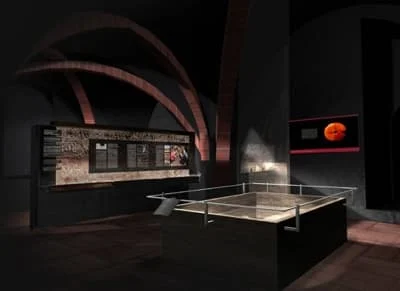
The aim of the exhibition is to present the amber collection amassed by the Castle Museum Since its establishment in 1961. The museum's 50th anniversary provided an impetus to view its amber collection from a new perspective. The exhibition's authors assumed that contemporary culture influences the perception of museum exhibitions, including, among other things, the way amber is presented in galleries, jewellery shops, or how this stone is used to promote the region. They therefore considered it necessary to take into account various contexts, contrasting historic works with the latest acquisitions and new technology. „We will show amber in all possible aspects that we observed while studying the collection,” explained the exhibition curator Anna Sobecka. She adds: „We will try to avoid monotony by juxtaposing, for example, the aspect of place with the aspect of amber crafting techniques, allowing us to view this unique stone in an even broader context.”.
The core of the exhibition will be formed by the well-known Malbork amber collection, which has been displayed worldwide, famed for its unique amber masterpieces, including a casket belonging to King Stanisław Leszczyński and a cabinet belonging to Stanisław August Poniatowski. Exhibits crafted by outstanding artists working in Gdańsk will also be presented, including works by Michel Redlin (a casket and reliquary) and Christoph Maucher (a casket).
Its complement will be works from foreign museums, including those already presented at the exhibition „Amber Treasures” Jacob Dobbermann's amber goblet from The Hunterian Museum in Glasgow. For the first time in Poland, in Malbork, a collection of 17 amber objects gathered since the 18th century from the former collection of the zu Dohna family from the palace in Słobity will be on display. It has been loaned from the Foundation of Prussian Palaces and Gardens in Berlin. A real highlight will be the medieval candlestick of Queen Sophia with an amber figure of the Madonna, likely a gift from the Grand Master of the Teutonic Knights, Konrad von Jungingen. „There are only two such works in the world – in museum collections in Bratislava and Hanover,” explained Anna Sobecka. This one presented in Malbork was loaned from the museum in Bratislava. Some of the archaeological artefacts presented at the exhibition come from Archaeological Museum in Gdańsk The Elbląg Museum has borrowed the amber-makers' guild book from the Słupsk Museum.
In addition to the aspects of time, place, the origin of amber, amber craftsmanship techniques, and collection building, the aspect of contemporary use as an artistic material is strongly emphasized. This is all the more important because Poland is currently strongly associated with amber – and no wonder, our country is the largest producer of jewellery made from this stone. At the „Amber Contexts” exhibition, we will see works that astound with their perfect execution, modern form, and conceptual design. These are works of contemporary amber art by Paulina Binek, Sławomir Fijałkowski, Arek Wolski, Jarosław Westermark, and Giedymin Jabłoński. Their works will be juxtaposed with amber achievements by foreign artists, including Manuel Vilhena and Fabrizio Tridenti.
The most interesting examples of contemporary jewellery, presented at the exhibition alongside art from past centuries, are intended to encourage reflection on the extraordinary richness of amber creations, which humankind has been producing for millennia.
Amber Contexts Exhibition„
Ground floor of the east wing of the Middle Castle
Corner Room so-called. Halberd
Curator Dr Anna Sobecka
Opening: 25.11.2011, 5.00 PM
The amber.com.pl Amber Portal is the media patron of the exhibition.