The collection is made up of Baltic amber (succinite), starting from the raw material in all its typical forms, through semi-finished pieces - examples of processing methods and methods to products present on the market at a certain time and works of art. The collection of pressed amber is important. It is an overview of pressed amber methods from the second half of the 20th century to the present day, from Poland, Russia, Lithuania and Germany. The collection also includes equipment and machinery used in the process of working amber, as well as selected jewellery and testing equipment. An interesting feature is a wooden workshop for polishing, turning, polishing and drilling amber, built on the model of 19th century amber processing workshops from Kurpie and Kashubia.
The collection has more than 10,000 objects and is in the process of being catalogued and described. All objects have been examined by amber experts. Some have been examined by academics - amber researchers, others have contributed to the knowledge of amber, others illustrate the works of authors writing about amber.
The collections include the following:
- Raw amber 1,200
- Natural forms 800
- Coloured varieties 1,500
- Inclusions in amber 2,900
- Semi-finished amber products 3,200
- Semi-finished and pressed amber products 215
- Amber products from the author's workshop 198
- Works from the studio of Gabriela and Wiesław Gierłowski 10
- Historical products 4
- New silverware from the 1970s 8
- Artists' works 75
- Sculptures and sculptural compositions 48
- Jewellery products from the 1980s 10.
- Contemporary jewellery 17
- Technical facilities 25
The collection of Baltic amber listed above, broken down by collection, was formed and shaped over many decades of my work with amber. Currently consisting of over 200 objects Collection of semi-finished and pressed products is mainly the result of my husband Wiesław Gierłowski's interest in this material and the technologies of its production, as well as my need to present, at the stand of the Amber Laboratory, wares made using increasingly perfect and diverse pressing methods. By means of comparison, the collection makes it possible to determine where the pressed amber wares come from and when they were made, and to trace the differences in the quality of pressing at a particular time in different workshops and countries.Objects from the Collection of artists' works and Collection of sculptures and sculptural compositions appeared and remained as souvenirs of events and journeys, some made to order, others purchased on the occasion of the author's exhibitions. The devices in Collection of technical objects enable the necessary comparative studies to be carried out.
W raw material collections features raw Baltic amber, most of which comes from beaches and hydraulic mines in the Vistula delta. This collection includes charts showing the commercial classification of the raw material, including internal structure, impurities. Also present are specimens of raw material (succinite) from deposits in Sambia and Ukraine and from post-glacial accumulations; including large lumps of over 300 g.
W collections of natural forms All forms of amber described by science are represented. These include droplets, icicles, infiltration and intraplaque forms, nacelles and others.
Collection of colour varieties contains polished and polished nuggets of various sizes and shapes, which show the multicolourfulness of amber, its diversity and unique beauty. At the turn of the 1980s/1990s, the following pieces were created from them Amber images, boards with multicoloured amber nuggets, were presented at the Earth Museum's exhibitions in the series Amber the treasure of the ancient seas, based on a concept by Professor Barbara Kosmowska-Ceranowicz, in various cities in Poland, including abroad.
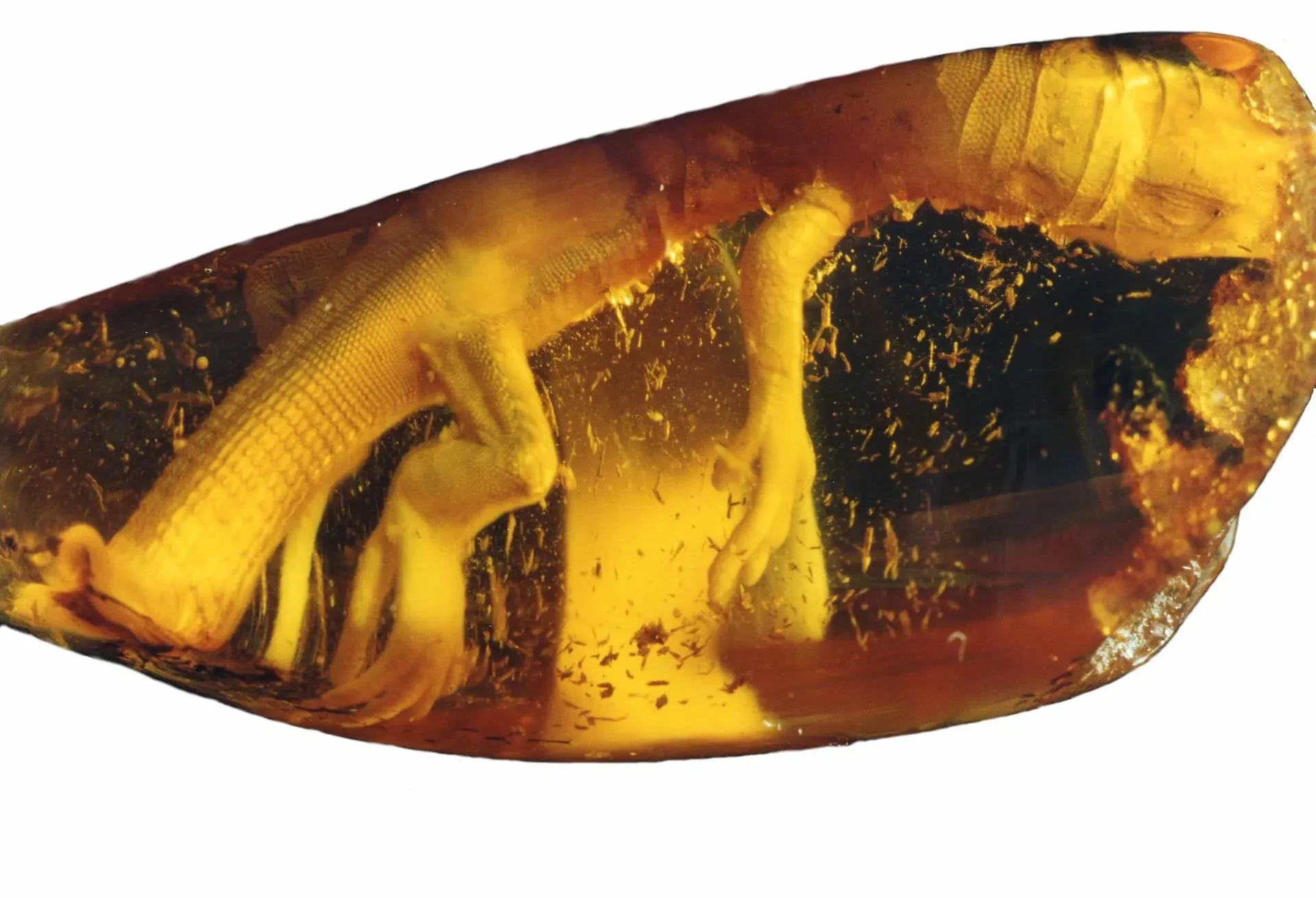
My habit of carefully examining nuggets during their selection allowed me to mature and reveal a lizard in one of them in 1997. The lizard became the number one specimen (GG1), starting the collection of organic inclusions: plants and animals in amber. It currently numbers some 2,900 objects. The lizard specimen, on the other hand, is one of the important exhibits today Amber Museum in Gdansk. Inclusions viewed under a binocular magnifying glass interested and fascinated me, and I collected and photographed them. „A look at the collection of inclusions...” collection is included in the fourth part of my book „On ancient amber collections and the Gdansk lizard” (2005).
Amber semi-finished products come from the artist's own workshop. This collection documents and illustrates the manual and mechanical processing of amber: grinding, cutting, turning, drilling, mending, gluing, manufacturing methods and techniques at different stages of the technological process and at different stages of progress.
Semi-finished and pressed amber products is an overview of different methods of pressing amber and various technologies, from the second half of the 20th century to the present time from Poland, Russia, Lithuania and Germany. The collection contains examples of all important, market-relevant methods of pressing amber based on both patent and workshop technologies: from powder, fine-grained lumps, larger multi-coloured lumps with the addition of young amber at a relatively low temperature (ca. 140oC) at pressures of up to 1,000 kg/cm - a product known as „rogue”. It is also pressed and then modified and flaked, also formed from a single unshaped lump into a specific shape, called shaped amber, and others. The collection includes both starting material (mouldings) and jewellery stones of various forms. There are also numerous finished products: necklaces, brooches, earrings, rings, bracelets, Mohican rosaries, figurines and sculptures.
Collection of amber products are derived from the most ancient traditions: pendants, brooches, bracelets, buttons of various diameters - irregular flat discs only partially polished with an archaic character emphasising the natural colour and texture of amber, and necklaces made of natural amber of varying degrees of transparency, a rich, varied colour range and various bead forms. Their beauty is determined by the careful, precise finishing of the surface, the colour selection of the beads, their shape, and the multi-faceted polishing that brings out the play of light specific to amber.
Also necklaces in which the diversity of amber is shown in one string. A necklace made of „figure-of-eight” beads, whose prototype was an archaeological find from the vicinity of Pruszcz Gdański, is a reference to the most ancient tradition. To the folk tradition, on the other hand, an amber purse modelled on the interior decoration of a cottage from the Museum in Łomża. There is one of three in the collection that have been made; of the other two, one is on display at the Amber Museum in Gdansk and the other is with an amber expert from Germany.
Important in the collection are products alluding to Kashubian folk products, such as brooches, a cross, two rosaries, two necklaces made of beads - talarks - and three necklaces made of natural amber, where the relatively flat beads have been additionally polygonal shaped on the edges in order to obtain an interesting play of light.
A memento of the 1993 Exhibition of Amber from the Collection of the Kings of Denmark at the Royal Castle in Warsaw is a magnifying glass made of naturally clear amber with a handle in the shape of a putto's hand with fingers wrapped in a „fig”, which was made on the model of 17th-century amber lenses from the collection on display at the time.
There are also traditional wares and jewellery stones made from amber corrected by a thermal process with oxygen, without the use of an autoclave. All of the amber wares come from a single workshop operating at the end of the last century - the author's. Products from this workshop can be found in all Polish museums collecting amber products, namely: Museum of the Earth PAN in Warsaw, Malbork Castle Museum, Amber Museum in Gdańsk, Archaeological Museum in Gdańsk and others, including European ones.
A collection from the joint studio of Gabriela and Wieslaw Gierlowski formed from objects dating from the 1980s and early 1990s, and includes, among others, a copy of a pendant modelled on the medallion of the Piast prince Jan Frederick, buckles, plaques, a goblet with an amber nodus, amber magnifiers set in silver on chains, brooches, pendants and others. Also a silver casket made by W. Gierłowski in the early 1980s; the lid was decorated with amber in the workshop of Lucjan Myrta in 2011.
Past products - is a collection of amber wares from the Staatliche Bernstein-Manufaktur, Königsberg (State Amber Manufactory in Kaliningrad). These include an incomplete brooch from the 1930s and two brooches (imitations from the post-war period). A pre-1945 amber butterfly - the central piece of the bracelet - and repetitive elements of the bracelet from the post-war period.
From the 1970s, a period of economic hardship, a small collection has been formed consisting of eight products in new silver (MZN 18 high nickel brass, an alloy of copper, zinc and nickel with the addition of manganese) decorated with amber. They are signed with the MET mark. This material has been supplied to jewellery suppliers since 1966 by the Cooperative Association of Artistic Crafts Producers „Art-Region” in Sopot. These works are interesting in terms of design: a bracelet made by the chemical engineer Janusz Fietkiewicz, another bracelet made by the art historian Wiesław Gierłowski, and two pendants with chains made to perfection by the skilled and professional mechanical engineer Leszek Gałecki. A pendant decorated with amber with an authored chain, one cufflink and two small rings from this period were made by an author unknown to me. All these wares were in the trade of the „Art-Region”.
Collection of artists' works was created over a longer period of time and was inspired by personal contacts with representatives of the artistic amber fields of Gdansk, St. Petersburg and Kaliningrad, and it was these contacts that enabled the collection of more than 60, mostly signed, works of art. These works Maria and Paweł Fietkiewicz, Wojciech Jakubowski, Alexandra Zhuravlyova, Sviatoslav Ivanov and Ernest Fox. M. and P. Fietkiewicz are an exceptional pair of artists whose monographic exhibition of works connected with the 40th anniversary of their creative work took place in 2009 in the Amber Museum in Gdańsk. In their works, amber is at the centre and the silver or gold setting added to it is a deliberate complement. The collection includes clasps, brooches, buckles, rings and pins.
In turn, the jewellery works of the graphic artist, author of almost a thousand ex-librises, initiator and organiser of the ex-libris biennial at Malbork Castle, W. Jakubowski's collection includes fourteen works: a necklace, a pendant, four brooches, five rings and three pairs of earrings. The intricate setting of amber in the brooches, rings and earrings is a type of contemporary filigree, where the forms of the final work of amber or other natural stones are created from coiled thin silver wire, which is additionally enriched with silver small balls.
A. Zhuravlov's works are characterised by his mastery of modern manufacturing techniques. The collection includes a Classical amber double-layered cameo set in a gold brooch by her husband Wieslav Gierlovski, cameos of shells on amber, carved intaglio amber stones with images of angels, women's heads, square intaglio tiles modelled on the great Danzig chessboard from the 17th century (now exhibited in the Archaeological Museum, used as lids of silver caskets) and a spoon. In addition, female heads painted on amber, in collaboration with the young painter Oleg Korshkov.
By S. Ivanov, a sculptor working on the reconstruction of the decoration of the Amber Chamber in the palace of Catherine I in Tsarskoye Selo, there is a sculpture of a dragon and an intaglio carved in transparent amber of the Tyszkiewicz Palace in Palanga. The collection also includes a cameo with the sign of the zodiac - Aries, made in white amber by an exceptional man, kind and compliant, a graduate of the Mukhina Sculpture Academy, the long-time (more than 50 years) artistic manager of the Kaliningrad Amber Combine, E. Lis. The cameo was framed by P. Fietkiewicz using the technique of multiple cargos.
Important objects decorated with amber, although not jewellery, include three works by the late Russian artist in the collection Lena Gradinarova: brooch, bracelet and phone case. The pieces were made of leather and amber.
The collection includes artistic works - a pendant and a brooch - by Jerzy Głowacki, who is characterised by extensive knowledge of jewellery, goldsmithing, thanks to which he masterfully applies ancient goldsmithing techniques to his products.
Pendants by Viktor Parchomenko from Kaliningrad are examples of beautiful form and precision workmanship.
The works of Andrei Kavetsky from Kaliningrad are in a collection of sculptures and sculptural compositions. They were made from natural amber from the Sambian deposit. They represent all existing varieties of amber. They are predominantly signed in the collection. The author, who has won numerous awards at numerous amber competitions, knows the structure of amber well and uses it masterfully. His use of inclusions in amber is interesting, where he builds the form of his works around inclusions and content saturated with a touch of humour, evoking humorous associations with situations from life. Thirty-one of his works represent all the existing varieties of natural amber, while four are made of autoclaved amber - owls, a bull, a cat and a grieving angel. The collection also includes seven figures - insects from this author's amber orchestra. A. Kawecki's works are characterised by lightness, also literal: the lightest is the Kid weighing 2 grams, while the heaviest bull sculpture is 95 grams. The bull sculpture has become a symbol of Amber Hossa Publishers.
In addition, the collection includes a figurine Fox - carved from a single lump of amber from the Klesovo deposit by Sergey Shmiruk from Rivne, Ukraine (together with the pedestal, it weighs 168 grams).
Small sculptures made of natural amber: an elephant, two hares, two ducks, a kitten and two made of heat-treated amber - a squirrel and a kitten - come from the workshop of Barbara Danuta Giergielewicz of Junoszyn.
7 small sculptures in the process of being identified.
A collection of jewellery products from the 1980s. are primarily the works of Leszek Gałecki, who is extremely precise in terms of workshop, Anna Surajewska, whose jewellery is based on her own workshop technology, and Mariusz Gliwiński, whose works from this period are characterised by an interesting exposition of amber in the product.
A collection of contemporary jewellery includes pieces decorated with both natural and enhanced amber, such as the work of Marek Gutowski, who uses small lumps of amber in a variety of ways, combining them with silver. Necklaces decorated with gilded silver come from the workshop of Leszek Krause. The jewellery products of the Amber Combination from Kaliningrad are numerous: brooches, clasps, bracelets, necklaces, powder boxes, flacons, bottles and others.
Collection of technical objects form the equipment and machinery used in the amber processing process from the late 20th century. These include two-speed grinders with dust extraction, grinders with a water-sprayed disc, grinder-polishers, a circular saw with diamond cutters and discs, an amber mill (dry), an amber mill (wet), grinding and polishing drums, amber drills, a regulated drill, an amber roasting furnace. In addition, a jeweller's table, a set of burners, an electric melting furnace, a set of broaching machines, scales: electronic, laboratory and bench scales, a set of testing needles, a stereoscopic microscope and a fibre optic illuminator.
Part of the collection was studied by Prof. Barbara Kosmowska-Ceranowicz of the Museum of the Earth PAS in Warsaw, the Polish representative in the group for the study of organic minerals at the International Mineralogical Association (this group is now no longer active). Individual objects by Ewa Wagner-Wysiecka, Ph.D., of the Faculty of Chemistry, Gdansk University of Technology. Some were used by the insightful researcher, amber enthusiast Dr Aniela Matuszewska of the Faculty of Earth Sciences (Department of Geochemistry, Mineralogy and Petrography of the University of Silesia in Katowice) for detailed studies of amber resulting in new, interesting, enriching information about amber. Several objects were examined using the ATR method - an infrared spectrometer from the Spectro-Lab company, Dariusz Wysiecki, M.Sc.
For more than ten years, the collections have been made available to the public in various configurations at the international amber fairs Amberif and Ambermart, also at exhibitions, and thus subject to the permanent judgement and evaluation of specialists: amber artists, scientists, amber experts from Poland and the world. They show the beauty of natural amber, the effects of its modification, the material and the products of various pressing methods. They inform and teach, among other things, about the correct, in accordance with the arrangements and standards of the International Amber Association, marking of products in trade. Often very puzzled and surprised, the owners of the galleries, which are springing up in increasing numbers, allow them to become aware of the great diversity that is hidden under the name of amber and the dangers of this diversity. The specimens from the individual collections serve to promote natural Baltic amber, and their photographs illustrate articles and books by many authors writing about amber - including my own, e.g. „The Beauty of Amber”, „Amber in Healing” and others.
The collection continues to be supplemented and expanded.
Literature:
- Gierłowska G. 2002: Amber In Therapeutics/Amber In Therapeutics/Bernstein In Der Heilkunde. Amber Hossa Gdansk
- Gierłowska G. 2002: Amber The Varietes and Modifications of Balic Amber [in:] Amberif Preview 7-10.03.2002. pp. 8-12. Gdańsk International Fair Co.
- Gierłowska G. 2002: Order in the naming of amber jewellery stones [in:] Polski Jubiler Nr 1(15) 2002, pp. 32-35. Warsaw.
- Gierłowska G. 2004: The beauty of amber/ The beauty of amber. Amber Hossa - Gdansk.
- Gierłowska G. 2001: Amber jewellery stones - Classification [in:] Zegarki&Biżuteria - monthly magazine of the watch and jewellery industry, March 3/2001 (49), pp. 12-13
- Gierłowska G. 2005: On ancient amber collections and the Gdansk lizard/ OnOld Amber Collection and the Gdansk Lizard. Amber Hossa Gdansk
- Gierłowska G. 2007: Amber, the Eternal Mystery - The Amber Laboratory. [in:] Amberif Preview 2007.14 International Fair of Amber, Jewellery and Gemstones (14-18.03. 2007) p.10 - 15. Gdansk.
- Gierłowska G. 2009: Inclusions in Baltic amber - their place in culture [in:]RynekJubilerski nr 2(8) Summer 2009, pp. 40-43. ISSN 1897-6433.
- Gierłowska G. 2009: Baltic amber - the king of fossil resins. [in:] Jewellery Market. No. 1(7) Spring 2009. pp. 20-24. Warsaw.
- Gierłowska G. 2010: Notes on the standardisation of amber. Lapidary about Baltic amber [in:] Jewellery Market No. 1(11) Spring 2010. p. 12 - 20. ISSN 1897-6433.
- Gierłowscy G. and W. 1998: Lizard from Gdańsk Stogów [in:] Amber - Views - Opinions B. Kosmowska-Ceranowicz, W. Gierłowski [eds.]. pp. 55-58. Gdańsk-Warsaw 2005.
- Gierłowski W. 1999: Amber and the Gdansk amber workers. Marpress Publishing House Gdansk.
- Kosmowska-Ceranowicz B. 1998: History and contemporary possibilities of the amber collection in Gdansk [in:] Amber - Views - Opinions edited by Barbara B. Kosmowska-Ceranowicz, W. Gierłowski [eds] pp. 194-198. Gdańsk-Warsaw 2005.
- Kosmowska-Ceranowicz B. 2009: Collections of fossil and subfossil resins in museum collections as material for the study of their properties. Amberif 2009 - 16th Seminar - „Amber - on monuments, organic and property inclusions”.” Gdansk-Warsaw 14.03.2009. p. 9-15.
- Kosmowska-Ceranowicz B. 2012: Amber in Poland and around the world. Warsaw University Publishers.
- Koteja J. 1998: Amateur and professor in a world of inclusion [in:] Amber - Views - Opinions. B. Kosmowska-Ceranowicz, W. Gierłowski [eds]. 2005 s. 70-74. Gdansk-Warsaw
- Leciejewicz K. and Kwiatkowska K. 2005: The explored beauty of amber. Museum of the Earth PAN Warsaw
- Matuszewska A. 2010: Amber (succinite), other fossil, subfossil and modern resins. Oficyna Wyd. Uniwersytet Śląski w Katowicacach.
The article appeared in the publication summarising the International Amber Researchers Symposium “Deposits - Collections - Market” during Amberif 2013.