Some were commissioned by members of the royal family from eminent artists in this speciality both in Königsberg (e.g. Georg Schreiber or Johan Kohn) and in Gdańsk; documented sources confirm that amber objects were sent to the Swedish court by Michel Redlin, a famous Gdańsk guild master. Some objects were acquired through legacies (mainly from Denmark). However, it cannot be ruled out that many of the amber wares found in Sweden originated from thefts carried out on a massive scale by Swedish troops during the Thirty Years“ War and during the ”Deluge'.
Today, the most significant collections of amber artefacts can be found in the following museums in Sweden: the Royal Treasury at Stockholm Castle (Kungl. Husgeradskammaren), the collections at Skokloster Castle, the Royal Scientific Society in Uppsala (Kungl. Vetenskaps-Societeten) and Gripsholm Castle; in smaller quantities, amber products can also be found at the National Museum in Stockholm and the Royal Armoury. Archaeological artefacts are kept by the State Historical Museum in Stockholm and the Archaeological Museum in Gothenburg.
The most valuable artefacts in Swedish museum collections
The Royal Castle Treasury, Stockholm
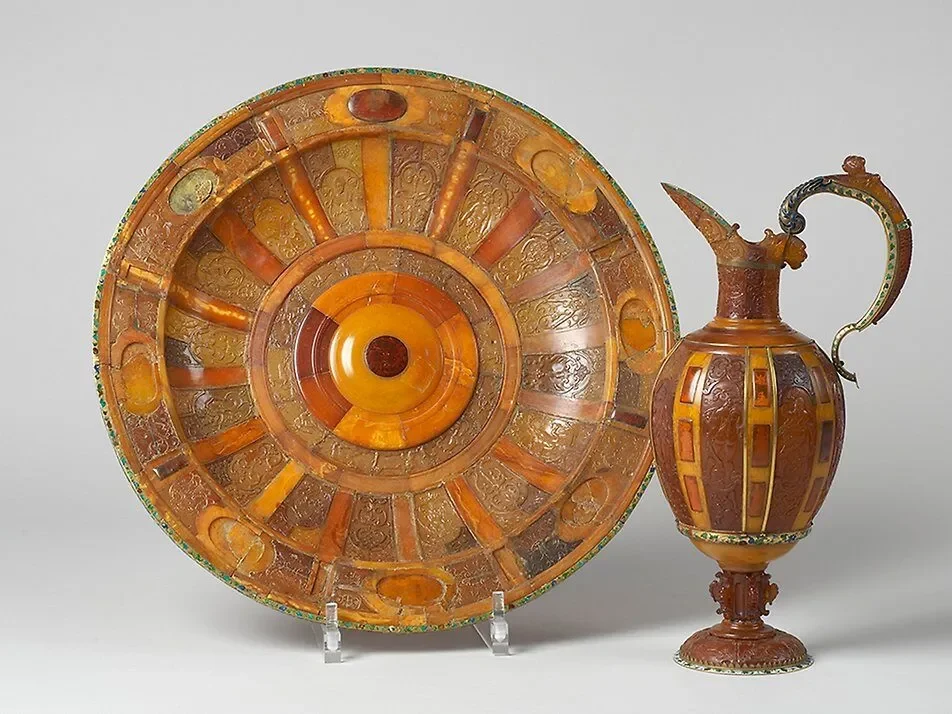
- jug and bowl from the collection of Maria Eleonora, wife of Gustavus II Adolphus - an outstanding work of magnificent quality, linked to the workshop of the famous Königsberg amber maker Georg Schreiber (dated c. 1640), decorated with reliefs depicting allegorical and mythological figures and hunting scenes. The handle of the jug and the rim of the bowl further decorated with gold and enamel;
- A two-storey casket with relief decoration with mythological themes and personifications of the seasons (Königsberg, Georg Schreiber circle, 2nd quarter of the 17th century). In the finial a full-plastic sculpture depicting Triton sitting on a dolphin. This object comes from the collection of Queen Hedviga Eleonora (1634-1715), wife of Charles X;
- goblet with lid with relief decoration with plant and mascaron motifs, signed work of the Königsberg amber jeweller Johan Kohn (ca.1625);
- two pairs of large candlesticks of bas-relief amber, set in gilt silver. The larger candlesticks, with floral motif decoration, were the property of Queen Hedvig Eleonora. The second pair, with relief decoration depicting birds and mascarons, came from the workshop of Johan Kohn of Königsberg;
Skokloster Castle
- tankard with lid in gilt silver setting, decorated with reliefs with zoomorphic motifs and a hunting scene. A product of the Königsberg circle of G. Schreiber from the 2nd quarter of the 17th century;
- a two-storey casket , richly decorated with ivory, Gdańsk product, late 17th century;
- two crucifixes with spirally twisted shafts, with ivory figures of Christ; they come from Elblag or Gdansk workshops from the 2nd half of the 17th century.
Royal Scientific Society, Uppsala
- A pair of oval mirrors in carved amber frames; made in Königsberg in the workshop of Johann Köster in the late 17th century;
- Casket decorated with ivory reliefs, Gdansk, late 17th century;
- Trik-trak game in amber decorated with reliefs and ivory, Königsberg workshop from the Georg Schreiber circle, circa 1620;
- candlesticks and a crucifix in amber and ivory from the early 18th century;
- trinkets and small wares: e.g. a scissors case, a needle holder, bowls and containers of various shapes, a paper knife, a magnifying glass, a clothes brush holder, flirt tokens, miniature clogs, etc.
Gripsholm Castle
- a magnificent amber cabinet, probably from Gdansk, signed and dated: “C.G.1712”, richly decorated with full-plastic sculpture and reliefs with biblical and mythological themes.
National Museum, Stockholm
- tankard with lid with relief decoration framed in gilt silver, Königsberg, c.1640;
- salt cellar and inkwell from the mid-18th century, linked to Lorenz Spengler's workshop in Copenhagen;
- architectural structure , a unique amber product, a kind of portico supported by seven columns flanking an amber back wall into which are set nine oval medallions with ivory reliefs, workshop unknown, 2nd half of the 17th century.
All the high-class works of modern art mentioned above were created outside Sweden. However, archaeological artefacts from excavations in the south of the country, especially the oldest ones, may have been created in local workshops. During the Neolithic period, amber manufacture also developed in southern Scandinavia. The most interesting artefact from this period is a small human head, probably a talisman, now stored in the Historical Museum in Stockholm. Here, there are also interesting amber objects from the Roman period, the migration of peoples and the early Middle Ages. The latter may have been brought to Sweden by the Vikings, who often visited Wolin and Truso, i.e. where the earliest workshops for working Baltic amber were established.
Author: Elżbieta Mierzwińska