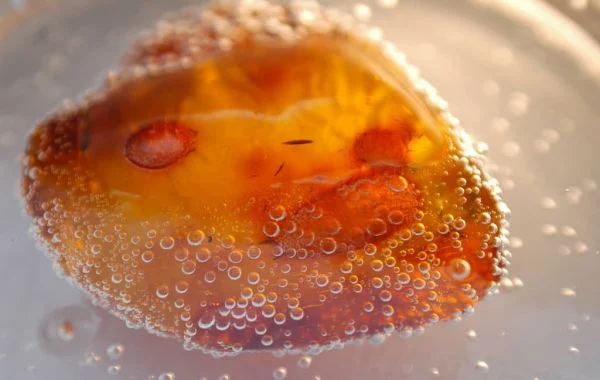
Despite the many processes that resin underwent to transform into amber, it remains in the fossilisation stage, meaning oxidation and polymerisation processes. As this process is still ongoing, amber is constantly changing, therefore it can be considered a “living” stone, and friendly to humans at the same time.
So, for several millennia, this extraordinary stone has remained of constant interest to humans, who have used it in crafts and art, while also believing in its magical and healing properties. Currently, amber adorns most of the silver jewellery produced in Poland, which is exported to markets all over the world.
Amber is light, its density is comparable to that of seawater and ranges from 0.96 to 1.096 g/cm3. This is a significant practical advantage, as impressive amber ornaments such as necklaces, pendants, and earrings can be made and worn.
Amber is the only fossil resin to contain 3-8% succinic acid – a medicinal substance with multiple effects; it is most abundant in the bark, which is its surface layer.
Amber floats in salt water, but in fresh water, in most cases, it sinks. Appearing in distant ages on rough, storm-tossed waves of the cool Baltic and North Seas, it sparked curiosity and suggested a unique, supernatural force within it. This still happens today: during colder periods (March, November), when the water temperature is around 4°C and its density is at its highest, amber is lifted from the seabed by the sea's movement and waves wash it ashore.
It occurs in deposits: in the vicinity of the Bay of Gdańsk, in Sambia and at the root of the Hel Peninsula (these are the world's richest amber deposits), as well as in Lubelszczyzna near Lubartów, in Volhynian Polesie (called Ukrainian amber) and Bitterfeld (called Saxon amber). It lies in deposits at depths ranging from a few to about 150 metres (see: Baltic amber deposits)
Raw amber it occurs in various non-random forms (e.g., drops, icicles, so-called streams) and lumps of various sizes, which are evidence of its formation and movement. (see: The genesis of Baltic amber)
Amber is characterised by great diversitycolour variants: from the white colour, most valued in ancient centuries, through all shades of yellow and brown to a specific red. There is also amber with a bluish, greenish or even black colour. Primary and secondary colours of amber are distinguished. (see: Baltic amber varieties)
Amber often contains organic inclusions: insects, arachnids, myriapods, small amphibians, plant debris, grains of sand, and gas bubbles. These are a source of knowledge about the time when the amber was formed, animals living near the resin-producing tree, or active during periods of resin leakage. An exceptional inclusion in a piece of natural Baltic amber is a specimen of a lizard known as the “Rat of Gierłowska“, held in the collection of Amber Museum in Gdansk.
The value of amber generally depends on the size of the nuggets, but the decisive factor is the principle – already known to amber craftspeople in ancient times, who argued over the purchase of raw materials – which states that “pieces equal in weight do not have the same price, which depends on purity, transparency, rarity, and the nobility of colours” (J. Grabowska).
Amber granules are warmer than other stones, and when rubbed, they attract tiny pieces of dry grass and small scraps of paper, because amber has the ability to acquire an electrical charge through such a process. It charges negatively – which is beneficial for humans.
The thermal and electrical conductivity of amber is low and isotropic, i.e. the same in all directions.
Set on fire Amber nuggets they burn with a bright yellow flame, giving off a pleasant, resinous scent. Pliny wrote: “Amber shavings dipped in oil burn brighter than flax fibre, and also longer”.
Amber is very heterogeneous in terms of chemical composition.
It is made up of:
C (carbon) – from 61 to 81%
H (hydrogen) – from 8.5 to 11%
O (oxygen) – approximately 15%
S (sulphur) – approximately 0.5%; as a secondary component, it may be present in quantities of up to a few per cent.
Amber also contains other trace elements and minerals.
Amber cannot be completely dissolved. It dissolves partially in certain organic compounds: in methanol at 20–15%, in ether at 18–23%, chloroform at 20.6%, benzene at 21%, and turpentine at 25%.
The hardness of amber on the Mohs scale ranges from 2 to 3, and its microhardness is in the range of 19.9 to 29 kg/mm².2. It is dependent on the varieties; and so: bone is 19.9 kg/mm2, transparent – 26.2 kg/mm2, weathered – 27 kg/mm2. The variations in microhardness degree within a single grain are often on the order of ± 5 kg/mm2.
The internal structure of amber is varied, mainly porous or foamy, but it can also be solid. Porous and foamy structures consist of gas bubbles, the number and distribution of which within the lump affects the amber's degree of transparency and colouration, but not only that, as recent studies of its structure have shown. Interestingly, a structure with very thin layers has been discovered within lumps of transparent amber. As well as the crystalline phase in amber – the discovered crystals have varied habits: tabular, prismatic, or bent fibrous crystals and “occur inside gas bubbles, similar to quartz brushes in oval geodes” (B. Kosmowska-Ceranowicz).
Amber is characterised by a characteristic conchoidal fracture.
Scratching the surface of amber causes a bright scratch and fine crumbs.
Amber undergoes weathering processes, which occur both in the sediment and outside the sediment after the amber has been extracted. In the past, to protect amber raw material from weathering, it was stored in brines. Currently, protective preparations made of synthetic waxes, impregnation with dammar resin or amber rosin in solutions with turpentine are used.
Amber also changes mainly as a result of light. Initially, the material's surface darkens, losing its luminosity and transparency. As the exposure time increases, the surface becomes rough. The next stage is the appearance of fine cracks and scales that flake off even with slight movements, and the loss of this layer.
Dry distillation of amber, without air access in heated retorts, yields: succinic acid, oil, and rosin, which are used in medicine, as well as high-class impregnating agents and components of lacquers and varnishes.
Amber is easily processed: it can be ground, cut, carved, engraved, and used to create intaglios and cameos.
Amber cooked in vegetable oil (almond or rapeseed) softens and can then be bent.
Heated suddenly, amber cracks. The softening temperature of amber is about 150°C, and the melting temperature is about 300°C.
Amber is coloured using natural substances, such as plant extract Dyer's Alkanet, Tyrian purple and goat fat – as already noted by Pliny the Elder – and using synthetic dyes.
Today, amber used in jewellery is very often corrected. Correcting is a process carried out in autoclaves filled with inert gas under high pressure: clarification, hardening and colour change. In this process, it is possible to achieve: complete transparency of the nuggets, complete fusing of layered pieces of amber, production of falsified inclusions in amber (insects, feathers, shells and plant fragments are placed between two parts of the nugget; after the process, the nugget has no trace of being fused), surface colouring, unification in terms of colour.
It is also possible Amber ironing, which involves bonding small pieces of amber, or even amber powder, into larger pieces under pressure. This creates amber material with a structure dependent on the technology used. In the 19th century, methods for pressing amber were patented and named after their inventors: the Spiller method and the Trebitsch method. Today, technical and technological advancements allow for the production of items from pressed amber, which are very difficult to distinguish from products made from natural amber nuggets.
According to gemmological and jeweller's studies, amber is characterised by a greasy, waxy lustre. Amber, after enhancement processes, has a vitreous lustre.
The refractive index of amber is 1.539 – 1.542. For comparison, for the glass used in the first amber imitations, this index ranges from 1.420 to 1.960.
Research and identification of amber are difficult, as it cannot be completely dissolved in any currently known solvents. Infrared absorption spectroscopy (IR) is effective and reliable, with the characteristic curve section known as the "Baltic arm", which forms in the band range of 1200-1260 cm, serving as a diagnostic indicator. -1.
Natural amber – untreated, only debarked and polished – it is alive because its internal transformation process is still ongoing and it benefits humans in a favourable way.
Personally, I am convinced that this is a stone that brings good luck. It supports and strengthens positive energy. It stabilises and rebuilds the natural electrostatic field, which has been disrupted by the ubiquitous computers and mobile phones.
Amber is unusual and mysterious. But it is also fascinating and beautiful in that it allows us to enjoy it and discover its secrets.
Bibliography
1. E. Krzemińska, W. Krzemiński – In an amber trap. Museum of Natural History, Institute of Systematics and Evolution of Animals PAS, Krakow 1993.
2. W. Gierłowski – Amber conservation – current problems. Gdańsk 2000
3. B. Kosmowska-Ceranowicz Amber and other fossil resins of the world. Baltic amber. Polish Jeweller No. 3(14) 2001
4. G. Gierłowska – The beauty of amber. Gdańsk 2004
5. G. Gierłowska – About old amber collections and the Gdańsk lizard. Amber Bull Publishing House Zalesie / Gdańsk 2005
6. B. Kosmowska Ceranowicz – Amber micro-worlds. ACADEMIA No. 1(5)2006