In literature and common understanding, it is identified with the functioning amber routes. However, this concept should be understood not as a real network of roads with merchant factors, but as the most probable directions of distribution from groups acquiring amber to users.
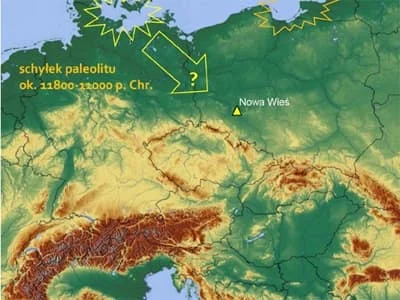
The oldest finds of amber associated with human activity date back to the Upper Palaeolithic. The latest research in Nowa Wieś, Bolesławiec district, makes it possible to attribute them with a high degree of probability to the Federmesser culture.3. Evidence relating to the organised sourcing and distribution of the raw material in question dates from the late Neolithic period.4. These are associated with the south-eastern Baltic coast and the Vistula Spit, inhabited by populations of the Globular Amphora and Rzucewo cultures. In the vicinity of Sandomierz, communities of the Złota culture resided, who both used amber and acted as intermediaries in its further distribution to the south. In this case, the Vistula was most likely the communication artery. Within the territory of Poland, two side branches of the „Neolithic route” can be identified during the period under discussion – both lead from the areas along the lower Vistula. One of them leads through Masuria, to the north-east.5, and the second through Kujawy into the middle Warta basin6.
In the Bronze Age, we encounter changes that will persist, apart from a few episodes, until the end of prehistory. These involve a diminished role for the Vistula axis (only its lower course being an exception) as the main distribution route, with this function being taken over by the Noteć, Warta, and Oder rivers. In the Bronze Age, two periods can also be identified, associated with varying intensities of amber distribution. The first of these is linked to the Early Bronze Age and is characterised by intensive export. Amber, still sourced from the Baltic, travelled through Kujawy to the communities of the Únětice culture, which formed part of the emerging Central European early Bronze Age proto-civilisation.7. The population of the latter group retained part of the raw material for their own needs, and exported the rest.8. During the period discussed, amber was also an extremely valuable, and therefore sought-after, raw material within Mediterranean cultures.9. Most likely the „routes” ran along rivers to the Black, Aegean and Adriatic Seas10. Perhaps the so-called... of organised amber trading on the mentioned route may indicate. Idol bread-like, which, according to some researchers, based on analogies from the eastern Mediterranean, were used to record and acknowledge commercial transactions11. Clusters of such artefacts are known mainly from the areas between the Po and the Alps and the middle Danube, and two analogous idol they also come from the Vistula and Oder interfluve12. Their distribution therefore coincides with the zone of activity of the early Bronze Age Amber Road, which could be connected with organised trade in amber. A deposit discovered in 2011 in Wieliszew near Warsaw, which, besides pottery and flint artefacts, also included amber beads originating from the Únětice or Iwenice cultures, indicates the existence of a regional route (routes?) running east-west.
The second of the mentioned periods is mainly associated with the dominance of the Lusatian culture, from which relatively few amber finds originate. Paradoxically, during this time in southern Europe, this raw material was still valued, and discoveries in burial sites indicate a large influx of it. It can therefore be assumed that it went almost entirely to southern Europe, where it was used to produce characteristic cylindrical beads with encircling ribs. These are known from Crete, Rhodes, Syria, the western Balkans, Italy, Sardinia, and Ukraine.13. The lack of places that can be indicated as intermediate stages on the distribution route makes it impossible to determine the most probable route or routes of transport. Recently, Volhynia has been indicated as a mining centre alternative to the Baltic region.14. This is why amber would reach the zone dominated by the civilizations of the Mediterranean and Black Sea basins. However, in light of the lack of any archaeological evidence for prehistoric extraction of the raw material in question in Volhynia, the presented concept can be considered purely theoretical.
In the early Iron Age, interest in amber intensified. The raw material reached the sub-Alpine zone and further into Northern Italy from the southeastern shores of the Baltic Sea, via the lower Vistula, the Warta and Oder river basins, and the middle Elbe. The population associated with the Hallstatt civilization played a special role in this, with their sites rich in amber artefacts recently discovered in the vicinity of Wrocław.15.
During the period of Celtic dominance, and after their fall to the Roman Empire, we encounter organised long-distance trade confirmed not only by archaeological finds but also by written sources. Amber workshops and their associated raw material depots operated in the regions of Hungary, Bohemia and Moravia, and Silesia, including Hradište near Stradonice, Staré Hradisko, and Wrocław-Partynice.16. Since its founding as a Roman colony in the 2nd century BC, Aquileia became a centre for the amber trade, from where expeditions to the north began.17. Within the Roman Empire, routes can be quite precisely identified that were connected by a network of excellent roads linking urban centers such as Virunum, Lentio, Emova, Poetovio, Savaria, Scarbantia, and Carnuntum. One of them ran onwards along the Vltava to central Bohemia, then up the Elbe through Lusatia and Lower Silesia down the Oder towards the Warta and further towards the lower Vistula with a branch to Sambia. The second, after crossing the Danube border near Carnuntum, led along the Morava to the Moravian Gate and then north along the Warta, through Kujawy to the mouth of the Vistula and to Sambia. Some researchers point to the existence of a third „eastern” route connecting the southeastern shores of the Baltic Sea: through Masuria, northern Mazovia, along the Bug to the Carpathians, and from there through mountain passes and Transylvania south to the Adriatic coast.18.
At this time, Central Europe also had to contend with local branches of the main routes. One of these led to Mazovia, where in the vicinity of Warsaw there were numerous settlements associated with a thriving iron smelting centre.
Social unrest during the Migration Period disrupted the existing socio-political order, contributing in many cases to changes in economic ties and, consequently, to the decline of trade routes that existed in Europe. In the early Middle Ages, entirely new political and trade arrangements led to the complete disappearance of amber distribution in Central Europe. It remained an object of trade, but the route ran along the Baltic Sea and the rivers of Eastern Europe – the so-called „route from the Varangians to the Greeks”.
Literature:
- Clark J. G. D., 1957. Prehistoric Europe: Economic Bases. Warsaw: PIW, : 217-234; GIMBUTAS M., 1965. Bronze Age Cultures in Central and Eastern Europe. Paris-The Hague-London, 32n,; MACHNIK J., 1978. The Early Bronze Age. In: A. Gardawski, J. Kowalczyk, Prehistory of the Polish lands, vol. III. Early Bronze Age. Wrocław: Ossolineum. 19–26, ill. 7; Bukowski, Z. (1998) *Pomorze w epoce brązu w świetle dalekosiężnych kontaktów wymiennych*. Gdańsk: Gdańskie Towarzystwo Naukowe & Zbigniew Bukowski.
- GIMBUTAS M., 1965. Bronze Age Cultures in central and eastern Europe. Paris-Haga-London,: fig. 15; Wielowiejski J.,1980. The Amber Road in the Roman Empire. Wrocław: Ossolineum; Bukowski Z., 2002. Amber findings in Bronze Age and Early Iron Age assemblages from the Oder and Vistula river basins. Warszawa IAiE PAN; Mazurowski r. F., 2005. The role of Żuławy Wiślane in the development of prehistoric amber working and exchange networks with the interior. . In: B. Kosmowska-Ceranowicz, W. Gierłowski, Amber views opinions. Gdańsk, : 111-116; Czebreszuk J., 2011. Amber in Mycenaean Culture. Poznań. Wydawnictwo Poznańskie, 158-162
- Burdukiewicz J. M., Furmanek M.. A multicultural site, Nowa Wieś 2, Bolesławiec district. In: „Archaeological Reports of the Motorway Z. 6 Investigations on the A4 Motorway”Part IV, Wrocław 2007, pp. 84–86, figs. 42, 43)
- Mazurowski R. F., 2005. The Żuławy amber region 4500 years ago. In: B. Kosmowska-Ceranowicz, W. Gierłowski, Amber views opinions. Gdańsk, 108-110.
- Manasterski D., 2009. The Masurian Lake District at the end of the Neolithic and the beginning of the Bronze Age in light of the Ząbie-Szestno type assemblages. Warsaw IA UW, 91-94.
- Czebreszuk J., 2011. Amber in Mycenaean Culture. Poznań. Wydawnictwo Poznańskie, 41.
- Czebreszuk J., 2011. Amber in Mycenaean Culture. Poznań. Wydawnictwo Poznańskie, 47; Makarowicz P., 1998. The Role of the Pit–Grave Culture Communities in the Genesis of the Trzciniec Cultural Circle. Poznań UAM, 253–254; Manasterski D., 2009. The Masurian Lake District at the End of the Neolithic and Beginning of the Bronze Age in Light of Ząbie-Szestno Type Assemblages. Warsaw IA UW, 145–146, with further literature therein.
- Bukowski Z., 2002. Amber finds in Bronze Age and Early Iron Age assemblages from the Oder and Vistula river basins. Warsaw IAiE PAN 54-55; Czebreszuk J., 2011. Amber in Mycenaean culture. Poznań. Wydawnictwo Poznańskie, 56.
- Czebreszuk J., 2011. Amber in Mycenaean culture. Poznań. Wydawnictwo Poznańskie, p. 103n.
- Czebreszuk J., 2011. Amber in Mycenaean culture. Poznań. Wydawnictwo Poznańskie, pp. 158-162, fig. 32.
- Fogel J., Langer J. J., 1999. Early Bronze Age European “bread idols”. An attempt at a new interpretation of their content using mathematical methods. Folia Praehistorica Posnaniensia 9, 87-99.
- Kaczmarek M., 2012. The Bronze Age in the Greater Poland-Kujawy Lowland in the light of interregional exchange contacts, Poznań, fig. 48.
- Choińska-Bochdan E., 2003. Amber in culture. In: H. Paner, B. Kosmowska-Ceranowicz. Amber through the millennia. The Archaeological Museum in Gdańsk, fig. II.38.
- Czebreszuk J., 2012. A contribution to research on the genesis of amber in Mycenaean culture. Museum of the Earth Works No. 50 (in print).
- GEDIGA B., 2007. Problems of the image of the early Iron Age culture in Silesia in light of new field research. Silesian Archaeological Reports. vol. 49, 123-146.
- Choińska-Bochdan E., 2003. Amber in culture. In: H. Paner, B. Kosmowska-Ceranowicz. Amber through the millennia. The Archaeological Museum in Gdańsk, pp. 68-73.
- Wielowiejski J., 1980. The Main Amber Route in the Roman Empire. Wrocław: Ossolineum
- Okulicz-Kozaryn J., Nowakowski W., 1996. In search of the Amber Routes. Traces of contacts between South-Eastern Coasts of the Baltic Sea and Celto-Illyrian and Dacian territories. In: Contacts along the Amber Road (between Caput Adriae and the Baltic regions) around the birth of Christ. Kraków, 157-170.
The article appeared in the publication summarising the International Amber Researchers Symposium Deposits - collections - market during the fair Amberif 2013.