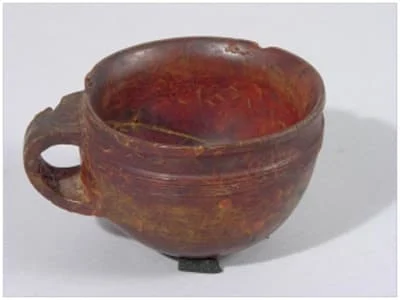
In Europe, the oldest amber artefacts have been found in the British Isles. In England, archaeologists have discovered beads from Gough's Cave in Cheddar Gorge in the south of England and from Creswell Crags in Nottinghamshire in the Midlands region, dating to around 900 to 11,000 BC. In Sussex, during excavations for construction in Hove in 1856, a Bronze Age amber cup was discovered. A Bronze Age burial was found there, which also contained other items, including a volcanic stone axe and a copper alloy dagger. Carved from a single piece of amber, the cup is 12.7 cm high; its base is flat-rounded, and the body is beautifully decorated with a delicate, raised ornamental line.
The amber cup from Hove is now housed in the Brighton Museum and Art Gallery; it is believed to have been made in the area of present-day Germany. Another amber cup was found near the town of Dorchester, but only in fragments, and was also made in a completely different craft style than the Hove cup.
In 1998, during archaeological excavations in the village of Mellor, in the Stockport district of North West England, a Bronze Age amber necklace was found. The necklace was discovered in a chest, within a stone grave. This was the first case in England of a 4,000-year-old amber necklace being unearthed. The necklace consists of two rows of centrally placed amber discs, which transition into two rows of long, barrel-shaped beads; both rows are joined by flat amber plates. The Baltic Sea region is considered the origin of the amber found – no research has yet been undertaken to determine if the amber did not, in fact, originate from the British coast. Preserved records from around 1500 AD indicate that the sea cast up approximately 6 kg of amber onto the coasts of England, and a small amount annually onto the coasts of Scotland.
In the English city of York, evidence from the Viking period (793–1066 AD) has been preserved. At an archaeological site on Clifford Street in the city of York in North East England, a significant amount of amber and partly worked amber beads were found. This material, totalling 100 items, is now part of the York Museum's collection. The amber found is succinite, with a possible origin from the coasts of the British Isles, though further research is needed to confirm whether this amber is of English origin.
Amber washed ashore on the British coasts is currently a rarity, with a total quantity of approximately 2 kg. Most of the amber found by locals is kept by them and made into ornaments. The amber found in the British Isles is succinite, and its place of origin is considered to be the Baltic Sea region, from where it would have been transported towards Great Britain during the last 200-300 years of the ice age by ice sheets retreating from southern Scandinavia across the North Sea region.
On the British Isles, amber is found on the coasts of East Anglia, including in the counties of Lincolnshire, Norfolk and Suffolk, with the latter two being the main locations for amber. Amber found on the coasts of Norfolk can originate from cliff erosion of ancient post-glacial deposits, as well as from material washed ashore by the sea onto beaches after tides or storms.
The average mass of amber nuggets found in past years ranges from a few grams to nuggets weighing over 100 grams. In 2013, a resident walking his dog found a nugget weighing over 700 grams washed ashore after a spring storm near the pier on the beach in Cromer, Norfolk. This nugget remains in the finder's possession.
Amber is also washed ashore in the seaside town of Cromer. It is a light honey colour, with good clarity. Some nuggets contain animal inclusions, but unfortunately, this amber has not yet been studied.
Suffolk is renowned for its past discoveries of large chunks of amber along its coastline. The majority of amber is washed ashore in Dunwich, where several pounds of amber were once found annually. The two largest known pieces of amber found in England originate from the Suffolk coast. One of these, weighing approximately 1kg, was found on Dunwich beach and is now displayed at The Amber Museum and Gallery in Southwold, Suffolk. The second piece, weighing 2kg, was recovered by a trawl net near the shore in Covehithe, Suffolk. The Amber Museum and Gallery in Southwold houses the largest known public collection of amber from the British Isles.
In recent years, an average of 10-20 lumps of amber, weighing an average of 10 grams, have been found annually on the Suffolk coast. As a result of the decline of fishing in Suffolk, much less amber, or none at all, is now being caught in trawl nets. In Scotland, amber washed ashore is a rarity, although the finding of three lumps, now in the collection of the National Museum of Scotland, has been recorded. All three lumps, measuring 50 to 70 mm in length, originate from the Fife region. Amber beads were also found at the Knowes Trotty site in Scotland's Orkney Islands, presumably made by representatives of the Wessex culture in southern England. Amber beads in gold foil, possibly worn on a cloak or dress, were also found; the age of the beads and other items is dated to the Bronze Age.
Amber has also been found on Bathgate Hill, approximately 5 km north-east of the town of Bathgate in southern Scotland. This amber occurs in fillings of small druse, in basaltic lava from the Lower Carboniferous. It is named middletonite and is also found in rounded pebbles in calcite and baryte gangue rocks of nickel at the former silver mine at Hilderston, near Linlithgow. The age of this amber is estimated to be 136-140 million years. One piece is in the collection of the National Museum of Scotland. At no time have instrumental infrared studies or FTIR analysis been carried out. The amber is not of gem quality.
Another amber location from the Ayrshire coalfield is also mentioned in Scotland. This amber contained microscopic fossil plant organisms, which were inclusions of fungi and coniferous plants. Unfortunately, these specimens have been lost and are not available for study. The only mention comes from the proceedings of the Glasgow Geological Society from 1896 by J. Smith.
Two other locations of amber from the British Isles are finds from the Isle of Wight and amber from Hastings. Amber from the Isle of Wight dates to 121-127 million years ago (Lower Cretaceous Barremian amber), and reports of it are known from several locations. This amber occurs in four lignite mudstone seams, in wood deposits in Weldon, in the Lower Greensand, and was discovered during the search for other fossil resins. This amber is unusual; it is typically brown, brittle, with numerous pyrite inclusions; it is not suitable for jewellers. Currently, the Isle of Wight Museum has recorded 16 finds of amber from Weldon; one of these includes 100 small fragments. Of these 16 finds, three contain inclusions, two of which are holotypes: the midge (Diptera: Chironomidae) *Dungeyella gavini* (Jarzembowski et al., 2008) and the spider (Araneae: Nemesiidae) *Cretamygale chasei* (Selden, 2002). The above collection is housed at the Isle of Wight Museum.
In 2001, research led to the discovery of further specimens of ochre flies and horseflies, as well as hymenoptera (Hymenoptera), cockroaches (Blattodea), and beetles (Coleoptera). One specimen contains fragments of spider web. No other inclusions have been found to date.
Reports of amber are also known from the area east of Gallery Hill in Hastings in southern England. Here there are exposed cliffs of bright sandstone from which amber is extracted. This amber dates from the early Cretaceous period, has a colouration ranging from translucent red to opaque brown and opaque black resembling jet. The amber is fairly hard but brittle, so its preparation for analysis is time-consuming. Several kilograms of amber have been recovered, but due to the long time required to prepare each specimen, only about 100 pieces with a surface area of 2 mm2 have so far been examined. Most of the specimens examined contain thread-like structures resembling a spider's web. One specimen contains the world's oldest spider's web. The amber from Hastings is covered by a research programme currently underway, in which further studies and publications are planned.
Amber from the British Isles requires further analysis, which we hope will begin in the near future. This is because this amber is not only a stone of jewellery quality but also an object of scientific interest, thanks to the plant and animal inclusions found within it.
Literature:
Braiser M., 2009. Hastings amber. Journal of the Geological Society 2009. Vol. 166. Pp. 989-997
Grimaldi D., 1996. Amber Windows to the Past. American Museum of Natural History
Jarzembowski E. A., Azar D., Nel A. 2008. A new chironomid (Insecta: Diptera) from Wealden amber (Lower Cretaceous) of the Isle of Wight (UK). Geologica Acta 6: 285-291
Selden P. A., 2002. First British Mesozoic spider, from Cretaceous amber of the Isle of Wight, southern England. Palaeontology 45:973-983
Smith J. 1896. Ayrshire amber. Journal of the Geological Society, pp. 318-321.