
This year I visited the Dominican Republic with my friend Doug Lundberg, as the next stage of my „ambersafari” – expeditions in search of various fossil resins. The Dominican Republic is well known to scientists as a source of Miocene amber (dating from around 20-15 million years ago) with perfectly preserved plant and animal inclusions. It is also a location where copal – sub-fossil resin from Cotui – is found. Jewellery made from Dominican amber is increasingly appearing in both Europe and the USA. However, collections in Polish scientific institutions are rather small, in terms of both the resin specimens themselves and the inclusions they contain. In previous years, in lumps of Dominican amber brought to Amberif by D. Lundberg, our scientists found unique inclusions. Based on one specimen, a new species in the order of true bugs, belonging to the suborder of planthoppers (Fulgoromorpha), was described. This specimen, which serves as the basis for the description (known in scientific terminology as the holotype), is today deposited in the collections of the Museum of Amber Inclusions at the University of Gdańsk (the scientific description can be found at: http://www.ambericawest.com/articles/douglundbergi.pdf). My personal endeavours resulted in several lumps of copal from Cotuí obtained by way of exchange with a collector in the USA, which I subsequently donated to the Museum of the Earth in Warsaw (inv. no. 24433).
Our travels took us this time to the Cotui region, known for the occurrence of copal, which everyone has heard of but few have seen, as well as to the mountains north of Bayaguana, into the trackless wilds of the Sierra de Agua region. We also planned to visit the mountains north of Santiago, known for many amber mines, including those where the so-called blue amber can be found.
Cotuí – interestingly, there is no copal in the immediate vicinity of this town. At least, that is the conclusion we came to in the field. The name stuck because it was an easy reference to the largest city in the region. After a few hours of travelling and asking people we met, we reached a woman who supposedly had some copal for sale. There was over three kilograms of it. After much negotiation and banter, now as its owners, we were taken to the cultivated fields where this resin is collected after every ploughing. At one of the farmsteads, we met an elderly woman who spoke with great enthusiasm about these lumps, about how nice it is to burn them on smouldering logs of wood for a pleasant aroma. Whereupon she quickly demonstrated to us how it is done. The aroma is very pleasant!
Bayaguana – much like Cotui – is a larger settlement credited as the origin of amber from the entire surrounding region. As far as I am aware, this refers to the mountain range to the north of the town. Our search focused on the vicinity of Sierra de Agua. Unfortunately, visiting the mines was out of the question this time due to a lack of time; sadly, that visit will have to wait until next year.
The tangible result of these efforts is contacts with people looking for and trading amber in this area, as well as an impressive lump of resin weighing over 500 grams with strong green fluorescence in reflected white light, and a naturally green colour in transmitted light. The so-called „Dominican blue amber” is a variety with strong blue fluorescence in white light. Current prices for blue amber in the Dominican Republic exceed USD 10 per gram... The green variety is also rare and valued.
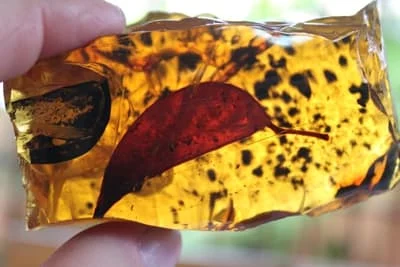
After a few days of rain, the most famous amber mines in the mountains north of Santiago were unfortunately inaccessible, and we couldn't visit them. But the amber and inclusions that we saw directly from the owners were, just like a year ago, incredibly interesting. Previously, Doug bought unique bird eggshell inclusions and the remains of a bird's wing there. This year, a leaf inclusion Hymenaea about 7 cm in length and an impressive piece of amber with a water inclusion, documented by a moving air bubble. The bird feather inclusion was so expensive that, despite its excellent state of preservation, it remained in the Dominican Republic. I only brought back photographs of these wonders of nature.
Most tourists visiting Santo Domingo pass through the Museum of Amber World (http://amberworldmuseum.com/). It was the biggest surprise of this trip for us as well, and not only because of the unique specimens of fossil resins of the world or larimaru, which is unique to the Dominican Republic. Run by Mr Jorge Caridad, the establishment is a private enterprise. The museum is a jewellery shop on the ground floor, offering visitors jewellery made of Dominican amber and larimaru. On the first floor, reached by a spiral staircase with an „amber” banister, there are truly impressive specimens of Dominican amber and equally interestingly displayed other fossil resins of the world, including Baltic amber. Attention is drawn to an impressive lump of Mexican amber donated by the President of Mexico.
But the most interesting thing is the building just around the corner from the World Amber Museum in Santo Domingo. Tourists and customers generally don't notice this. It is the building of the foundation run by Mr Caridad. Young, homeless boys straight from the streets are taken in to learn the trade of a jewellery technician. On the ground floor, 20 people learn the theory, and on the second floor, practical training takes place for 45 days. The project, partially funded by the Ministry of Labour, is nevertheless thanks to Jorge Caridad. The next class has just finished their training on Friday, 25 February 2011. In the world of amber, there are many people who have achieved financial success. However, I don't know many who share their fortune in such a humanitarian and effective way as Jorge Caridad (http://fundarte.org/). To me – in a sense – this is associated with the idea of the Amber-Maker of the Year award.
Amberif 2011 is coming soon – I invite everyone to the exhibition of photographs of me and Doug from our expedition to the Dominican Republic, as well as the specimens of fossil resins that we collected in the field. The exhibited specimens will be added to the collection of the Amber Department of the Museum of the Earth of the Polish Academy of Sciences in Warsaw.