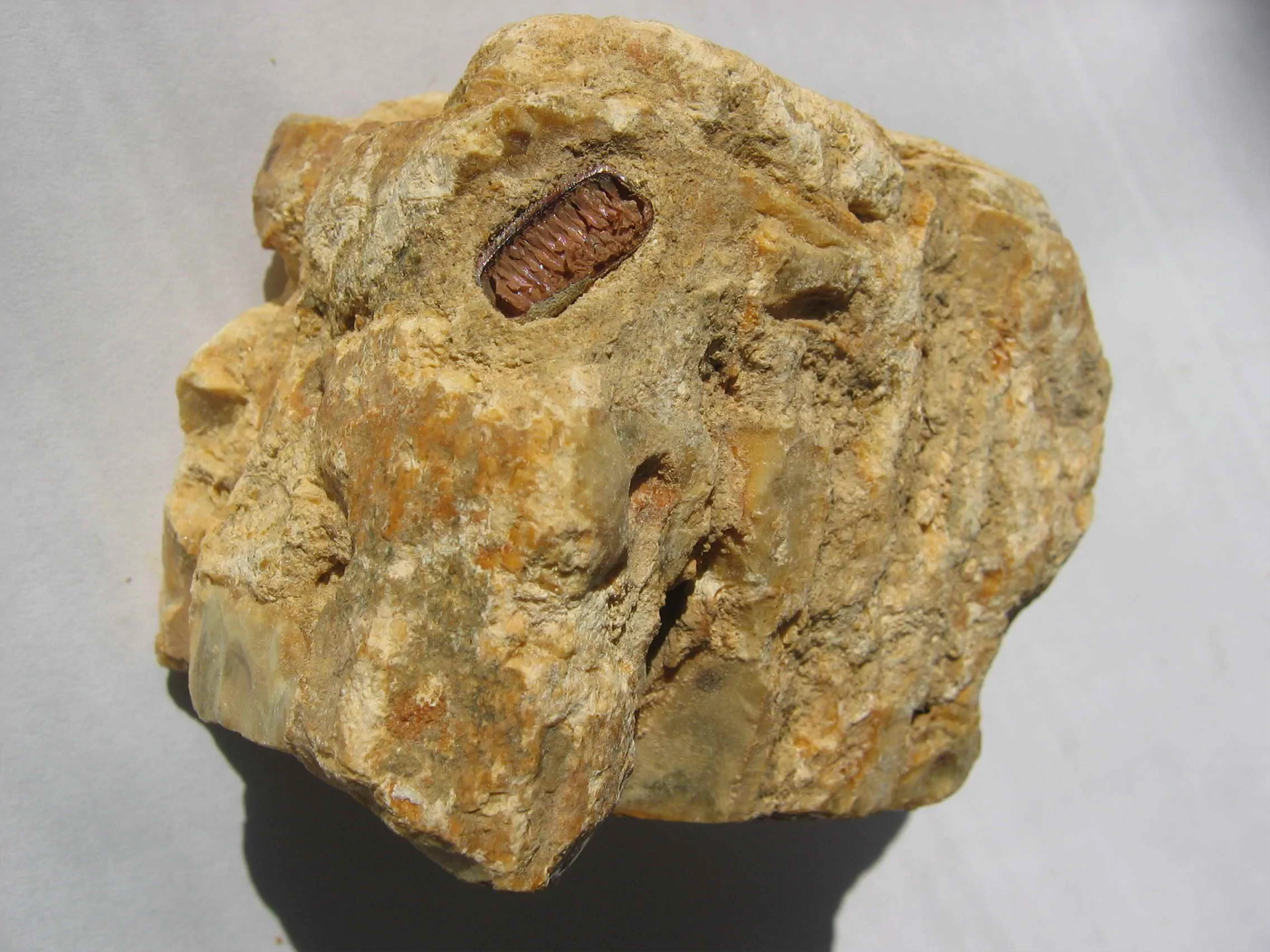
Useful fossilised resins, which in a broad sense include amber, do not include subfossil resins, commonly known as copals (although the Polish pronunciation of this name suggests a connection with digging), as this name actually derives from the indigenous term "copall," meaning tree sap. Hardened modern resins are also not considered fossilised.
Both copals and modern resins have long been used to make amber imitations, almost always surrogates for succinite, or Baltic amber – see overview of methods.
Since the beginning of the 21st century, when a shortage of natural Baltic amber emerged on the market, the mass production of its imitations from copal, using autoclaves (furnaces filled with inert gas under high pressure), has become widespread. Copal, repeatedly roasted at various temperatures and in a changing mixture of gases, becomes deceptively similar to thermally treated amber, both in appearance, smell, hardness, and resistance to solvents. This has led to attempts to introduce it to the market, primarily in the form of amber gemstone fakes. Copal after thermal modifications does not supplement the amber market but poses a threat due to consumer concerns about the authenticity of the real material. Products made from hardened copal peel on the surface after a dozen or so years (creating the so-called “dandruff effect”).
The criteria for the success of fossil fuels in the global market remain:
- Age and depositional conditions allowing for complete fossilisation
- the natural beauty of stone
- machining capabilities
- durability of finished products
- resource size in deposits, and above all, a significant scale of extraction.
The age limit separating fossil resins (in the broad sense of ambers) and peat is conventional, and is most often set at 1 million years. The age of resins practically usable in jewellery is much longer than this limit, generally exceeding tens of millions of years, and most often oscillating between 40 and 50 million years.
The qualitative characteristics of the resins were influenced by the presence of seawater in the early stages of fossilisation. The exceptionally good properties of succinite were due, among other things, to the transport of resin.
The Baltic beaches and coastal lagoons were the earliest source of raw material for local processing and long-distance trade, which contributed to succinite being named “Baltic amber”, although its formation is in fact linked to a completely different sea, 40 million years older.
Amber mining in various regions of the world
Fossil resins are found in all parts of the world, and their types and varieties number in the hundreds. Only a small fraction of this number are resins useful in processing. Even fewer are the places where deposits and accumulations are actually exploited.
Only the following are extracted on a large scale amber (Baltic amber) and Borneo amber.
In addition to these two resins, we present a few others that are appearing on the market in small quantities, or those like birmite, which was popular a century ago but has lost its significance. Products made from them, although rare, do appear on the market, so they cannot be entirely overlooked.
Bornean amber
This amber comes from the state of Sarawak in the northern, Malaysian part of the island. It is extracted in impressive quantities from two to five thousand tonnes per year incidentally, with the exploitation of brown coal mines. However, it does not yet play a significant role as a raw material for the production of jewellery stones, and as a material for artistic (sculptural) creation, it has only local importance. It is clearly inferior in beauty and workability to all other fossil resins currently used for similar purposes. Perhaps the role of Borneo amber on the market will grow rapidly as a result of the development of new enhancement technologies, analogous to those for copal. Janusz Fudala, who knows the issues of resins from the Sunda Islands and the Philippines from autopsy, presents this problem in more detail in a separate article on this portal.
Offers for amber from Borneo have appeared on the Polish market, though they are not particularly attractive in terms of price – 225 USD per 1 kg in batches of no less than 100 kg. The quality advantage of this offer is the large grain size (20–100 g per piece), whilst the disadvantage is the excessive proportion of dark pieces containing organic impurities.
Baltic amber (succinite)
The dominant, or rather almost exclusive, position in the supply of the global amber industry is held by Baltic amber, also known as succinite. Its market share has fluctuated over recent decades between 98 and 99% of total supplies for processing.
It is primarily extracted in open-pit mines on the west coast of Sambia (Kaliningrad Oblast of the Russian Federation, settlement of Yantarny) and in mines on the border of Volhynia and Polesia (Volyn and Rivne Oblasts of Ukraine).
Amber, as for millennia, is collected on sea beaches, particularly on the southern Baltic coast, and in significant quantities along the stretch from Gdańsk to Klaipėda. The practice of amber fishing from the sea in the coastal zone has decreased but not disappeared. However, Russian and Polish attempts to exploit the seabed of the Gulf of Gdańsk, using various methods from large floating units, were unsuccessful.
Certain quantities of Baltic amber are still obtained from post-glacial deposits in Poland and neighbouring countries, but only incidentally during agricultural and forestry work, and from mining other minerals (for example, in gravel pits and from spoil tips at lignite mines). There are no longer any mines operating on post-glacial amber deposits, as there were in the 19th century. The famous Amber Mountain, just outside Gdańsk, is a nature reserve. In the Narew forest, where 3,000 amber diggers went to work daily in the 1820s, amber is only sporadically and illegally dug up by folk artists from the Kurpie region.
Amber flushing in the Vistula Delta
Significant results were obtained from washing out amber using hydromonitors in the Vistula River delta. The largest amount (approximately 150 tonnes) was recovered in 1972, when 14 mining teams operated legally. In total, legal extraction between 1972 and 1989 yielded 416 tonnes of excellent raw material from fossil beaches, located on average 5 metres below the current ground level. Amber from the Vistula delta is characterised by its superb quality, as it underwent a natural purification process during its journey from the sea and currently lies in a preserving aquatic environment. Currently, 6-8 exploration and extraction concessions are being used for small private plots.
Unfortunately, most of the amber from the Vistula Delta is illegally extracted (around 600 tonnes were extracted between 1970 and 2006). This is due to complicated legal procedures and high fees for environmental use and land lease. This particularly affects the administrative area of the city of Gdańsk, where procedural difficulties and conflicts of interest between amber extraction and transport and industrial investments have prevented the legal development of well-known amber deposits for many years.
Amber - the primary source of succinic acid
Illegal mining and the theft of mined ore are also major problems in the Kaliningrad Oblast of the Russian Federation. This region has numerous deposits that are not currently being exploited industrially, with outcrops of the amber-bearing “blue earth” layer in coastal cliffs and vast areas where amber lies 2–3 metres below the surface. Many thousands of “poverty pits” have been dug in these areas. Extraction from these sites accounted for 25% of the mines’ output, whilst offering greater suitability for processing, as the diggers discarded the fine, unusable fractions of the raw material.
Until recently, two state-owned open-pit mines operated legally in Sambia, both on the same “Palmnikensky” deposit in the Yantarny settlement:
- “Beach” right on the seafront, shallow (up to 11 metres), very efficient and profitable, provided official annual yields in the 1990s ranging from 500 to 700 tonnes, despite a significant portion, including the largest nuggets, being stolen.;
- “Primorska”, 2 km from the seashore, deep (up to 60 metres) and inefficient but very extensive with an annual yield of 150 to 300 tonnes.
In the 1990s, a total of 600 to 850 tonnes of amber was delivered to the Yantarny combine's warehouse, with the pilfered and illegally extracted portion of the yield amounting to 100 to 250 tonnes. Overall, between 800 and 1100 tonnes of amber annually entered the market from Sambia during this period.
The collapse in supplies occurred after 2001, when the efficient “Plażowa” mine was flooded. Currently, only one mine, “Primorska,” is operational, and its supplies are six times smaller than during peak years. In 2005, 218 tonnes were extracted, and in 2006, only 133 tonnes. However, Sambia still remains the primary global source of amber raw material.
The growing importance of succinite extraction in Ukraine
The role of mining in Ukraine is growing, although state-owned open-cast mines, opened in 1993 on the border of Volhynia and Polesia, have not yet moved beyond the experimental phase. Their output is only 3 tonnes per year.
In this region, illegal mining has, however, developed rapidly. Its volume is estimated by various sources at 10 to 50 tonnes per year. The raw material from Volyn is characterised by favourable, large granulation, useful not only in jewellery making, but also in the creation of sculptures and decorative objects.
Until the end of 2006, the extraction and processing of amber in Ukraine constituted a state monopoly. In 2007, the Ukrainian government announced radical changes, primarily issuing concessions to private prospectors for several dozen sites with non-industrial amber deposits (small plots, small reserves). These deposits lie very shallowly in border areas of Polesia, in wetlands, and could be exploited using an efficient hydraulic method (as in the Vistula Delta).
A walking-type bucket-wheel excavator has been introduced to the state mine in Klesów, at the “Pugacz” deposit, which can multiply extraction results and improve the mine's economic performance.
Despite a severe supply shortage, Baltic amber still constitutes the lion's share of material available to the global amber industry. Around 140 tonnes of raw material per year comes from the mines in Sambia and Volhynia, about 55 tonnes from illegal washing and digging in Poland, Russia, and Ukraine, and about 5 tonnes from beach collecting and post-glacial deposits. Thus, in total. we have 200 tonnes of Baltic amber annually. How does this compare to the yield scale of other fossil resins?
Dominican amber
The eastern part of the island of Hispaniola (Haiti) within the Dominican Republic has long been known for hiding reserves of beautiful fossilised resin in its mountain ranges – the Cordilleras: Northern and Eastern (map). These are difficult to access, as the lumps of resin must be mined from steep mountain slopes in hard sandstone, rather than from loose sedimentary deposits like succinite in Central Europe.
There are no mines here in the industrial sense, but rather individual shafts, trenches, and adits scattered over large areas, carved by hand with pickaxes and chisels. The adits are sometimes long, narrow tunnels dug horizontally into the mountains, even up to 70 metres.
The prospectors, whose current numbers are estimated at 3,000, are obliged to sell all their findings to the landowners. They occasionally manage to obtain a few kilograms in a single day, but also spend weeks fruitlessly chipping away at the rock. It is therefore difficult to estimate the amount of total annual extraction. It is likely that, on an annual scale, one to two tonnes of raw material suitable for processing are managed to be extracted.
The processing must take place on-site, as the Dominican Republic's government banned the export of raw amber as far back as 1987. The range of products includes various ornaments: necklaces, bracelets, and pendants, as well as jewellery incorporating common and partly precious metals. Most products are sold locally. Export production is negligible.
Dominican amber is considerably more difficult to work with than succinite: it sticks when sawn dry and when ground at high speeds of the grinding wheel. Vigorous polishing causes it to “pull” and crackle beneath the surface. However, individuals with appropriate experience manage to master the techniques of grinding, carving, and polishing, although the surface shine of the items remains less impressive than in Baltic amber products.
In terms of transparency, amber from the Dominican Republic has a clear advantage over succinite from mines, where opaque, waxy varieties predominate. In the Dominican Republic, the raw material is transparent. Consequently, thermal clarification technology – which destroys the richness of the varieties – has not become widespread there. Whilst the golden colour saturation of the nuggets is usually much weaker, with a lemon-like hue, it is generally preserved in its natural state in the finished products. There are also crystals with intense colouring: ranging from orange and honey-coloured to red.
The most sought-after, distinctive, and prized variety is Baltic amber with a natural blue fluorescence. Finished products retain this ability for a relatively long time, although – like products made from all other varieties of Dominican amber – they tend to develop a network of cracks on their polished surface after about 10 years, which impairs the effectiveness of the fluorescence phenomenon. In the 1998 volume “Dominican amber and its inklusions”, local collector Rafael Jie Chang Wu estimates the monthly output of finished products with blue fluorescence at approximately 2.5 kg, which is about 30 kg annually.
Jewellery stones made of Dominican amber reaching the world market are currently significantly more expensive than those made of Baltic amber. This applies not only to those with fluorescence, but also to thermally treated stones. The price per gram in Europe is over 20 euros, compared to 2-3 euros for succinite stones.
Mexican amber
Mexican amber originates from the southernmost state of Mexico, Chiapas. This is an area inhabited by indigenous people who, to a certain extent, cultivate ancient Mayan traditions. Mining is carried out by the local population, who do not allow outsiders to access the amber deposits, considering it a gift from the gods belonging only to them. The scale of extraction is completely unknown. The mining methods are identical to those used in the Dominican Republic, as the amber in Chiapas is found in similar geological conditions.
The local products are not exported, and raw specimens are only shipped out occasionally. Large lumps, even weighing up to 2 kg each, mostly reach Europe. Their price is about twice as high as that of identical pieces of succinite, reaching up to €5 per gram for lumps over 1,000g.
The properties of Mexican amber are almost identical to Dominican amber, with the difference being that its colour range is darker. It's true that it starts similarly to Dominican amber with light yellow and light greenish hues, but it has a large proportion of red, and even crimson, lumps with a characteristic greenish fluorescence. Red varieties likely resulted from heating within rocks in geologically active volcanic and seismic areas.
Birmit – amber from Burma
Birmit, originating from northern Burma and neighbouring countries, has long been a popular artistic material in China. Following the British colonisation of Burma, burmite products also reached Europe, though not in significant quantities. As they were made from a previously unknown material, they aroused scientific interest. As early as the 1810s and 1820s, T.D.A. Cockerell wrote a series of papers on Burmese amber nodules, which were later donated to the Natural History Museum in London. The largest piece of burmite in the museum's collection was purchased in 1860 in Canton (now Guangzhou) in China.
Birmite is a chalky resin, very old, dating back about 100 million years. Its processing properties and visual qualities are clearly inferior to succinite. Nevertheless, in the early 20th century, birmite was mined and processed on a fairly large scale, mainly for use as sculptural material (approx. 40 tonnes). However, it was quickly displaced by succinite supplies to Asia from the Königsberg company “Stantien & Becker”. Therefore, even cult sculptures, for example, Buddha statues from a hundred years ago, are most often made of Baltic amber. Today, the sale of birmite sculptures must be certified by an individual expert report, even when stylistic features and content indicate Burmese origin. There is no information on current birmite mining and processing, and thus on prices.
Symetite – Sicilian amber
Smytyt has been around since antiquity and has always been highly valued. In the 16th and 17th centuries, its price was considered equal to that of diamonds. It originates from deposits in the centre of Sicily, from where it is washed down by mountain rivers, particularly the Simeto, which flows into the sea on the east coast of Sicily near Catania. For a long time, it was collected after heavy downpours on the banks of this river, especially on the spit of land at its mouth. However, the collection of smytyt was negligible and never met the needs of even wealthy collectors.
Sicilian ornament makers imported succinite, which is known to be preparable into the characteristic Falernian wine-red colour of symetite.
Simetite has excellent working properties and a beauty second to none of succinite, and items made from it are durable. Unfortunately, it is only found in a few museums. In a few varieties of simetite, fluorescence occurs, which disappears after a period of exposure of specimens and items, and as a result, this resin becomes similar to succinite.
In Poland, for 40 post-war years, “Desa” shops sold necklaces of a characteristic cherry colour, claiming they were made of Sicilian amber, but in reality they were made of a substitute called galalith. This practice has not entirely died out yet.
Japanese amber
This amber is found on all the main islands of Japan, from Hokkaido in the north to Kyushu in the south, across a distance of over 2,800 km. For a long time, the main, and now the sole, source of extraction has been the mine in Kuji on the Pacific coast in the north-eastern part of Honshu island.
In 1937 and 1938, 13 tonnes of amber were mined in Kudzie. From the interwar period, two large pieces have survived: weighing 19.875 kg and 16 kg. Records exist of the mining of enormous pieces weighing 45 kg and 60 kg in 1905, but the pieces themselves have been lost.
The colour range of Japanese amber includes numerous varieties from green to black. There are also striped varieties, similar to agate. Japanese amber emits a specific smell, similar to camphor. For centuries, it has been, and still is, used to create ornaments for clothing and the body, as well as cult objects.
Japan is currently one of the few countries where amber is processed on an industrial scale, a sector dominated by the joint-stock company Belouna. For economic reasons (the high cost of rock excavation), the company has significantly curtailed mining operations on the slopes of Mount Kudzi. It uses all the raw material from this source for its own processing and does not offer it for export. Local amber meets only 10% of Belouna’s processing requirements, whilst the company’s actual operations rely on supplies of succinite from the mine in Jantarny on Sambia, amounting to 2–3 tonnes per year.
Japanese products made from succinite and amber from Kuji are sold almost exclusively on the domestic market and are tailored to it in terms of function and design. The only foreign sales location is a gallery in the Catherine Palace in Tsarskoye Selo, on a reciprocal basis for the supply of raw materials from Russia.
Cedaryt
Cedaryt is one of the older fossilised resins, but it is completely new to the market. Until recently, it was described as unsuitable for processing. In fact, its susceptibility to various methods of working (sawing, grinding, milling, turning, and polishing) is equal to that of succinite. A disadvantage is the fine grain size of the nuggets and fragments collected on the shores of lakes and rivers in the Canadian province of Manitoba and the US state of Winnipeg. There is no mining of underground deposits yet, and due to the low supply, cedaryt does not yet have market significance or a generally accepted price. However, it is a material of the future. It owes its name to its occurrence near Cedar Lake in Manitoba.
Useful fossil resins of little-known or local significance
Besides the fossil resins presented above, there is a whole range of others which are also used in jewellery or artistic production. Today, in the era of the common practice of roasting succinite from mines in order to clarify and standardise the material for processing, undescribed resins accompanying succinite in deposits are sent to autoclaves, primarily: succino-gedanite, gedanite, glessite and others. As a result, they do not have a separate position in commodity science. However, it is worth being aware that their scientific value is considerable and deserves appropriate sensitivity when selecting mined material, as well as when qualifying it for processing operations, especially roasting in autoclaves which causes irreversible changes.
In today's market, no articles made from rumenit are offered, although just a hundred years ago this beautiful fossil resin, found not only in the southern part of the Carpathians (processed into ornaments in several regions of Romania), was quite fashionable. Rumenit occurs in many distant locations, for example in Azerbaijan and Sakhalin, and has a chance of returning to favour with consumers one day. Similarly, other interesting and currently neglected fossil resins have a chance.