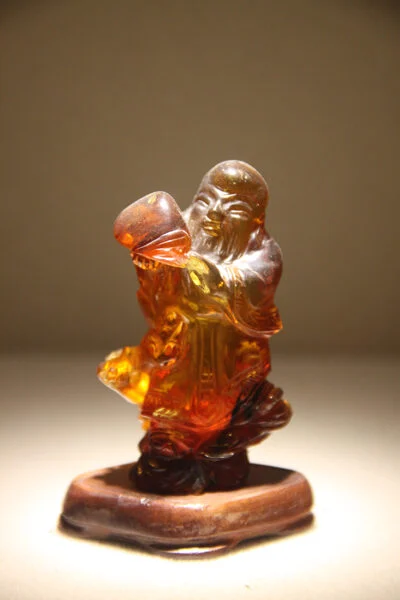
This resin, now known as Japanese amber, had characteristics somewhat similar to succinite (Baltic amber) in terms of workability, although it required considerably greater care during all operations, especially polishing, due to a “stretching” effect. Only a small proportion of the samples possessed a beauty akin to prized varieties. transparent and golden Baltic amber. The predominant variety Opaque dark orange, and a significant part of it is brownish lumps with characteristic small spots.
At that time, I had no opportunity to familiarise myself with products made from this resin, nor with information about the scale of its occurrence, or traditions of its use in its country of origin. It was only the exhibition presented by the Japanese in the summer of 2006 at the Kaliningrad Amber Museum and its accompanying catalogue that allowed me to appreciate the significance of Japanese amber in the economy and culture.
This amber is found in many locations, on all the main islands of Japan, from Hokkaido in the north to Kyushu in the south, over a distance of more than 2,800 km. The main, and currently the only, source of extraction has long been the mine in Fuji. Extraction has been carried out here since the 6th century, and at certain periods it was on an impressive scale. For example, in 1703, as much as 1,296 kg of amber from Fuji was brought to the city of Kyoto alone, and considerably larger deliveries were sent to nearby Edo (now the capital – Tokyo).
In 1937 and 1938, 13 tonnes of amber were extracted in Fudżi. Two large lumps from the inter-war period have survived:
– in private collections weighing 19.875 kg and measuring 40 x 40 x 25 cm, excavated in 1927
at the National Museum of Science in Tokyo, weighing 16 kg and measuring 40 x 23 x 23 cm, excavated in 1941, just before the outbreak of war with the USA.
Records have been preserved of the extraction in 1905 of enormous lumps weighing 45 kg and 60 kg, but the lumps themselves have been lost.
The colour range of Japanese amber corresponds to the description of the samples I provided in the introduction, and furthermore contains numerous specimens in green shade to black. Striped varieties similar to agate also occur.
The author of an article on the origin and properties of Japanese amber in the catalogue of the Kaliningrad exhibition, KAZUHISA SASAKI, states that the parent tree of Japanese amber must have had very specific properties. Bubbles containing camphor have been preserved in the fossilised resin, which burst when heated to 330°C, releasing an exceptionally strong scent.
Fuji amber is found on the slopes of the mountain to a depth of about 600 metres, in rocks of various ages. Most of it dates from the Cretaceous period (80 million years ago), with the remainder from the Oligocene (30 million years ago). It is extracted from sandstone and quartz. Most pieces are cracked due to seismic vibrations and high pressure at significant depths. Often, quartz crystals are embedded in the cracks, formed from liquid that flowed into the cracks and crystallised within them, creating characteristic spatial structures. Fuji amber with quartz content naturally has a much higher density than Baltic amber, although purely resinous pieces have a density within the same range.
For centuries, Japanese amber has been used to create ornaments for clothing and the body, as well as ritual objects. At an exhibition in Kaliningrad, a modern replica of a cushion from a princely tomb, dating back to the 6th century AD, was shown. It was horseshoe-shaped and made, similar to the original in Tokyo's collections, from greenish Fuji amber. The other exhibits by contemporary Japanese artists at the Kaliningrad exhibition were made of Baltic amber.
Teruhisa Takaba and Takajuki Makita, members of the management team at BEOLUNA TOKYO plc, who estimate their company’s dominant share of the Japanese amber processing and trading market at 90%, describe the post-war process by which Baltic amber displaced domestic amber as follows: “War damage affected the mine on the slopes of Mount Fuji and the processing plant at its base. Japan’s catastrophic economic situation in the first post-war decades diverted public attention away from luxury goods, contributing to the neglect of efforts to revive earlier amber traditions.”.
The impetus for their resumption was the Washington Convention prohibiting the use of “Hawks Bill” sea turtle shells for the production of tortoiseshell goods, in which Nagasaki Bekko, the legal predecessor of BEOLUNA, specialised. The techniques of processing and the traditions of intricate tortoiseshell design were to be transferred to amber.
At that time, around 1980, the Japanese market was already familiar with Baltic amber products, imported from Poland, the GDR, and the USSR. The Japanese were aware of the qualitative superiority of succinite, both in terms of the material's beauty and its technological advantages, over local raw materials. This was supplemented by an economic factor: the low price, as well as the abundance and regularity of supplies from the Kaliningrad Amber Combine. Therefore, they did not return to Fuji amber (apart from experimental work), but the traditional shield-setting design was transferred to Baltic amber. However, until 1980, certain manufacturing techniques were kept secret, including maki-e technique (makie) consisting of shallowly carving the surface of items and creating images using “urushi” lacquer.
However, for the most part, the amber processing techniques are identical to those used by the Poles and Russians, who, moreover, worked in Japan as instructors for many years.
The design, however, is different and specific to Japan. Although it is adapted not only for the embellishment of traditional kimonos but also for European attire, the ornamentation and symbolism are original. Decorative and cult objects play a significant role in production, such as symbolic Pagoda models.
A further note regarding the assessment of BEOLUNA's management – it appears their market share is not as dominant as could be perceived. Many Polish and Lithuanian companies have already secured a good slice of this pie. This is not only due to systematic participation in trade fairs (Osaka and Tokyo) but also the continuous penetration of our manufacturers by Japanese buyers from galleries and retail chains.