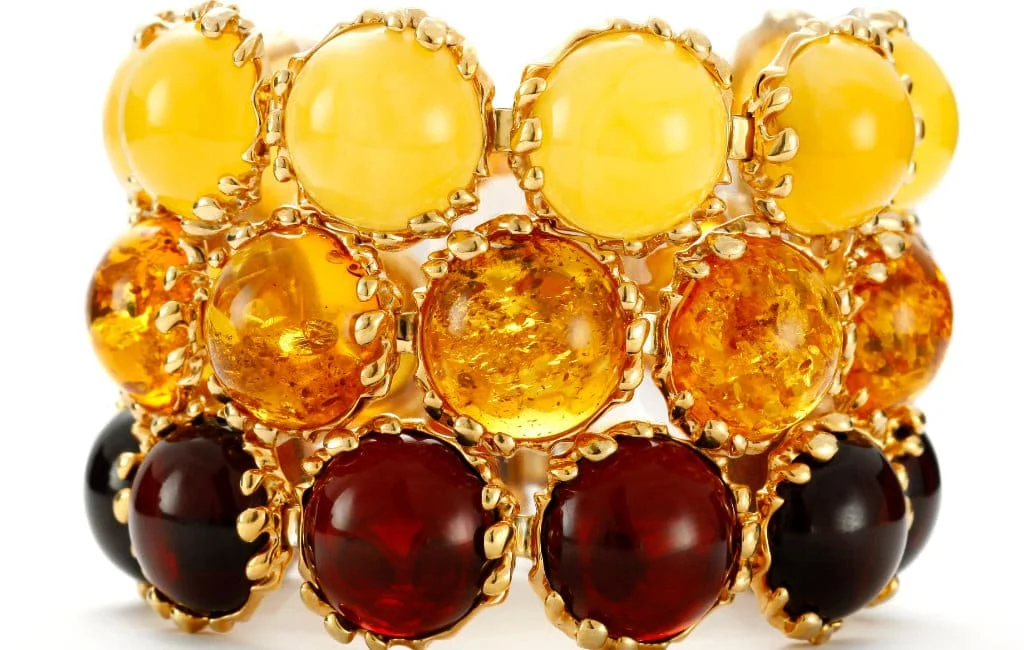
We have a cognac colour hard-wired in our minds as the one characteristic of amber, but these colours can be much more varied. „Manufacturers of Baltic gold products make every effort to satisfy the tastes of all customers, hence their offer includes a rich range of shades of natural lumps, but also many colours of enhanced amber,” explains Karolina Drąg from the Amber Museum in Kraków. How to tell them apart?
Natural colours
Baltic amber is characterised by a wealth of varieties. This means a wide diversity in both the degree of transparency of the amber and its colour – ranging from white through shades of yellow to bluish, greenish and brown. The most valued variety is the white one, as it occurs least frequently. Milky and yellow varieties are also in demand – this is linked not only to their rarity, but also to great interest from customers in the Middle Kingdom. Natural varieties with a bluish, greenish, reddish or even black tint are also very-rare – these are true rarities for collectors, which is why they are rather difficult to find in jewellery products.
What does the colour of amber depend on?
The colours of amber and the degree of transparency of the pieces depend on the size of gas bubbles, the formation of which was associated with the release of volatile components from fresh resin during the hardening process. The greater the number of bubbles per 1 mm3 of surface area, the whiter the amber is. Colour is also hugely influenced by the conditions in which the amber resided and the type of organic remains that entered its interior during the resin hardening process, as well as the effects of their partial decomposition.
It is worth noting that one of the characteristics of amber is its colour instability: over time, under the influence of weather conditions, the stone darkens. This is precisely why the outer layer of the lump gradually becomes darker, sometimes even cracked or more brittle.
Read also: Baltic amber varieties
Colours enhanced
„Changing the colour of stones to improve their aesthetic qualities is already standard practice. It is also standard to inform the customer about the types of modification the stone has undergone – we should look for this on the label or the certificate attached to the item” – translated by Karolina Drąg. Pressed amber should be cheaper, but in practice – especially when it comes to low-grammage items – it is often offered at prices similar to natural amber.
The most common amber colours obtained through modification processes are: lemon, cognac, green and cherry. Stones of lesser beauty are subjected to high temperature and pressure – as a result of the changing physical properties, they colour to a lemon shade. To obtain a cognac colour, the temperature must be increased, and to obtain a cherry colour – increased even further.
Read also: Cherry, cognac or lemon? In the shell or without?
Green amber, on the other hand, is obtained in two ways: either by stronger firing and grinding down the top layer while leaving the bottom of the stone, or by painting the bottom of the stone with a dark varnish.
A common procedure aimed at improving the appearance of the stone is the use of so-called scales, which are internal fractures created by heating the stones to a high temperature and then suddenly cooling them.
Read also: The true story of green amber
The colour palette of treated amber has recently been expanded by red – a shade obtained through the action of temperature and chemicals.
Which colour should we choose? One that we like – as long as it's a conscious choice!
The article was written in cooperation with The Amber Museum in Cracow