11. OTHER MINERALS
11.1. AMBER
11.1.1. Introduction
Amber concentrations in the area of Poland occur in a dual stratigraphic position:
- as Upper Paleogene amber-bearing formations in the position in situ, in the coastal zone of an epicontinental Eocene sea,
– as deposits redeposited within Quaternary deposits.
Eocene amber-bearing formations occur under quite thick overburden on the western edge of the Gulf of Gdańsk and in the northern Lublin region. Quaternary amber deposits were formed as a result of the destruction and sometimes repeated redeposition of Paleogene amber-bearing formations, especially the Sambia-Chłapowo deposits found along the edge of the Gulf of Gdańsk. In Pleistocene sediments, amber is mainly found in fluvioglacial zones of outwash plains. Holocene amber accumulations are associated with fossil beaches of the Litorina Sea and with certain sections of contemporary Baltic beaches.
11.1.2. Balancing criteria
Under the current balance criteria according to the Regulation of the Minister of the Environment on the criteria for balance of mineral deposits (Journal of Laws of 2001, No. 153, item 1774, as amended), two requirements have been set for amber deposits: maximum documentation depth and minimum amber content in sediment (Table 11.1.1).
Table 11.1.1. Amber Deposit Balance Criteria
|
Parameter |
Unit |
Marginal utility |
|
Maximum depth of documentation |
m |
30 |
|
Minimum amber content |
g/m² |
80 (40*) |
off-balance sheet assets
11.1.3. Status of documented deposit recognition
The documented amber resources total 29.7 tonnes and are found in three deposits in the Pomeranian Voivodeship (Table 11.1.2.).
11.1.4. Forecast and outlook areas and resources
The amber resource reserve consists of calculated prognostic resources, prospective areas, and hypothetical ones, the distribution of which can be approximately estimated based on lithological and facial premises. The definition of such resources is met by two groups differentiated by the stratigraphic position of the parent rock and the lithological-facial characteristics of the mineral accumulations (Tables 11.1.2 and 11.1.3):
prognostic resources in situ in Eocene works,
– prognostic and prospective resources redeposited in Quaternary sediments.
Table 11.1.2. Areas and predictive resources of amber in Eocene and Quaternary deposits
|
Voivodeship |
Predictive area |
Field name |
Resources (t) |
|
Eocene resources | |||
|
Pomeranian |
The Kashubian Coast |
Swarzewo Meadow, Hel Peninsula |
643 820 |
|
Pomeranian |
Słowiński Coast |
Okolice złoża Możdżanowo |
20 |
|
Lublin Voivodeship |
northern Lublin Voivodeship |
area around the Górka deposit Lubartowska with its deposit |
56 504 |
|
Resources in Quaternary deposits | |||
|
Pomeranian |
The Kashubian Coast |
Borek |
23 |
|
Pomeranian |
Vistula Delta |
Stegna |
1,4 |
|
Pomeranian |
Vistula Delta |
Sztutowo – Field I |
10,3 |
|
Pomeranian |
Vistula Delta |
Sztutowo – plot II |
8,9 |
|
Pomeranian |
Kashubian Lake District |
Smołdzino |
0,6 |
|
Together |
44,2 | ||
|
Overall |
700 388,2 |
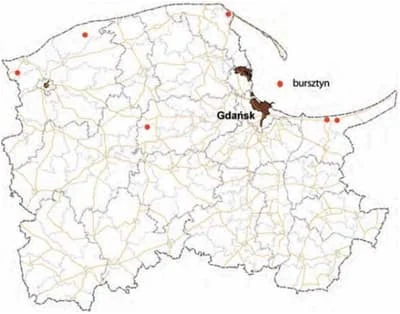
The most promising area is the Vistula delta and nearby sectors of the Baltic Sea floor.
Positive results of amber prospecting were also obtained in other areas of the Baltic coast (Table 11.1.3).
Table. 11.1.3. Amber Prospect Areas
|
Voivodeship |
Perspective area |
Location |
|
Pomeranian |
Vistula Lagoon |
Jantar |
|
Pomeranian |
Vistula Spit |
Krynica Morska |
|
Pomeranian |
The Kashubian Coast |
Ostrowo |
|
Pomeranian |
Słowiński Coast |
The northern part of the Lake Żarnowiec trough |
|
Pomeranian |
Kashubian Coast (Gdańsk city area) |
Jelitkowo–Brzeźno
|
|
Pomeranian |
The Kashubian Coast |
Różyny, Kleszczewko, Warcz, Smęgorzyno, Lipce |
In addition, occurrences of amber, which may indicate the existence of resource potential (prospective resources), are known at the following locations:
– southwest of the town of Lidzbark Warmiński (Warmian-Masurian Voivodeship),
– in the vicinity of Kajkowo, on the northwestern slope of the Morliny lake basin, south of Ostróda (Warmian-Masurian Voivodeship),
– in the area of Zielnowo near Grudziądz (Pomeranian Voivodeship),
– in the vicinity of Góra Puławska, near Puławy (Lublin Voivodeship).
The size of the estimated prospective resources will probably not be confirmed in the documented deposits due to the depth of amber occurrence in the Pomorskie Voivodeship (Table 11.1.4).
Table 11.1.4. Amber resources as of 31.12.2009.
|
Voivodeship |
Number of deposits
|
Balance sheet assets (t)
|
Number of deposits
|
Forecast resources (t)
|
|
Pomeranian |
3 |
29,7 |
7 |
643 884,2 |
|
Lublin Voivodeship |
– |
– |
2 |
56 504,0 |
|
Together |
3 |
29,7 |
9 |
700 388,2 |
11.1.5. Recommendations for further work
In the case of amber found in situ In Paleogene deposits, the application of standard methods for mineral deposit documentation yields satisfactory results. The situation is different for amber found in Quaternary sediments, where amber may be exploited during the deposit documentation phase or become the subject of illegal exploitation immediately after documentation, during the period preceding the issuance of an exploitation concession. To improve the presented situation, two potential formal and legal courses of action can be suggested:
– permitting the award of comprehensive concessions for research and exploitation of a deposit,
– preparation of simplified geological documentation based on an estimation of the volume of amber-bearing sediment and the yield in the region, expressed as a percentage of positive excavations out of the total number of geological excavations in the broadly defined deposit area.
11.1.6. Barriers and limitations
The development potential of prospective amber resources is limited by external factors, which can be conventionally divided into four groups:
– limitations caused by geological and mining conditions affecting the cost of raw material acquisition,
– limitations related to the need for natural environmental protection,
– limitations caused by conflict with infrastructure on the deposit sites,
– limitations caused by regulations concerning the documentation of amber resources.
11.1.7. Conclusions
1. Only a very small portion of Poland's amber resources has been formally documented.
2. The search for amber accumulations should be conditioned by paleogeographical (short distance from the Eocene sea coast) and facial prerequisites. Paleogeographical prerequisites therefore limit the search area to the Pomerania and eastern Poland regions, and the application of facial prerequisites allows for the selection of prospective areas within these regions. The methodology discussed above was successfully applied during the study of sediments of the amber-bearing association in northern Lublin Voivodeship.
Source: Polish Geological Institute – National Research Institute, www.pgi.gov.pl