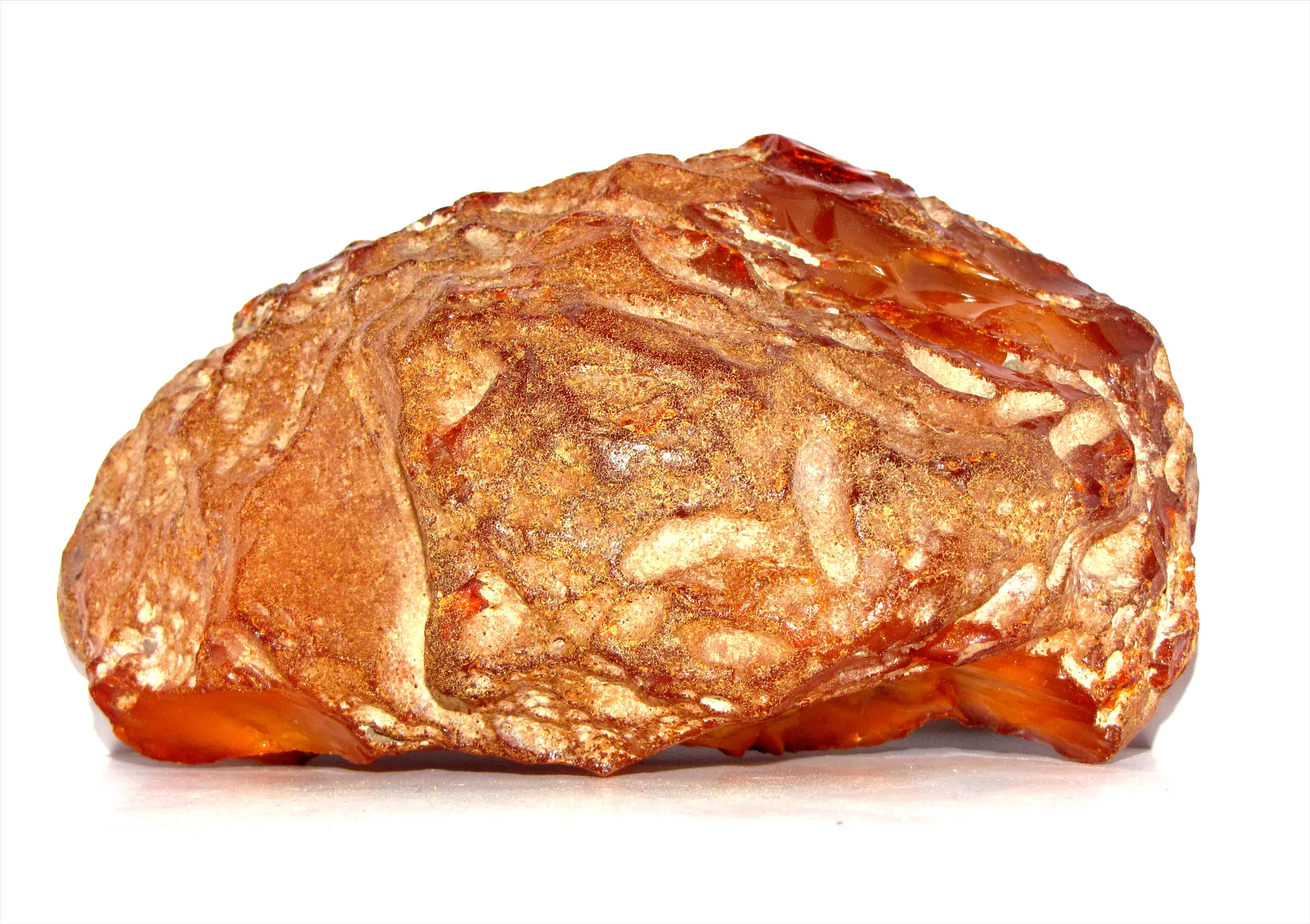
- Naming and terms for Baltic amber (succinite) gemstones
- Classification of Baltic amber raw material and semi-finished products
- Classification of fossil resins
- Classification of Baltic amber imitations
Classification of amber gemstones
The Board of the International Amber Association, at a meeting on 5 September 2014, introduced changes to the hitherto valid Classification of Amber (succinite) Gemstones.
MSB in Gdańsk has established and applies the following classification of amber gemstones to companies it recommends, which also applies to finished amber products.
Baltic amber (succinite) natural:
Stone subjected only to mechanical processing (e.g. grinding, cutting, turning, polishing) without any alteration of its natural properties.

Modified Baltic amber (succinite):
A stone subjected to thermal or pressure treatment causing a change in physical properties, such as degree of transparency and colour.

Baltic amber (succinite) connected:
Stone consisting of two or more pieces of natural, modified or reconstructed Baltic amber bonded with the smallest possible amount of colourless bonding agent necessary to join the fragments.

Baltic amber (succinite) reconstituted (pressed):
stone obtained from one or more pieces of Baltic amber compressed under elevated temperature and high pressure without additional components.
The following abbreviations may be used in the description of the applied stone modifications:
N – bez modyfikacji
H – ogrzewanie
HPHT – wysokie ciśnienie i wysoka temperatura
International jewellery and gemological organisations recommend fully informing clients about stone modifications that have been carried out.
Classification of raw Baltic amber (succinite) and semi-finished products
Source deposit:
- Baltic amber (including from fossil beaches)
- amber from glacial deposits
- Baltic amber (from Sambian deposits)
- Amber from Ukraine (Ukrainian amber)
- eisenach amber (Saxon amber)

Raw material forms
- plump
- platelet
- drops, icicles
- irregular

Construction
- Solid, massive
- layered

Transparency
- Transparent
- translucent
- Opaque

Organic pollution
- Pure
- with minor inclusions
- polluted, porous
Prefabricated raw material
- Idle
- pellets cleaned in mills
- sandblasted
- after heat treatment (roasted) in bulk solids and liquids
- in autoclaves
- whole lumps of amber pressed into the shape of cabochons, beads and other forms
Pressed semi-finished products
- Amber plates and rods of uniform structure, without binder, transparent, bright
- Pressed amber plates and rods with a uniform structure, matt and opaque
- Amber blanks, uniform, with added pigment
- Amber castings with traces of grain contact or streaks of red weathering
- Amber slabs and rolls of non-uniform structure with the addition of a binder – pure amber meal
Classification of fossil resins
Fossil resins known by the name amber (in the broader sense: as fossil resin, not as succinite) and a prefix indicating their region of origin.
These are the types of amber available on the market: Dominican amber, Mexican amber and Borneo amber, the succinic acid content of which ranges from 0 to 3%. There are also many other fossil resins of collector’s and scientific interest.
Fossil resins that have proper names given by the researcher who created the type for that kind of resin, and who first published its properties. These include, found on the market for finished goods: birmite, rumenite, symetite. Also many other fossil resins of collector and scientific importance.
Fossil resins accompanying Baltic amber in deposits:
1. Gedano-succinite can only be defined in laboratory studies. In processing, it hardly differs from succinite at all. However, we distinguish so-called associated resins of succinite deposits, some of which are quite easily distinguishable from Baltic amber.;
2. yellow, transparent gedanite with typical white weathering rind;
3. exceptionally rare, black stantienite that takes a very good polish (“black amber” appearing on the market is obtained either by pressing or by discolouring in an autoclave: confused with jet);

4. other “soft” and “hard” black resins occurring in slightly larger quantities in the deposit at Bitterfeld, differing from stantienite in hardness;
5. Glessite, in its various colour variations, polishes well, occurring more frequently in amber deposits in Lusatia and the Bitterfeld area;
6. zygburgite – natural polystyrene, also known from Germany, dirty white in colour;


Classification of amber imitations (succinite)
Imitations of Baltic amber (succinite) are raw materials, semi-finished products, or finished goods made from substitute, usually cheaper, material that resembles amber in appearance but has different chemical and physical properties. These include:

natural or modified subfossil resins, for example Colombian copal, New Zealand kauri copal;
2. plastics: glass, celluloid, polyesters, phenolic resins and others;
3. Baltic amber (succinite) pressed with plastic masses or copal;
4. Baltic amber (succinite) fragments encased in natural and artificial resins;