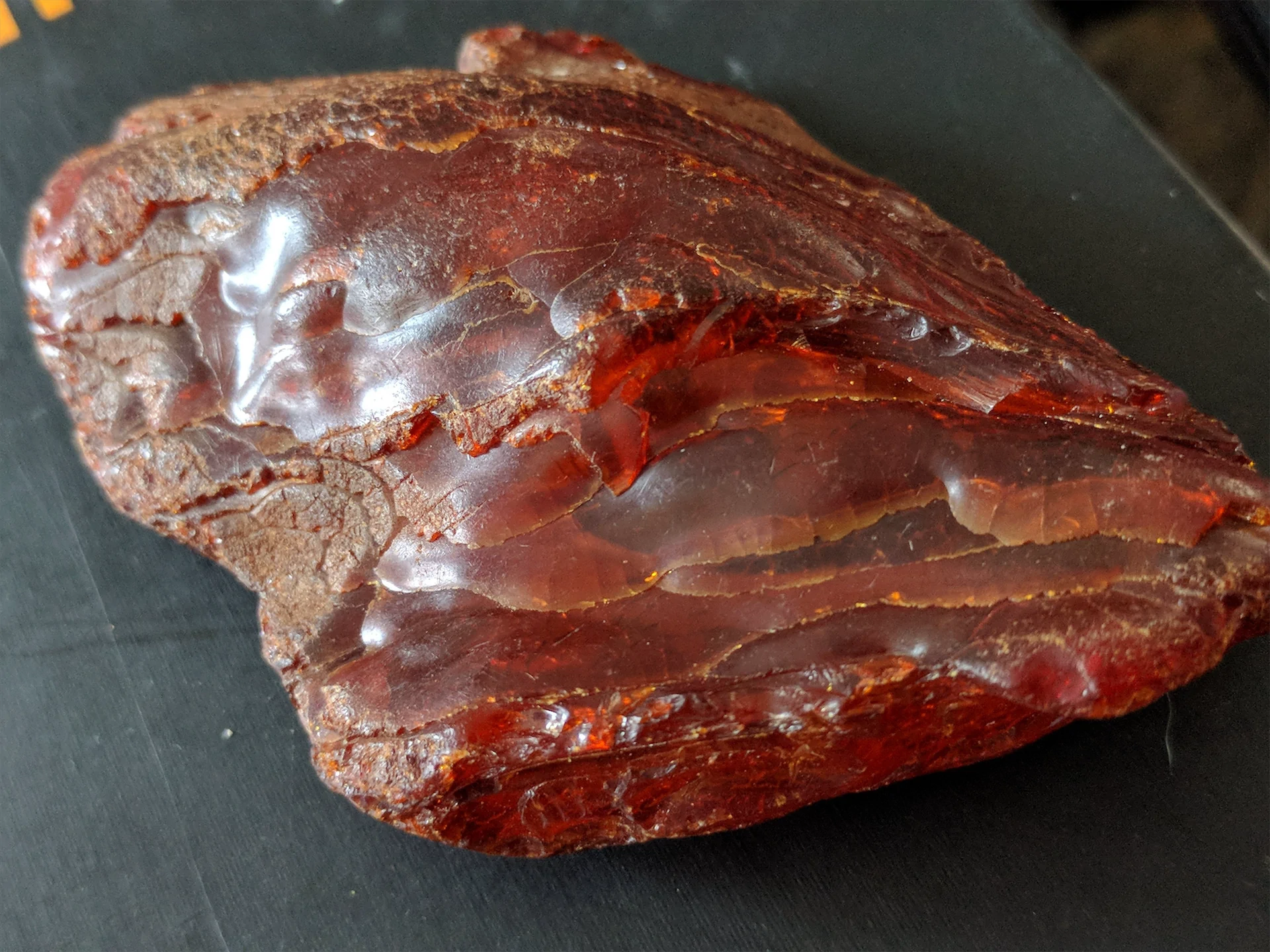
If the planned reform succeeds, it will impact the development of local jewellery making and reduce the flow of raw material smuggling into Poland, which Polish amber prospectors will undoubtedly feel the effects of.
Although the Gdańsk jewellery industry largely relies on supplies of Ukrainian amber, the Ukrainian monopolist on the amber market is experiencing serious difficulties due to a... lack of raw material. Illegal mining, smuggling, and, above all, regulations unsuited to the current realities are the main reasons for the problems in the amber industry in our neighbouring country. However, this may soon change, as liberalisation of amber extraction and trade is slowly progressing under pressure from local authorities in Polissia. If the Ukrainian reform is successful, it will influence the development of the jewellery sector there and reduce the flow of smuggled raw material into Poland, which Polish amber artisans will undoubtedly feel.
The beginnings of illegal mining
The history of illegal amber mining began around the mid-1980s. The Soviet Union was on the verge of collapse, and the era of Gorbachev's „perestroika” (restructuring) facilitated the emergence of semi-legal private enterprise, particularly in the Baltic republics. During this time, enterprising Lithuanians began arriving in the Polesia region, offering to buy raw amber almost on the spot, for hard currency, which was scarce at the time. It is not surprising that illegal mines sprang up like mushrooms after rain in such circumstances, and private amber mining became a quite good way to shore up a crisis-stricken budget, especially during the difficult transformation years (1990-1998).
Industrial amber mining only began in the 1990s, after Ukraine gained independence. Previously, the Soviet authorities did not care about Ukrainian amber because, compared to the vast output in the Kaliningrad Oblast, the deposits in Polesia were of little importance. In 1993, the state-owned enterprise Ukrburshtyn was established, receiving a monopoly on the extraction, processing, and trade of this valuable raw material. In addition to open-cast mines, the company also engaged in, among other things, the production of jewellery and other amber products, as well as the manufacture of tinctures and amber acid. Politicians at the time presented a vision of a prosperous Polesia, which was supposed to become a land of milk and honey thanks to amber. However, this did not happen, and the complex, launched at a cost of tens of millions of dollars, began to incur losses, fell into debt, and eventually went bankrupt, only to operate under a new name, Amber of Ukraine, after restructuring. One of the reasons for the troubles was, among other things, a failed investment in an amber acid production line, which nobody wanted to buy. What's more, problems arose with... a shortage of raw materials, which might be surprising given that the amber industry in Gdańsk relies significantly on Ukrainian amber. According to the management of the amber complex, its own extraction covers only a quarter of its needs, and the complex has to import the rest of the raw material... from Russia.
„Masterful craftsmanship”
However, the state-owned complex's biggest problem is the difficult-to-curb illegal mining. It is obvious that a state-owned company has difficulty competing with illegal diggers who do not bear the costs of administration, land reclamation, or taxes. „Staratele” – which is what Ukrainian amber poachers are called – initially extracted „Polesie gold” with shovels, digging down to groundwater. In the mid-1990s, a Polish patent arrived in Ukraine – motor pumps. This method of raw material extraction proved to be excellent in Ukrainian conditions – Polesie is a water-rich region, so it is always possible to connect to a nearby lake, river, or, in extreme cases, a ditch or swamp.
The prevalence of illegal amber mining is due to several factors. Firstly, amber is found quite shallow, at a depth of 3-5 m, and the sand or clay above the amber-bearing deposits is easy to wash away or dig up. Furthermore, Polesie is a sparsely populated region, full of wild forest areas, which are difficult to control. The low penalties for illegal mining and the ease of selling the raw material to intermediaries mean that the authorities„ fight against ”starać" (scrapers) has so far been doomed to failure.
Combating illegal activities
Interestingly, to patrol the area in search of diggers, Ukrainians use not only militia units but also well-equipped special units „Sokół” and „Berkut” (equivalent to our BOR and GROM). However, a well-organised „starać” brigade easily avoids contact with law enforcement officers. At the entrance to the forest, there is usually a „guard” who pretends to be a forester or, for example, sells mushrooms. When a suspicious car appears on the horizon, the „guard” calls his colleagues, who most often hide the motor pump and the loot in a pre-selected hideout, or as a last resort, abandon the tools of the crime and the extracted amber. Such losses are included in the costs of the „starać craft”, and quite substantial earnings compensate for the associated risks.
Of course, „starać” (amber hunters) are sometimes caught red-handed, but the penalty for illegal amber mining (and environmental damage) is ridiculously low. The Penal Code, in some cases, even provides for imprisonment or restriction of liberty, but in practice, it is rarely imposed, usually on repeat offenders or leaders of organised smuggling groups. Illegal amber mining itself falls under Article 240 of the Penal Code, „Violation of the rules for protection of natural deposits.” If a person is caught for the first time, a court may impose a fine of 850 hryvnias (approx. PLN 300) or a restriction of liberty for up to two years, although the fine is usually even lower. There is also a clear loophole in the Penal Code: the legislator has only provided for a penalty for illegal amber mining (to prove it, you need to catch the offender red-handed), but there are no penalties for storing the raw material, its sale, purchase, etc.
The high profitability of „diligent craftsmanship” is facilitated by the fact that illegally extracted amber can be immediately sold to an intermediary who organises the smuggling of „goods” to Poland or Belarus (and from there to Lithuania or, for example, China). The intermediary pays an average of $100 per kilogram for the raw material, and prices increase across the Polish or Belarusian border, though by a maximum of double. Consequently, it should come as no surprise that the illegal extraction of Ukrainian amber several times exceeds official figures. The Amber of Ukraine company extracts only 2-3 tonnes of raw material per year, while, as Governor Viktor Matuchuk argues, 20-30 tonnes of Polissian amber are sold annually on the amber market in Gdańsk and its surroundings alone.
Attempts to break the state monopoly
In this situation, the authorities of the Rivne Oblast are consistently calling for a change in the current regulations and an end to the fiction of the state monopoly on amber. Importantly, certain steps in this direction have already been taken. First and foremost, the definition of amber has been changed, which ceased to be a precious stone and was reclassified as a semi-precious stone – and as such is no longer considered a „strategic state resource”. The state monopoly on amber extraction has also been officially broken: private companies have been able to apply for a licence for several years. But there is little consolation in this – the formalities and costs of such an activity are so enormous that it is not worth anyone's while.
A staunch advocate for further liberalisation of the industry is the Rivne governor, Viktor Matviychuk. The current head of the region has broken the conspiracy of silence and was the first to speak loudly about the fiction of the state monopoly on amber. It is widely believed that the previous leaders„ long-term ignorance of the problem was possible because many local politicians are ”deeply involved" in the illegal mining and smuggling business. In turn, Matviychuk's close contacts with the outgoing president, Viktor Yushchenko, led to the president issuing a decree in 2007 reforming several aspects of the industry, which in reality became the beginning of long-awaited liberalisation. However, it should be emphasised that the presidential decree, despite its rather revolutionary nature, has rather declarative significance: most of its provisions are recommendations for the parliament and government administration bodies, which are being implemented rather reluctantly due to Yushchenko's conflict with Prime Minister Yulia Tymoshenko.
Nevertheless, Wiktor Matczuk seizes every opportunity to promote his proposals for further liberalisation. The most important proposals include legalising the private purchase of amber from the public and establishing a state-run procurement system in the largest towns of Polesia. The authorities are proceeding from the assumption that since „staratelstvo” (amateur gold prospecting) cannot be easily eliminated, it is worth creating conditions whereby amber extracted illegally remains in Ukraine and serves local jewellers, instead of being exported abroad for a pittance. This is all the more so because the management of the Amber of Ukraine enterprise and private jewellers claim they could easily offer individual suppliers twice the price that smugglers offer them on the black market – however, current regulations prohibit them from doing so.
In addition to this, the changes proposed by Matczuk and Yushchenko include, among other things, stricter provisions of the penal code, the introduction of facilities for private companies extracting amber, as well as tightening the border – especially the Belarusian one, through which the largest quantities of the raw material are smuggled.
The ongoing elections in Ukraine mean that any assessment of the future development of the situation should be postponed until a new government is formed in Kyiv and a new governor of the Rivne Oblast is appointed (this is the prerogative of the president). We will certainly return to this matter.
Photograph: A piece of Ukrainian amber after grinding and polishing. Photo: Gdańsk City Hall