The creator of the Grünes Gewölbe was King August II of Poland, born in Dresden in 1670. - known as both a powerful ruler and a passionate art collector. In the last decade of his long reign, August founded and reorganised a very modern art collection association in Dresden - the resulting museum association has survived to the present day in its basic concept and form under the name of the State Art Collections in Dresden.
Metamorphosis of the Dresden Treasury
The transformation of the Grünes Gewölbe collection located on the ground floor of the Dresden palace from an exclusive, more or less private treasury into a princely and royal museum began in the summer of 1723. The entire rooms were designed in a theatrical setting: the presentation of the collection was based on the materials from which the objects were made, and the rooms of different sizes were adapted - both in colour and decoration - to the exhibits (ivory, silver, preciosities, coats of arms, jewellery, bronzes). It was a unique concept that made the Grünes Gewölbe collection world-famous. When King August II signed the inventory book of the so-called Hall of Precious Objects of the Treasury on 5 January 1725, which also listed the amber collection, the first stage of the construction of the Treasury was considered completed. The Hall of Precigs has the largest surface area: 200 m2. It is a sumptuous room almost entirely lined with mirrors giving it an almost fairytale-like appearance thanks to the seemingly endless mirror reflections. Thus, there are various wall panels for different types of vessels made of precious stones, rock crystal, boat shells and turban snails, mother-of-pearl and ostrich eggs. Originally, the narrow panel between the gemstone, mother-of-pearl and ostrich egg vessels was used to display the prestigious amber collection.
The new Amber Room
Since 2006, following the renovation of the Dresden palace including the reconstruction and restoration of the historic Grünes Gewölbe and the creation of the Grünes Gewölbe in 2004. New Grünes Gewölbe, exhibitable amber objects are displayed in the so-called New Amber Hall. They are protected by glass showcases characterised by the highest technical standards. The small room, which is only one window wide, was rebuilt to its original proportions from around 1724, when it served as an office for the treasury staff. The Grünes Gewölbe amber collection, although small, represents one of the finest collections of its kind. The entire inventory, starting from the time of the Kunstkammery established between 1723 and 1729, has survived and is still in the possession of the institution.
Amber products from Königsberg
At the turn of the 16th and 17th centuries, the leading centre of amber art was Königsberg: until 1618, it was the seat of the Prussian court and also a vibrant goldsmithing centre.
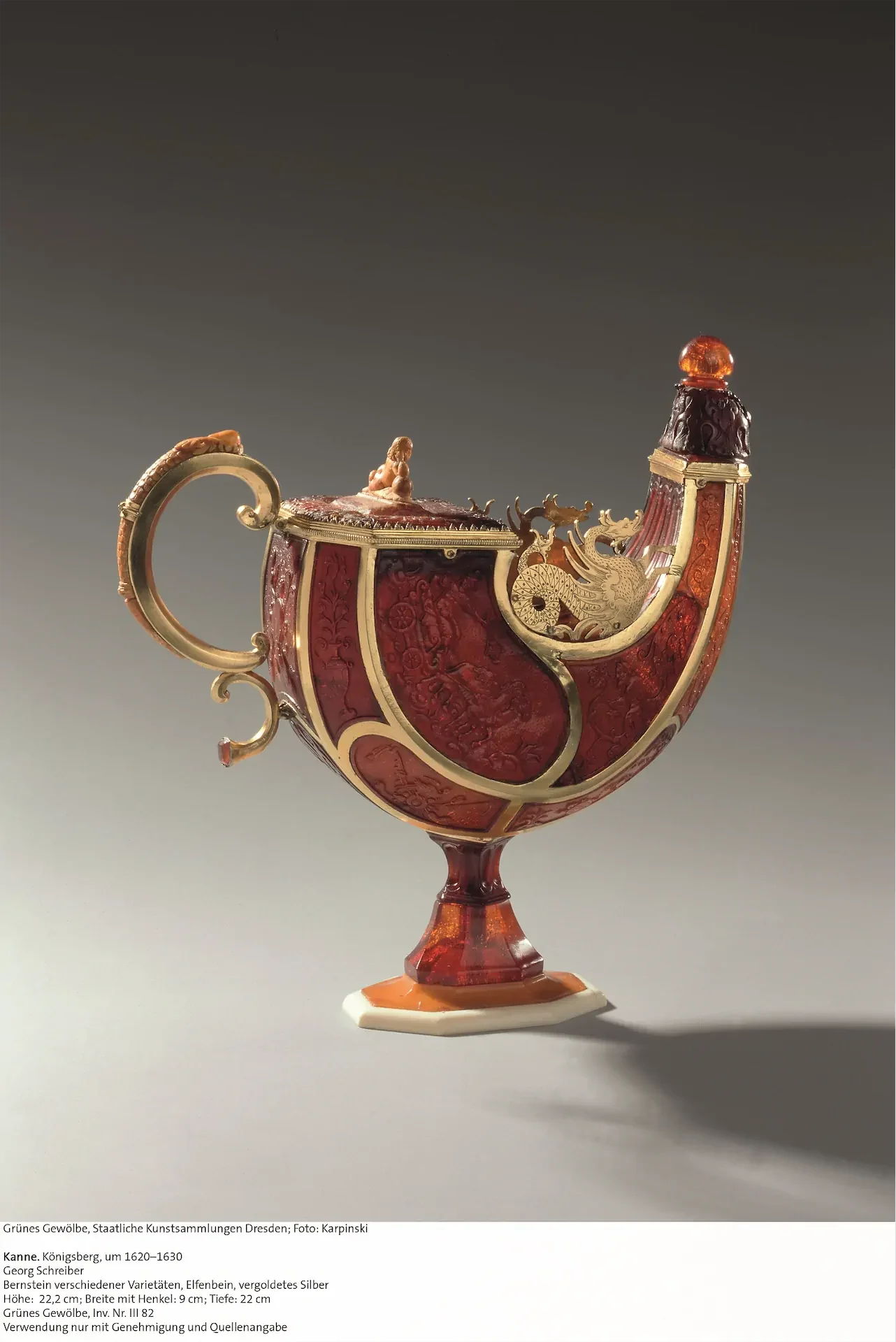
Georg Schreiber (†1643), one of the (two) founders of the guild in Königsberg in 1641, signed several of his works, while others have been attributed to him. Among them is a magnificent jug in the shape of a snail shell - it was found in the Dresden Kunstkammer (almost 20 years after Schreiber's death) in 1662. It is a masterpiece representing one of the most typical specialities of the Königsberg style: the jug, which never served any practical purpose, is made of very thin translucent amber segments decorated with carvings. Gilded silver strips form a border in which the amber elements are set.
Jacob Heise (†1667), also a leading master from Königsberg, worked in a comparable technique and continued Schreiber's style. Made in amber, Heisse's masterpiece arrived in Dresden as a gift from the Elector of Brandenburg, Frederick William - the Great Elector - to the Elector of Saxony, John George II. Signed and dated 1659, this work reflects the appearance of contemporary as well as older vessels made of rock crystal and jewellery stones, which were similarly designed in soft forms inspired by nature. At first glance, one might assume that the bowl of this magnificent vessel was cut from a single large lump of amber. Its body, however, consists of more than 30 differently curved amber plates decorated with maritime-themed scenes. It is difficult to overestimate that amber was also used in works of craftsmanship in the form of tankards, cups, caskets, jugs and bowls made in the late 16th and early 17th centuries.
Amber products from Gdansk
Gdansk amber makers specialised in the use of amber in contrasting colours, carefully designing and making a variety of cabinets, caskets, pouches and also cutlery.
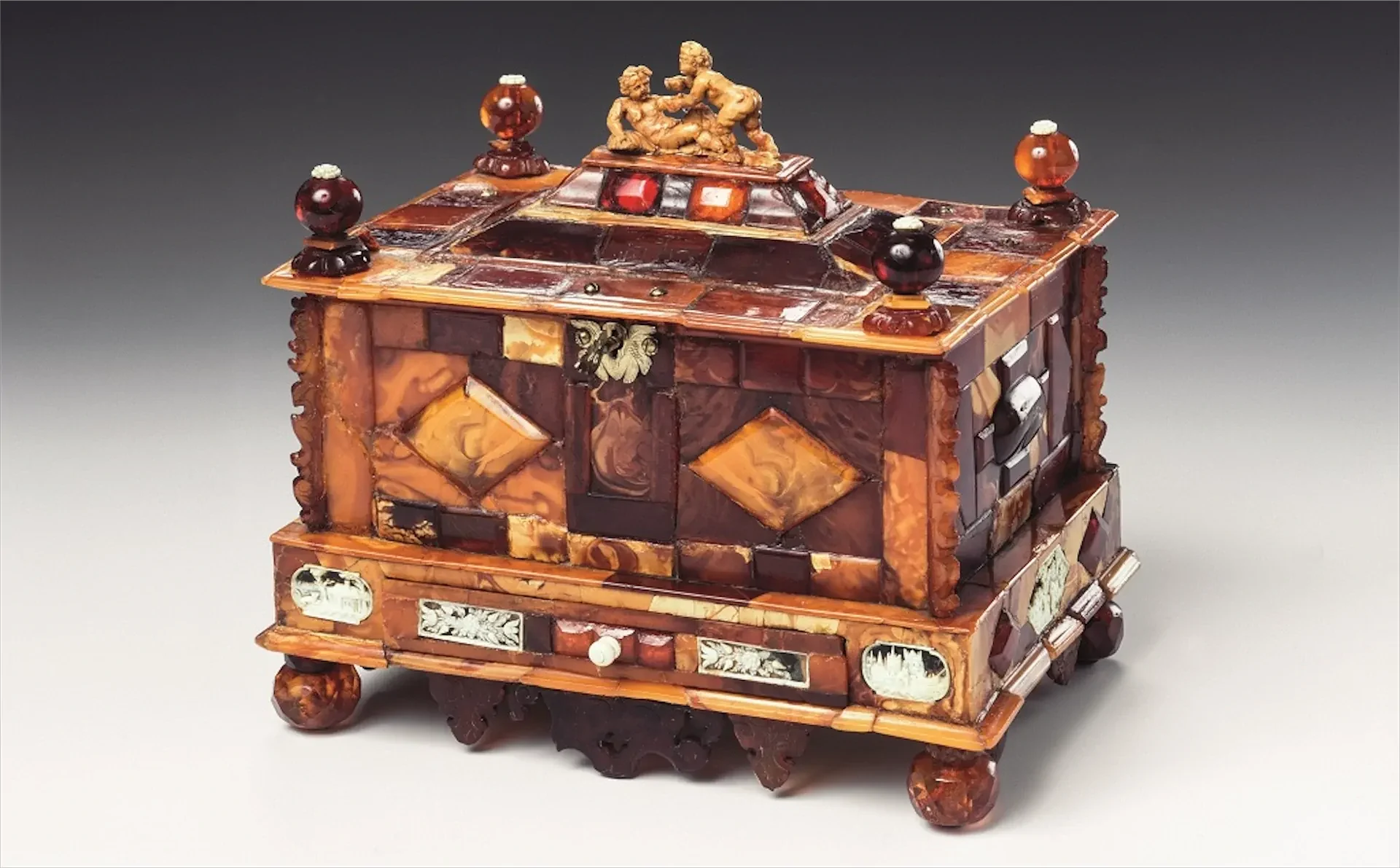
Michel Redlin (active from 1669 to around 1688) was a highly sought-after innovative artist, and his distinguished clients included the Elector of Brandenburg. The architectural design of a typical „Redlin casket” is clear and elegant: the copy in Grünes Gewölbe has a low base with drawers, resting on four ball-shaped legs. Only this very low base is stabilised by a wooden frame, and the square box itself consists of amber plates and cabochons with engravings on the reverse. Thus, all the „Redlin caskets” reveal all their splendour and wonderful secrets only on close inspection. This was precisely the intention of their creator. A total of four caskets by Redlin belong to the Grünes Gewölbe collection - they were first mentioned in the inventory of the Grünes Gewölbe Precious Room in 1733.Two candlesticks and an hourglass, made
in Gdansk in the second half of the 17th century, was mentioned in the inventory of the Hall of Precious Objects in 1725. Obviously, candlesticks, hourglasses and caskets were certainly produced in series, on commercial orders (not only on behalf of princes and kings) and in accordance with current models and fashionable designs.
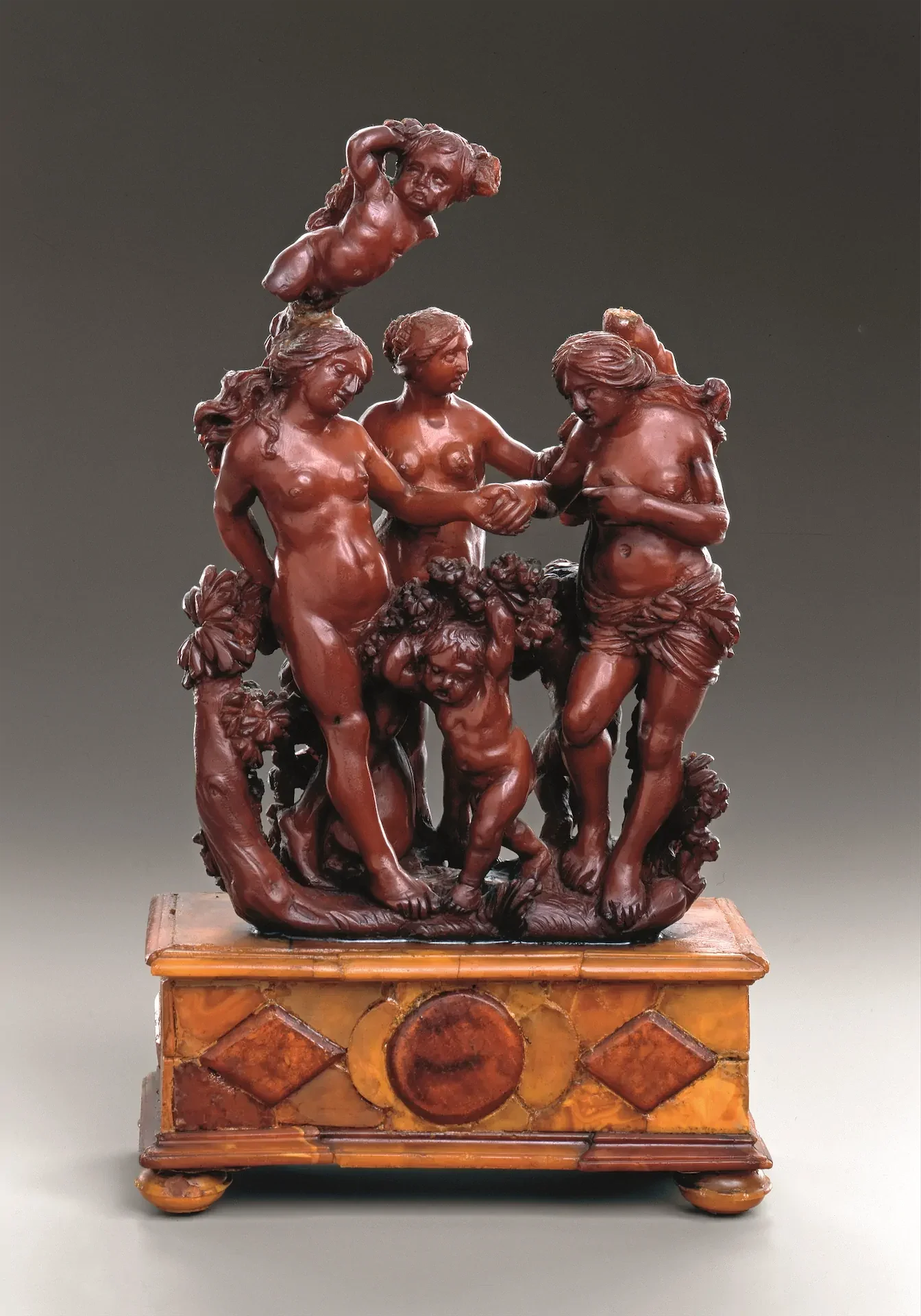
Christoph Maucher Born in Schwäbisch-Gmünd, he arrived in Danzig around 1670. He became famous for his carvings in ivory and amber, and his works embody the Danzig style. Maucher considered himself primarily a sculptor. The Grünes Gewölbe collection contains one of his best-known groups made of amber with depictions of mythological figures - the Three Graces. This group and a version of the Judgement of Paris from London (Victoria and Albert Museum) are hallmarks of Maucher's style.
Large amber cabinet
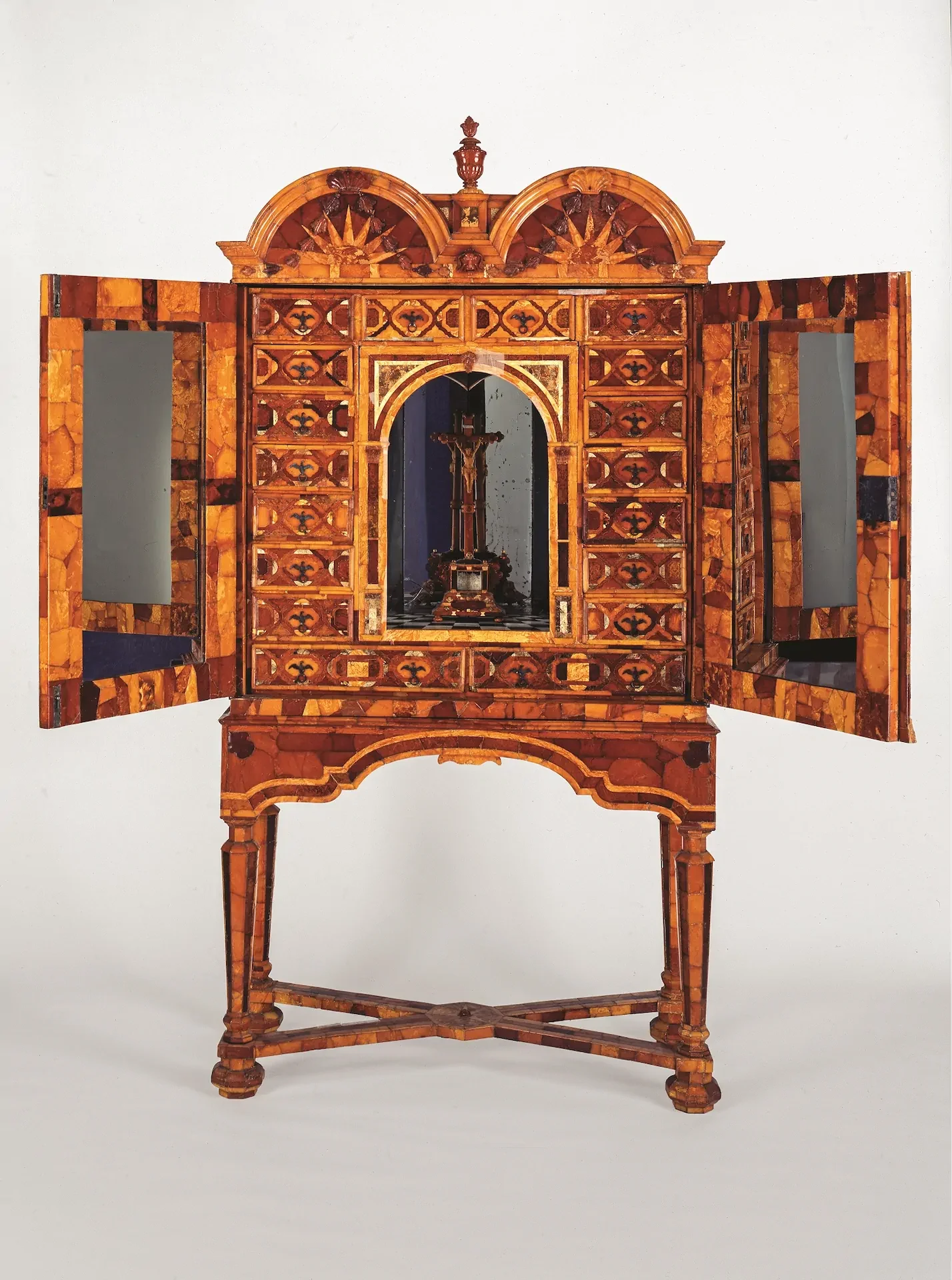
This cabinet was a gift from the King of Prussia to King August II of Poland during the latter's official visit to Berlin from 26 May to 13 June 1728. Frederick William I carefully upheld (not least with this valuable gift) the Prussian tradition of using amber wares as political and diplomatic gifts. Under intense time pressure, the „large cabinet” was hastily made in Königsberg, as the surviving correspondence confirms.
King Augustus the Strong of Poland must have been surprised by the fascinating cabinet and the extraordinary variety of precious amber trinkets deposited in his drawers. The vast majority of these were also supplied from Königsberg. But, as is well known, the Prussian king added a number of amber wares from his collection, thus completing the contents of the drawers. This decision explains why some of the amber objects in the drawers came from Gdansk. Almost all of the contents of the drawers have survived, and the amber cabinet itself is one of the many wonderful attractions of the Grünes Gewölbe in Dresden.
Jutta Kappel, Senior Curator and Deputy Director of Grünes Gewölbe
Article appeared in Amber magazine No. 44 (March 2020)