
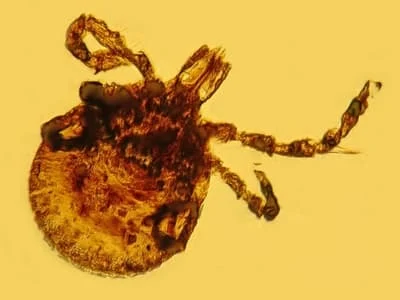
„Ticks in amber are very rare, and ticks with Borrelia bacteria, that is indeed an exceptional find. It's fascinating that attempts are currently being made to identify even such tiny organisms as bacteria in fossilised material,” says Prof. Jacek Szwedo from the Department of Invertebrate Zoology and Parasitology at the University of Gdańsk.
American scientists examined inclusions of four ticks preserved in Dominican amber and found a large population of bacteria causing Lyme disease. This is significant evidence that the disease, only recognised in the 1970s, may have existed before humans appeared on Earth. The oldest documented case of human infection with borreliosis to date is the Tyrolean Iceman found in the Italian Alps. „Before he was frozen in the glacier about 5,300 years ago, the Iceman was likely already in poor health due to Lyme disease,” says George Poinar, professor emeritus in the Department of Integrative Biology at OSU College of Science.
Poinar is one of the world's leading experts in the field of plant and animal inclusions in amber. Previously, the scientist studied a tick found in Burmese amber dating back 100 million years, where he detected the presence of fossilised rickettsia – bacteria that can cause various types of spotted fever. In total, over 30 years of work studying inclusions, Poinar has documented the presence of diseases such as malaria and leishmaniasis. It was he who extracted dinosaur DNA from insect blood preserved in amber – this discovery became the basis for the script of Steven Spielberg's film. Jurassic Park. It only later turned out that this was not possible – what Poinar believed to be dinosaur DNA was most likely the result of contamination of the samples with modern material.
So, can the results of these studies be considered reliable? „Fossilised resins preserve and contain the remains of microorganisms, including bacteria, but their identification is a very big challenge,” states Prof. Szwedo.