The scientific seminar on amber, which took place on the last day of the Amberif trade fair, enjoyed enormous interest from both specialists and amber enthusiasts.
When planning the programme for this year’s 15th academic seminar on amber – which, as is well known, has been a regular feature of this fair since its very first edition – Professor Barbara Kosmowska-Ceranowicz aimed to select content that would ensure the comprehensiveness of the five-year cycle. The 2004–2008 five-year period will be documented in a book, produced – as has been the case for the previous 10 years – by the International Association of Amber Craftsmen.

The seminary hall was filled to capacity with a distinguished, albeit diverse, audience. High school students from Gdańsk, members of the amber enthusiasts' club (or rather, already devoted connoisseurs), led by Małgorzata Befinger, were seated in the auditorium alongside world-class academics, amber researchers from many countries, and equally numerous research disciplines.;
I can't help but mention some of them even before the referrers:
• From Germany: Dr Brigitte and Dr Günter Krumbiegel with a group of scholars from Bitterfeld, a Saxon amber mining centre; researcher and promoter of the collecting of natural amber specimens Dr Wolfgang Weitschat; Director of the German Amber Museum in Ribnitz-Damgarten Ulf Erichson, co-author with W. Weitschat of the museum’s recently published, modernly edited collection catalogue.
• from the Russian Federation: Dr. Zoya Kostiashova, Deputy Director for Scientific Affairs at the largest Russian amber museum in Kaliningrad, and biologists specialising in organic inclusions in amber, Dr. Elena Yezhova and Dr. Andranik Manukyan. Also present were top researchers in amber conservation issues, co-authors of the Amber Room reconstruction – Alexander Zhuravlev and Alexander Krylov.
• from Ukraine: Dr Olena Bieliczenko – Head of the Expert Department at the State Gemological Centre of Ukraine
• From Canada: Prof. Alicja Zobel – member of the New York Scientific Society and the World Amber Council
• from various parts of Poland: professors – Wiesław Krzemiński from Krakow, Andrzej Szadkowski from Łódź, Ryszard Szadziewski from Gdańsk and many other scientists, including Dr. Eng. Sławomir Safarzyński – an expert for the Minister of Culture and National Heritage in the field of precious metal artworks, and Dr. Regina Kramarska from the Marine Geology Department of the Polish Geological Institute.
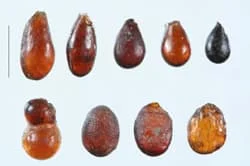
The speakers presented topics previously unknown to the Polish public. For example, Prof. Eugenio Ragazzi presented the oldest Triassic fossil resins (235 million years old) from the Alps, and Dr. Maksim Bogdasarov presented amber from Belarus, accumulated there relatively recently, perhaps a few hundred thousand years ago at most.
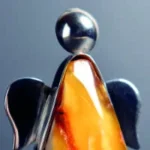
Similarly, they contrasted in age: the problem of the functioning of amber trade and manufacture during the Roman Empire presented by Marcin Stąporek with the presentation of the project of creating a triptych by Mariusz Drapikowski for the fourth station of the Cross in the Basilica of the Holy Sepulchre in Jerusalem, using amber, gold, silver, and titanium. This latter task will be a continuation of the work of Polish soldiers from the Second Corps during their complicated journey home during the Second World War.
Dr Elżbieta Sontag presented a paper on „Descriptive Types and Syninclusions in the Amber Inclusion Museum of the University of Gdańsk.” Her arguments for the advisability of collecting the exhibits in university laboratories convinced everyone. The quality of the collection's development, largely from donations by Pomeranian amber artisans (including the impressive donation from Bożena and Wojciech Kalandyk), and the efficiency of cataloguing the collection in a way that allows public access, received widespread acclaim.
My paper on the causes of huge fluctuations in the supply of raw material (succinite) over the last thirty years concluded the seminar with an economic emphasis.
Detailed summaries of the papers will be posted on the website www.amberif.pl. Portal amber.com.pl plans to publish shortened abstracts, enriched with discussion results from the seminar and extensive illustrative material.
In the picture: Triassic resin drops from the Alps (top) and a triptych design for the IV Station of the Cross in the Basilica of the Holy Sepulchre in Jerusalem by Mariusz Drapikowski (bottom).