The Amber Museum showcases our city's centuries-old amber traditions to visitors, as the Amber Capital of the World. The appearance of unique, antique amber artworks on the antiquarian market is a rare occasion, which is why we act without hesitation, ensuring that works crafted in the workshops of Gdańsk masters can return after centuries to the place where they were originally made. These particular pieces, which most likely date back to the 17th century and were made in Gdańsk, are comparable in craftsmanship and precision to those found in the Rijksmuseum in Amsterdam, the Schatzkammer in Munich, and the Ashmolean Museum at the University of Oxford – announced Waldemar Ossowski, Director of the Museum of Gdańsk.
Recommended: A new decade for the Amber Museum – a conversation with Waldemar Ossowski
Modern cutlery adorned with amber
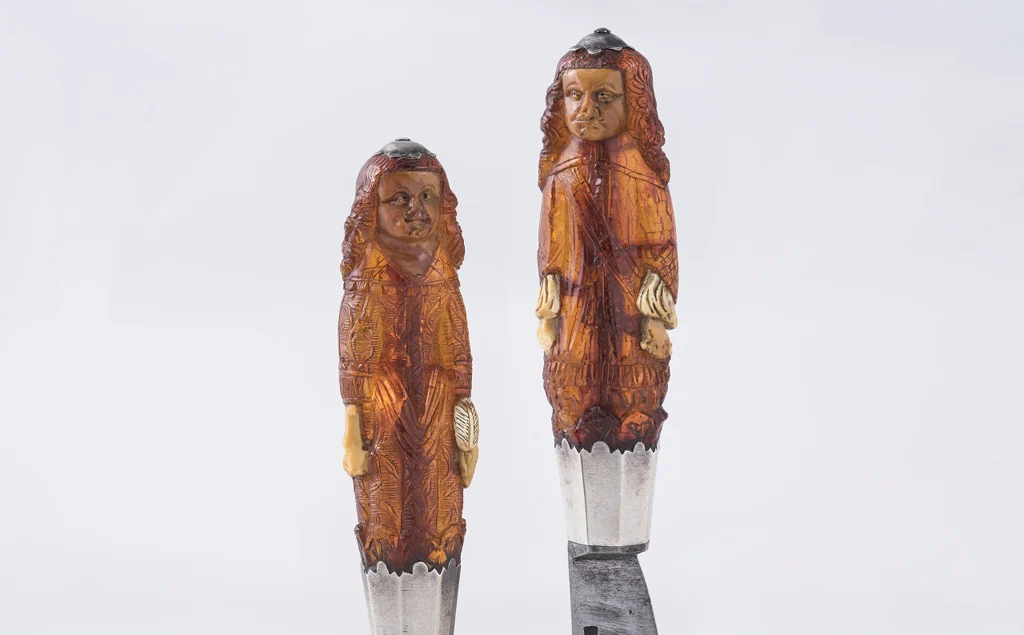
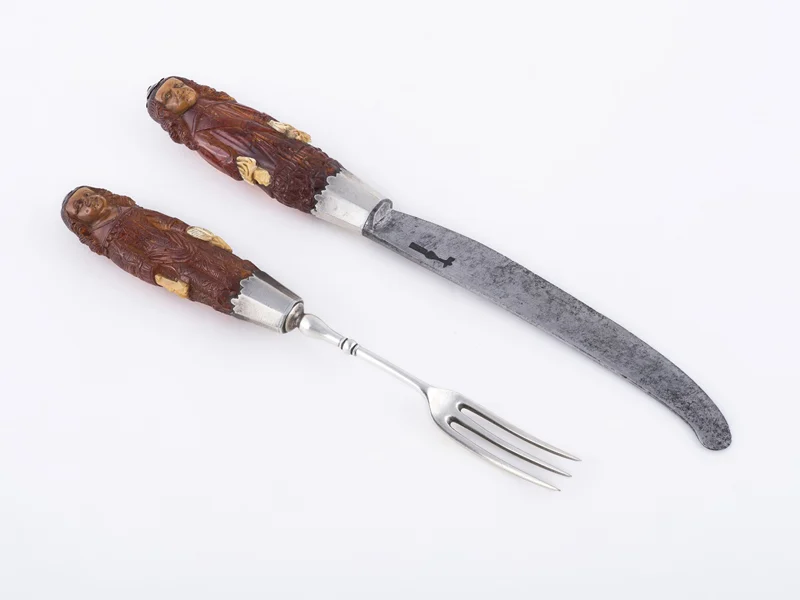
The handles of the cutlery are made from clear, dark honey-coloured amber, sculpted into ¾ height figures. The knife handle is a man. The fork is adorned with the silhouette of a woman. The faces of the figures, their hands, and shirt cuffs are made from light, opaque amber. The base of the figures, serving as an attachment point, is decorated with a silver band at the top, ornately cut, resembling cuffs. At the top of the heads are protruding metal rivets in the form of rosettes. These form the end of the tang that passes through the interior of the sculpted figures.
The object is distinguished by its interesting composition and the highest quality of craftsmanship in the smallest details. Of particular note are the presented details, such as the collars of the costumes, patterns on the fabrics, hairstyles, and the lady's attribute in the form of a feather, as well as the man's sword slung over his belt. The entire figures are carved and engraved; both the front and the back of the figures are decorative – summarised Joanna Grążawska from the Museum of Gdańsk, deputy director of the Amber Museum.
The cutlery was probably a wedding present, and the elements of the costumes indicate people of Protestant faith. The cutler's mark remaining on the knife blade has not been identified.
We believe this lead will lead us nowhere anyway. A certain clue is provided by analogous sets of cutlery stored in the Victoria & Albert Museum. It was often the case that amber figures from Gdańsk were sent to many European cities as semi-finished products, and the knives themselves were assembled and produced in local workshops. In this way, the finished products were offered for sale in London, Lübeck, and other cities – explained Joanna Grążawska.
The Amber Museum consistently builds a collection of objects connected to the golden age of amber craftsmanship in Gdańsk (16th-18th centuries).
The acquisition of the cutlery collection is one of many steps being taken by the Amber Museum to recreate a collection of objects related to the golden age of amber craftsmanship in Gdańsk (16th-18th centuries). Before World War II, the Stadt- und Kunstgewerbemuseum's collection contained 36 works of antique amber art from various historical periods, but these have not survived to the present day. They were either destroyed or lost. Amber is an extremely fragile and impermanent material, and it deteriorates under the influence of light and temperature. Consequently, few historical works of art made from this material have survived, and they command high prices.
The Gdańsk Museum has acquired a pair of modern cutlery with amber handles, thanks to funding from the National Museum Institute. The Gdańsk Museum's project was highly rated in terms of its content, achieving seventh place in the latest edition of the "Expansion of Museum Collections" programme, which is operated by the National Museum Institute. The qualified financial support from the Ministry of Culture and National Heritage for the purchase of exhibits will amount to PLN 122,400. The Gdańsk Museum will allocate PLN 30,600 for this purpose.
Recommended:
We promote amber ceaselessly – a conversation with Joanna Grążawska
Impressive collections are built over years – a conversation with Joanna Grążawska