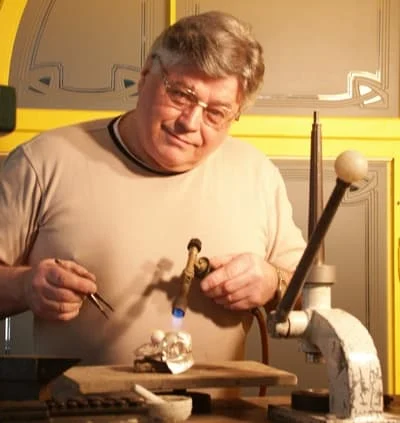
When Bogdan Mirowski is typed into the search engine, most results point to the Amber Nightingale.
In the course of 15 years, many people have received it - not only winners of the Sopot Festival organised by TVN, but also Nobel Prize winners and even the Pope. It also became a symbol of Sopot - it was so popular that even at one time Hestia considered it more recognisable than the official coat of arms with the seagull and fish. For 15 years, my authorship of the statue was not abandoned. I didn't even realise how much it helped me - the fact that I was the creator of the Amber Nightingale often determined that I was the one who got certain commissions. However - although I am strongly associated with it - it is only part of my work.
You specialise in sculptural forms and, according to many, have achieved unquestionable master status in this field.
I started my adventure with goldsmithing more than 30 years ago, making jewellery. But from the very beginning I was convinced that sculpting was the right way to go. And that's the beautiful thing: to know what you want to achieve and to pursue it consistently. In my opinion, it's not the sculpting itself that's very difficult, but making sculptural forms from dozens of pieces, the way I transform it. Because you have to know the workshop really well to meet this challenge. My figures are, as it were, frozen in the frame, snatched for a moment from what they are doing. Sometimes people get lost in where reality is and where fiction is... Also knowing the nature of amber helps me to use it in the right way.
What is the proper use of amber?
I don't cripple it. I don't sand it, I don't polish it. Rather, I add a theory to a piece of amber. Even if someone has previously interfered with its natural form, I try to use this interference appropriately. This can be seen very well in my larger sculptural forms, for example, in the work entitled The Scribe: I cut a piece of amber in such a way as to create the effect of the pages of a book, and I used its bark as the cover. This raw material is extremely original and should not be processed „to kill”.
I believe that amber is currently being profaned - that is why I am full of praise for the educational efforts of Professor Barbara Kosmowska-Ceranowicz. Although she is not able to stop this avalanche of profanation, she has still managed to instil a certain sensitivity to natural amber. When, many years ago, I started working in a jeweller's workshop, where hundreds of kilograms of raw material were processed, nobody particularly cared about it. But I am the only one who knows what sensations accompanied me during the grinding work. Maybe that is why I have a special relationship to it. And sometimes when I pick up a large, beautiful piece, I feel bad about doing anything with it. I would dress it. No matter the difficulty, no matter its shape, I try to tell a story as long as I don't destroy it. I was once given an amber „to do” - I incorporated it into a suitcase held by a human figure. This amber suggested to me the final form of the whole work! I remember that the commissioning artist on receiving it said: „I thought I was going to expose it, and it stayed in the background.” And it seems to me that this is exactly the point: not to force it into the foreground, but to compose it skilfully. That's why in my works a lump of amber is sometimes the head of a woman with a bun, sometimes a sable fur, at other times trousers... The worst thing is to polish, clarify or polish it to - paradoxically! - to render its qualities. Let this mystery remain in it - I am convinced that this is a form of respect for the age of amber.
The „Sopot Nightingale and Others” exhibition at the Ambermoda Gallery in Sopot this summer was an important artistic event and a treat for admirers of the Lord's art.

For me, exhibitions are such an attempt to indicate that I am constantly developing, trying to create something new. I'm not racing against others, I'm racing against myself. The older you get, the more you reflect on the passing of time and the feeling that something is slipping away... Fortunately, this doesn't affect my work - I feel like I'm breathing fully... I'm also thinking about going back to making jewellery....
It was at this exhibition that you announced your return to rings.
I have a lot of experience in this field: I started with gold rings. And although they were made from die-cutting machines at the time, I always took the trouble to make them at least a little different - I could make 30 pieces a month, each one different.
I think there is a certain void in the market at the moment. Yes, it's abundant, but it doesn't have the kind of jewellery I'm thinking of. The kind of jewellery that you need a hammer to create - because you just have to hammer it out. And to do it in a perfect way. When you look at a finished mould, it seems so obvious that it has been made properly, but few people think about how it was made. Especially in the case of large moulds, which are - in my opinion - a kind of trap, because they expose any workshop shortcomings. That's why I think there is still a lot of work to be done here.
Who are the recipients of your work?
First and foremost, these are individual customers. I make works which then often turn out to be an absolute hit, because they perfectly suit a particular recipient, they hit their taste. The artist's greatest success is when the studio is empty. When I'm working, I also try to spare no time for detail, I try to live these works of mine. There is always the danger that when I rush, the work loses out. For me, the notion of the finished thing is inextricably linked to the reaction of the viewer: if, when looking at the finished work, he or she is surprised by the attention to detail, I know it is good. One cannot begrudge invention or time. Nor can the creator be driven by a mercantile goal, because that kills art. I can of course make things a la the 21st century, simple and economical in form, but I don't see the point. Besides, I've always been more interested in something else - the medieval period.
Your work truly breathes the aesthetics of the period.
It may sound highbrow, but I was once inspired by Bosch. There is something appealing about this art, the look at the human being and this circling around human beings in different forms. It is close to me and I feel good about it. My dream is to create 2-3 sets of human figures; for now, though, I am still practising the detail. Although if these characters of mine so far were grouped together, there would already be an amazing story. Plus the architecture, which I'm practising with semi-finished pieces: wood, resin masses - they are able to convey the atmosphere well. I was also thinking of putting these figures in ceramic moulds. I'm not in a hurry to realise the ideas, though, because I know that the bigger realisations have to come when you're sure you won't cut them....
Like this frame for the triptych in the Amber Museum, which has waited many years to be filled with content.
Yes, a certain maturity is needed. It's not enough to be good at your craft, you need form, content, lightness, plasticity, expression... I'm convinced that you can only get there by working. Silver has become completely obedient to me. I have no problem with the form, I know very well how it should look. But I still need time.