
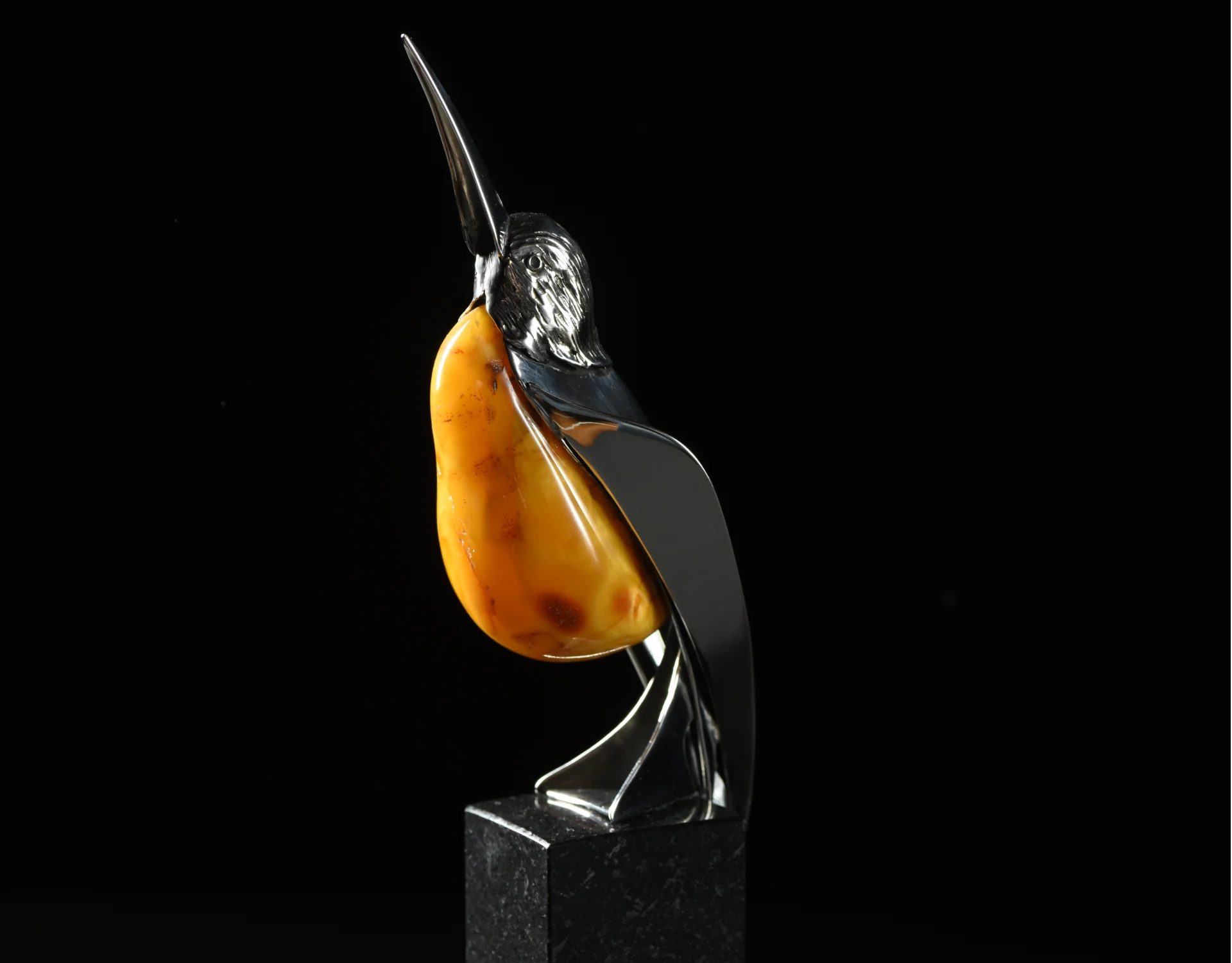
A bird and a stone - two symbols of one idea
The nightingale has always been synonymous with a beautiful voice, artistic sensitivity and musical talent. Amber - known as the „gold of the Baltic” - symbolises permanence, the beauty of nature and the rich tradition of Pomerania. Combined in one form, they create an extraordinary statuette: each one is unique, as the natural inclusions and colours of amber are never repeated. Few people know that the statuette of the Amber Nightingale was awarded not only on the stage of the Sopot Forest Opera - its creator admitted in an interview for the Amber Portal that he also made such statuettes for Nobel Prize winners and even the Pope.
RECOMMENDED: Dressing amber - a conversation with Bogdan Mirowski
Bogdan Mirowski - creator of not only the Amber Nightingale
Bogdan Mirowski is one of the most eminent masters whose works combine silver and amber, the precision of the jeweller's workshop and artistic imagination. His works are distinguished not only by their craftsmanship, but also by the depth of their symbolism - he was able to extract from amber not only the beauty of the stone, but also emotion and story. He became famous mainly for his sculptural forms of figures as if frozen in a frame - individual or integrated into a larger story, precisely forged using goldsmithing techniques.
Mirowski was not „just” a craftsman - he was an artist who saw amber as more than an ornament. He was able to give it a soul and meaning, making each piece a unique work of art. It was this sensitivity, his ability to extract the hidden history from the matter and his unique sense of form that led him to be entrusted with the creation of the Amber Nightingale. He continued to make statues until his death in June 2014.
Evolution of the award
The history of the Amber Nightingale is also - and for many above all - the history of the changing Polish music scene. In the 1970s and 1980s, it was one of many festival trophies - sometimes the grand prize, other times an accolade in phonographic or interpretation competitions. The real breakthrough came after 2005, when the Sopot Festival came under the wing of TVN television. It was then that the Nightingale became the focal point of the event, and the selection of the winners was handed over to the viewers through an exciting SMS vote. This also gave the statuette a new energy and momentum, and each gala brought tension, joy and a sense of participating in something special.
A springboard to a great career
The Amber Nightingale is not only a symbol of recognition, but also a ticket to a world of greater success. Many artists emphasised that winning in Sopot opened the door to a wider stage and media career. The list of laureates is a veritable kaleidoscope of names: from foreign stars of the 1980s - such as Anne Veski or Maywood - through Polish stage icons such as Kasia Kowalska, Andrzej Piaseczny, Mieczysław Szcześniak, to the latest generation of artists: Dawid Kwiatkowski (2021), Michał Szpak (2022), Kwiat Jabłoni (2023), Oskar Cyms (2024) or Carla Fernandes (2025). International triumphs included Gabriella Cilmi, Eric Saade, Garou and Imany - proof that the Nightingale's magic reaches far beyond the Polish scene.
From festival to museum
The work of Bogdan Mirowski, a master amber artist, has also been recognised in the art world. One specimen of the Amber Nightingale can be admired in the Amber Museum in Gdańsk, alongside other works by the artist, including the famous triptych „On amber in books was written”. In this way, the festival award has become not only a festival trophy, but also a museum exhibit - a bridge between popular culture and the artistic heritage of Pomerania.