
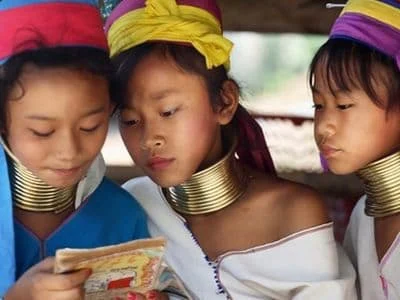
During her numerous travels, her lens captured members of various tribes who, despite geographically bordering each other for centuries, maintained their linguistic, religious, and customary distinctiveness, nurturing ancestral traditions from generation to generation. This is clearly visible in the example of the mountain tribes inhabiting northern Thailand. The Padaung group, belonging to the Karen tribe, is known for the custom of encasing women's necks in heavy brass rings. Women from the Lahu and Lisu groups wear bright clothing and adore jewellery, while the Akha dress incredibly ornately, wearing beads, ribbons, and sewn-on coins. This is because, in addition to their aesthetic function, jewellery also serves magical and religious purposes – the symbolism of ornaments is based on old tribal traditions and religious beliefs. The placement of specific magical signs and motifs with cult significance is intended to protect the wearer of the jewellery from the influence of evil forces. This is clearly visible in the example of the ceremonial outfits of women from another Thai tribe, the Miao, whose weight can reach up to 15 kilograms! They consist of a headpiece adorned with silver, topped with horns, birds, flowers, and bells, as well as enormous, richly decorated necklaces, bracelets, and rings inspired by the art of embroidery and full of symbols.
Jewellery from African peoples presents a different picture. That worn by the Dogon tribe, who inhabit the southeastern regions of Mali – whose art is considered the most interesting on the continent – is most often made of wrought iron or bronze and is a sign of prestige and is intended to ensure contact with the source of power and spiritual forces. Special consecrated rings are meant to heal wounds, and an inherited necklace called a „Dugo” is meant to connect with the spirits of ancestors. Another people living in the Sahara, the Tuareg, are famous for their carpets and silver jewellery, mainly talismans, special boxes containing rolled verses from the Quran, intended to ensure fertility and strength. These function as protective amulets, as do the crosses symbolising the four cardinal directions and passed down in the male line.
The exhibition „Woman in the Lens of Maria Magdalena Kwiatkiewicz” will be accompanied by an extremely interesting, colourful, and exotic display of tribal jewellery from the peoples of Asia and Africa. The jewellery collection will be presented to the public for the first time.
MARIA MAGDALENA KWIATKIEWICZ A woman from Poznań, who initiated the creation of the YES Gallery, promoting goldsmithing art and the achievements of Polish designers. Co-founder and co-owner of the YES Biżuteria company.
In addition to her involvement in promoting art, design, and artistic jewellery, of which she has been building a private collection for many years, she is passionate about photography, understood as a way of experiencing and interpreting the world. Her photographs capture emotions and preserve the impressions of a given moment without unnecessary narration. For the author, the most important element is the person, with whom, despite linguistic and cultural differences, she establishes an intimate relationship in an incredibly easy and subtle way. Her passion for photography has resulted in her photography cycles from travels, which have already been exhibited several times.