What does Frou-Frou mean?
The term frou-frou originated in 19th-century France. It originally described the sound that accompanied women moving in multi-layered, ornate gowns. Over time, the word came to be used to describe the lace ruffles hidden underneath the dress. That is, frou-frou means something that is hidden, invisible to the eye, yet very feminine and delicate. That's what my jewellery is - delicate and feminine. When I was thinking of a good name for my company, I liked this one. And that's how it's stayed.

Did you know from the very beginning what kind of jewellery you wanted to create?
First there was the need to make lace, because I discovered that crocheting relaxes me and calms me down. And then I got the idea that crocheting is not necessarily doilies or jumpers, that after all there are many possibilities and why not try it with jewellery. So first there was the idea, then there was learning on my own, and then there was the need to improve my workshop with the support of professionals. That's how I ended up at the Antidotum Studio - a jewellery design school, where I learnt all the basic goldsmithing techniques. And so my adventure with jewellery has continued for 15 years...
Fifteen years ago, though, knitting lace on a crochet hook was a bit of a snooze, especially for the young. How did you come up with it?
The roots are in my home - my mother was a real nut when it came to all kinds of knitting. And, of course, she tried very hard to get me into it, and I was terribly ashamed of it, because it was, as you said yourself, disgusting. Anyway, I had to face that disgust because as a child I had to wear what my mother created. So at the time of the jeans fashion, I wore my brother's trousers with crochet patches and a toadstool motif (laughs). I had an aversion to knitting for a long time, but at some point it came back to me as a form of relaxation. Initially, I tried to avoid at all costs any reference to crafts, which I invariably associated with doilies and jumpers. Today, I think that this negative attitude probably stemmed from my little belief that such crocheted jewellery could be a fully-fledged type of jewellery. But that is thankfully in the past, and I now openly admit to being inspired by folk art. I have always had this need to prove that crochet jewellery can be taken seriously. One of the things I was very keen on was that it should have a proper setting. That's why I pay so much attention to good photos, visually attractive catalogues and well-maintained social media profiles. And I think I've made it - today my jewellery is sold in good galleries in Poland and all over the world, which I didn't even dare dream of at the beginning.
„Looking at the designs made with this technique, one can imagine that the jewellery is not a winding wire, but an enclosed space, bounded by weaves. Is what we are looking at matter or air?” - you wrote on your website. So what is your jewellery?
This work calms and soothes me so much, even puts me into meditative states, that at a certain point, concentrating only on the technical action - eyelet after eyelet, eyelet after eyelet - I switch off thinking. When I am no longer focused on what is to be created, I notice the shapes created in the space enclosed by the wire. There, a completely different layer of the object is created.
When you sit down to crochet, do you know what effect you want to achieve?
It depends on what the plan is. If it is a repeatable jewellery order, I have to stick rigidly to a specific design. However, when creating pieces for competitions or exhibitions, it is completely different. Even if I have a clear idea of what I want to do, this vision can change many times along the way, and the final object is far from the original design.
Such knitting seems quite easy and enjoyable....
...meanwhile, it is not necessarily so. Yes, crocheting in general is not difficult, as many women do it, but there is a huge difference between crocheting with yarn and crocheting with wire, which I use. Being used to the softness of yarn makes it very difficult to switch to a stiff wire, which, on top of that, cannot be ripped if you make a mistake. I realised this when I was looking for someone to work on my projects. It turned out to be easier to teach wire crochet to someone who has never been exposed to crochet than to someone who is proficient in knitting with yarn.
Do you use any special tools, or do you just sit down with a crochet hook and wire here on the couch in the studio and crochet?
Many of the activities require my presence in the studio and the use of typical workshop tools, but the „crochet” part I can actually do anywhere, such as in the park or even while riding the train. The trouble is, however, that I really need to concentrate, so I choose places where no one disturbs me. I can't get distracted, because strangely enough, my wire breaks every time I do it (laughs).
All of your past collections have been grey, meanwhile, for this latest one you have introduced a lot of new colours. What has changed?
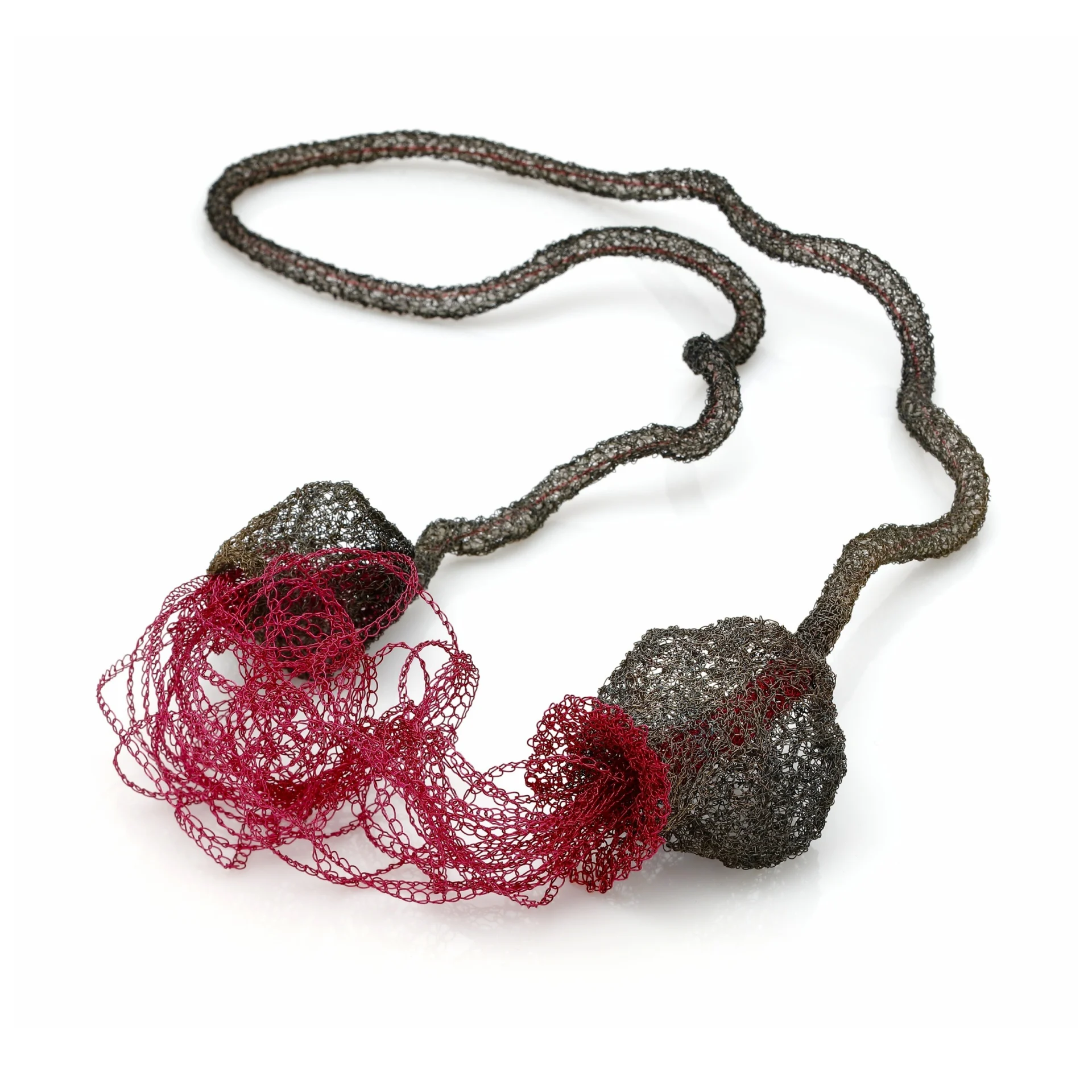
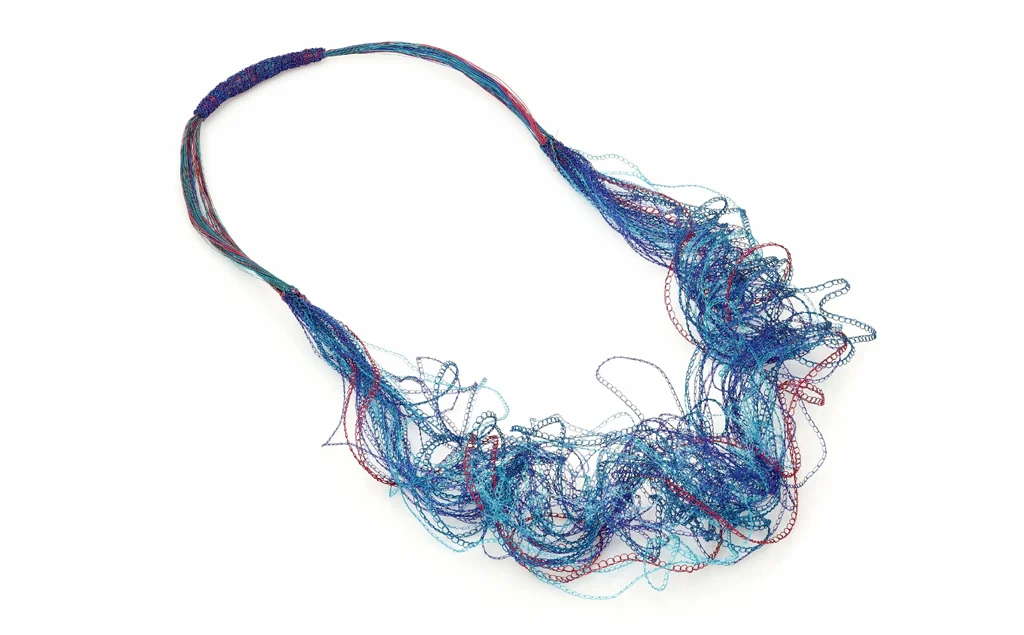
So far, I have only used three colours: bright silver, oxidised and gilded, and various combinations of these three colours. Avoiding other colours was a form of defence against the association of my jewellery with cordage and folk art. But, as I said, this has changed, so I can now use colours without fear. I am gradually reaching for them even in my wardrobe, which until now was exclusively black, navy and grey (laughs). The second reason for introducing colour is closely linked to my exhibition I'm fine / Help me, which is on show until mid-June at the Art Gallery in Legnica. It is the result of my reflections on relativism in the perception of the world around us. This relativism affects many areas of our lives. It is a very capacious, difficult subject, all the more so because for the purposes of the exhibition I have narrowed it down to themes of mental disorders. The collection of brooches and necklaces made for the exhibition is very colourful. I thought that juxtaposing such a heavy subject with a feast of colours would be a good start to a discussion about relativism. In addition, colour in itself is a good carrier of emotions. There are relaxing colours, annoying colours, energising colours. They can also be mixed and created in sets, which also have an effect on the viewer. Colour combinations that may have a calming effect on one person, may annoy another. This is how I feel about the combination of yellow and purple in one of my works. Personally, I don't like this combination very much and used it precisely to irritate the eye. My teenage daughters, on the other hand, loved it and thought the colours looked very good together.
Still not fond of this combination?
Still. For that, I liked this explanation that the link is there to make it uncomfortable.
The exhibition in Legnica - your most important solo exhibition - is the realisation of the Legnica Art Gallery's award in the Presentations 2020 competition. When did the idea for it come about?
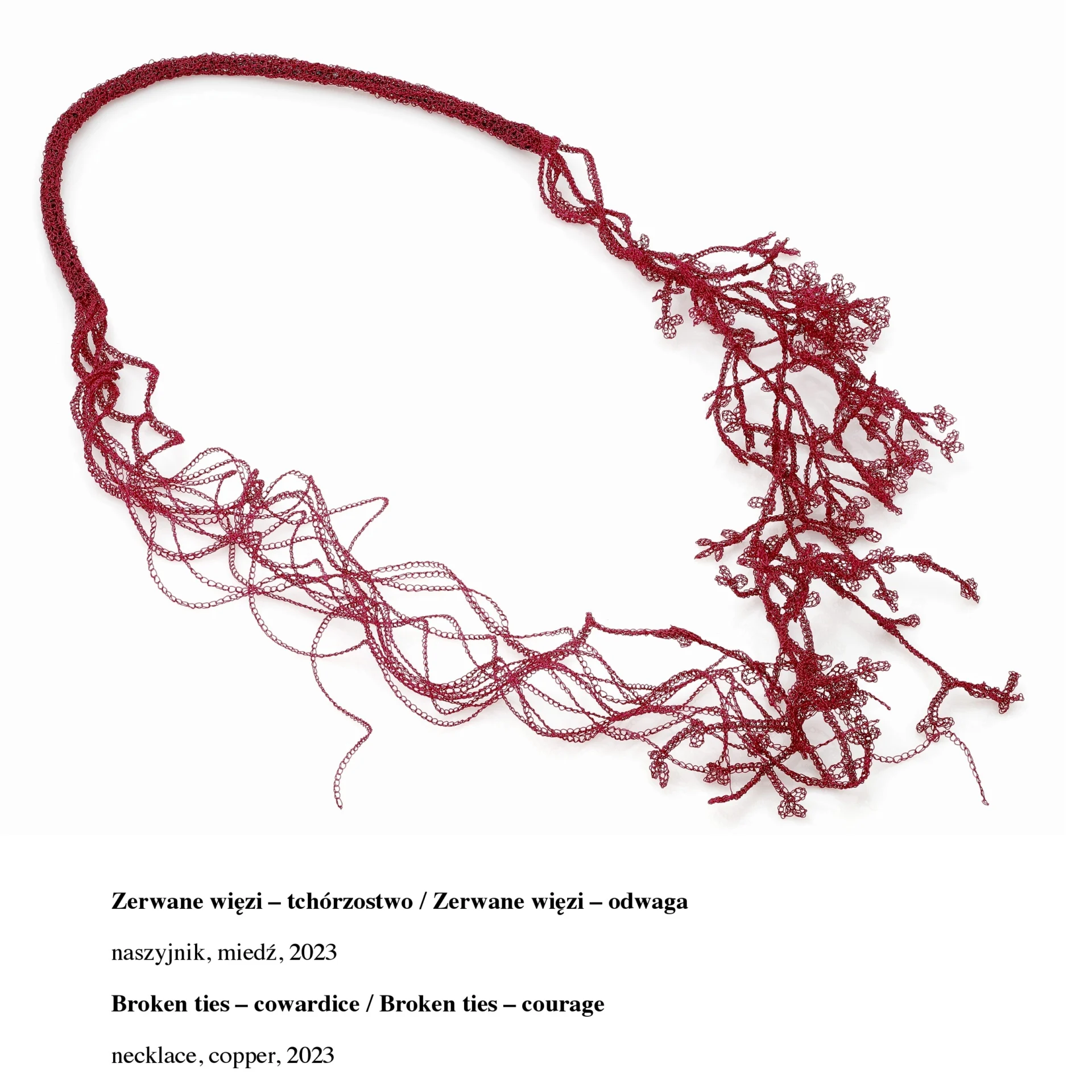
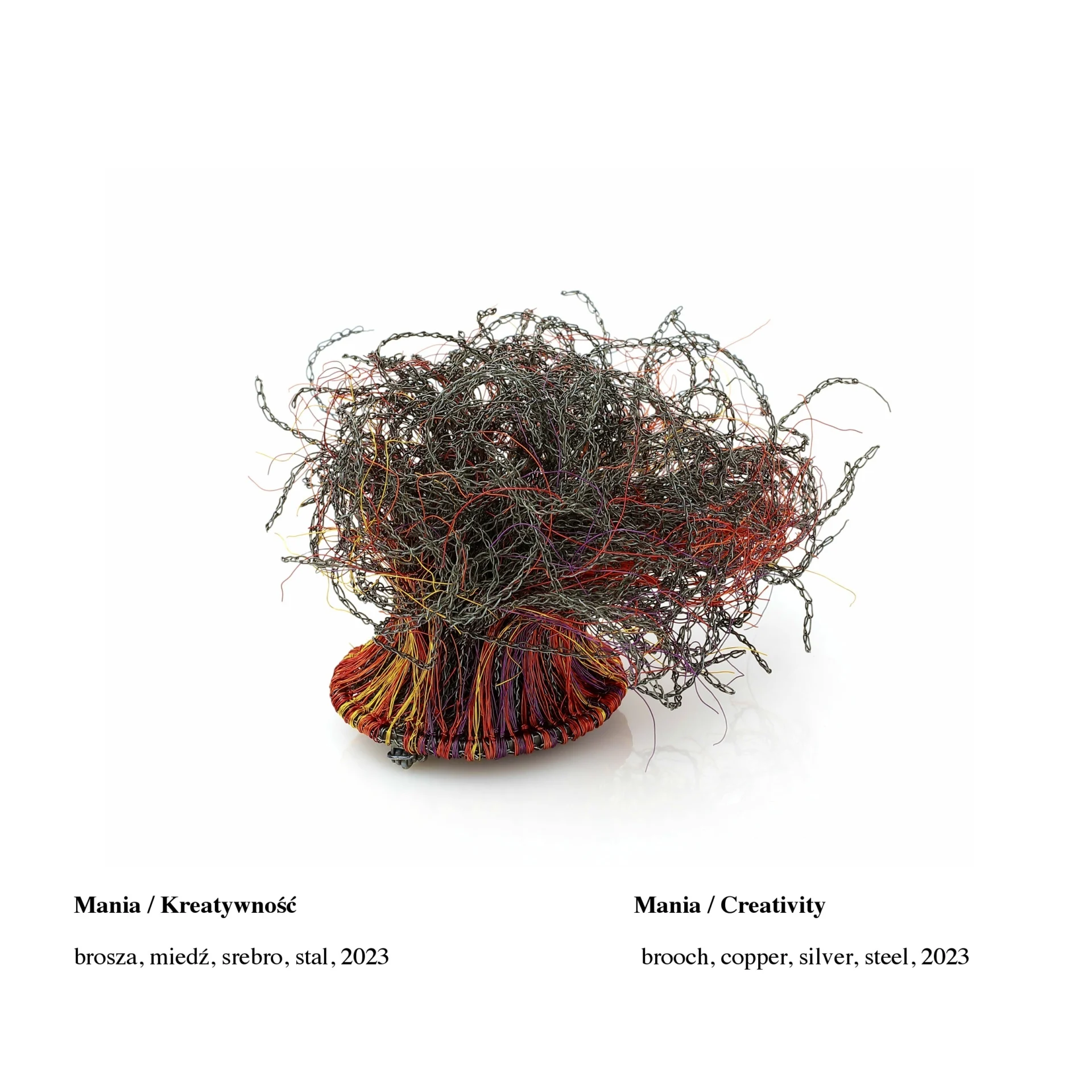
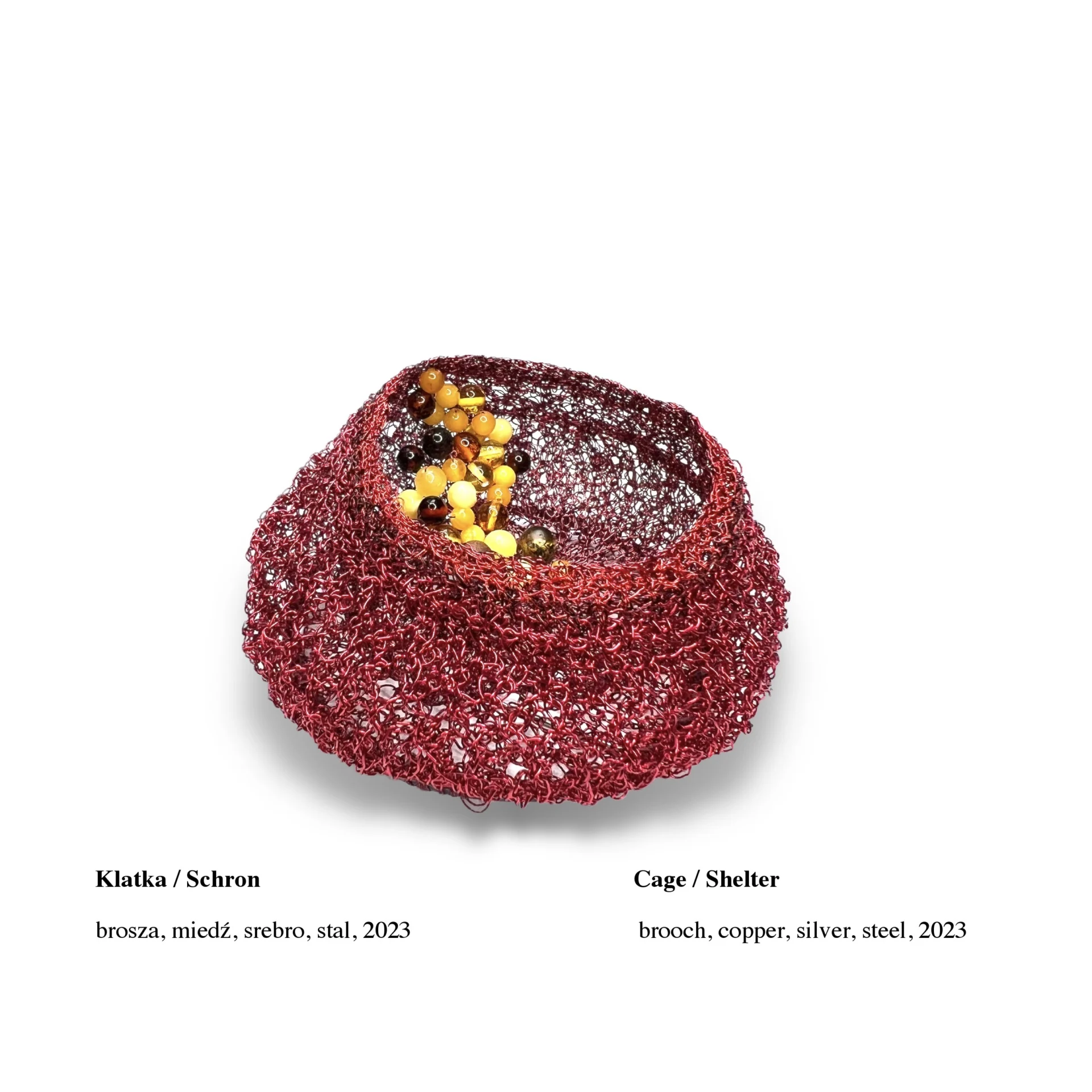
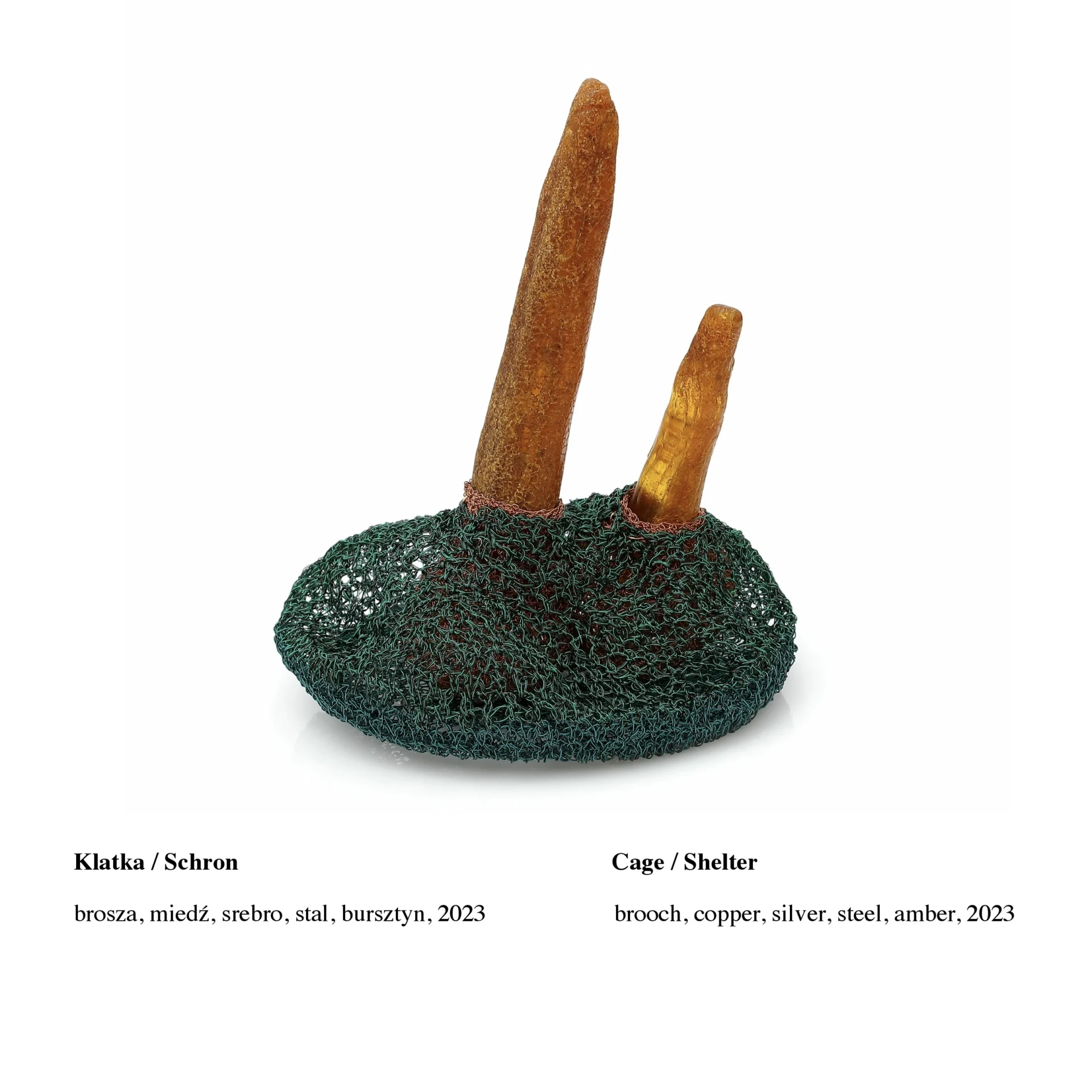
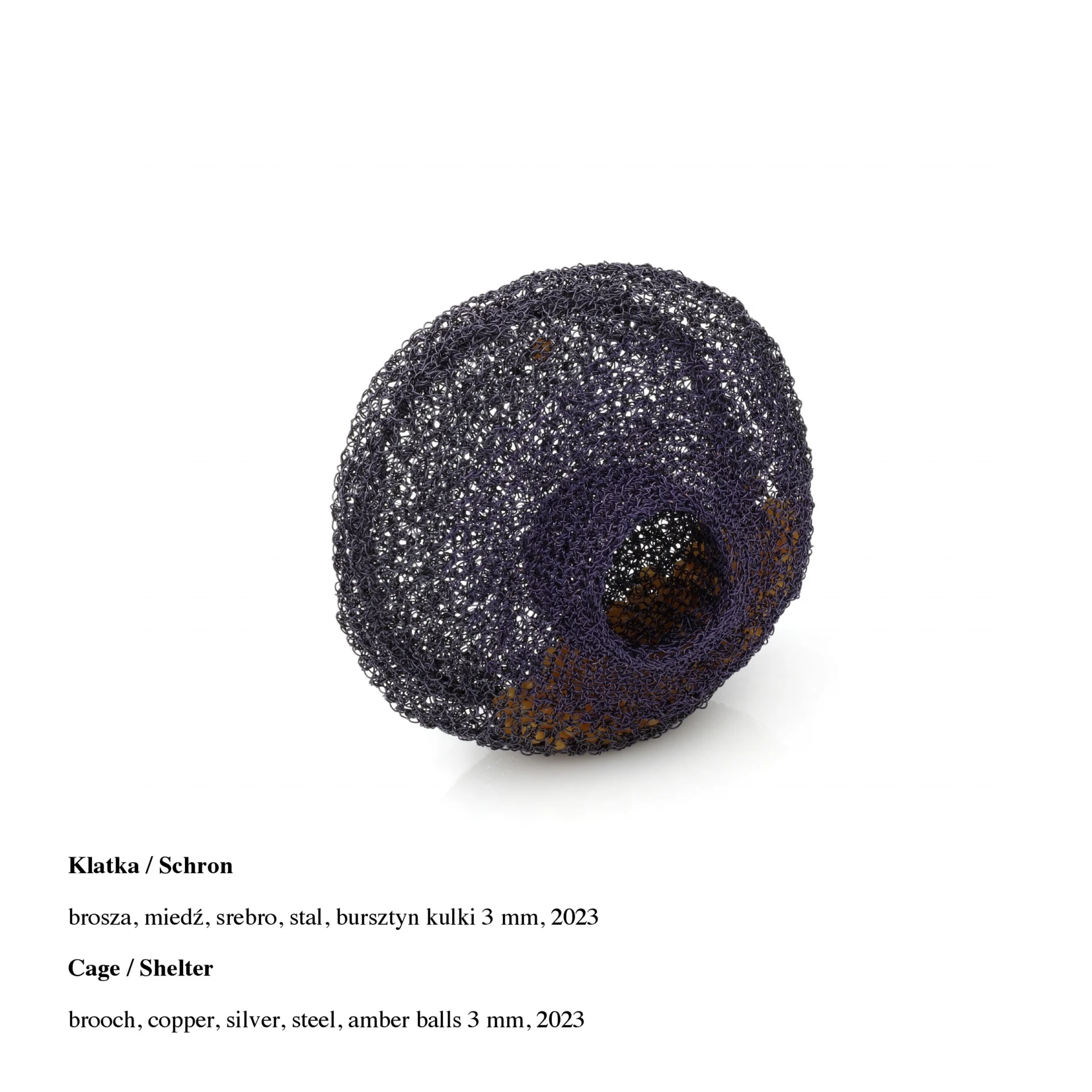
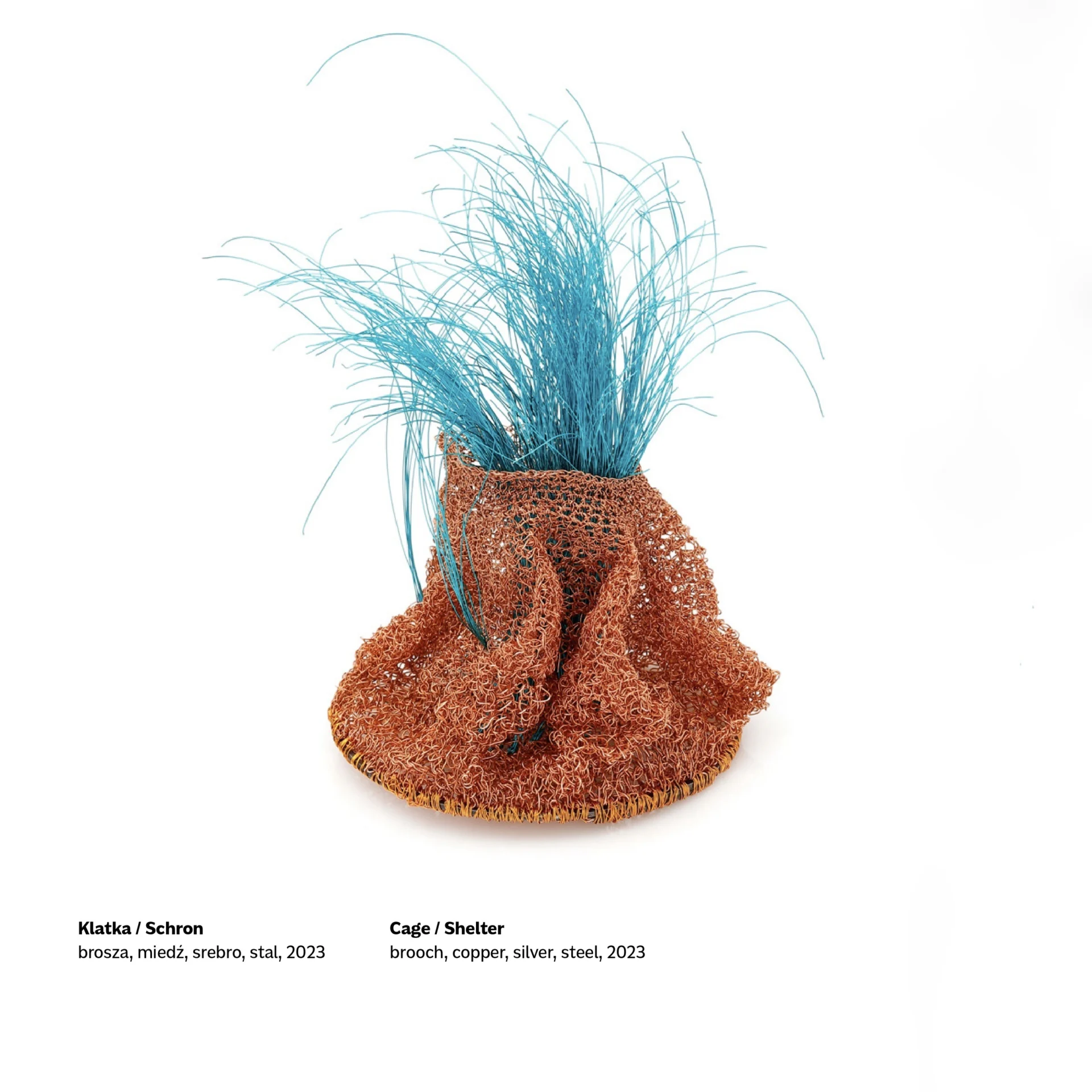
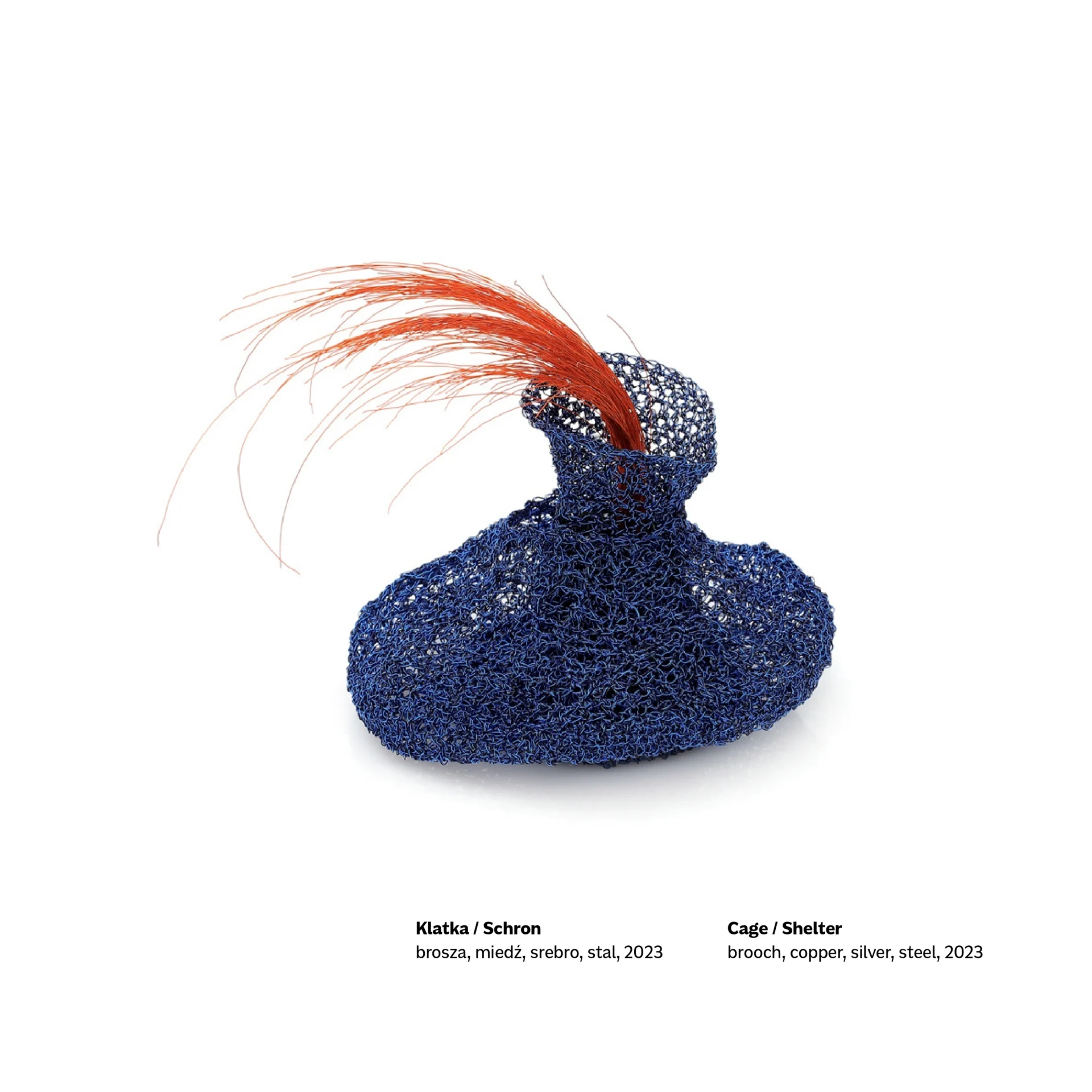
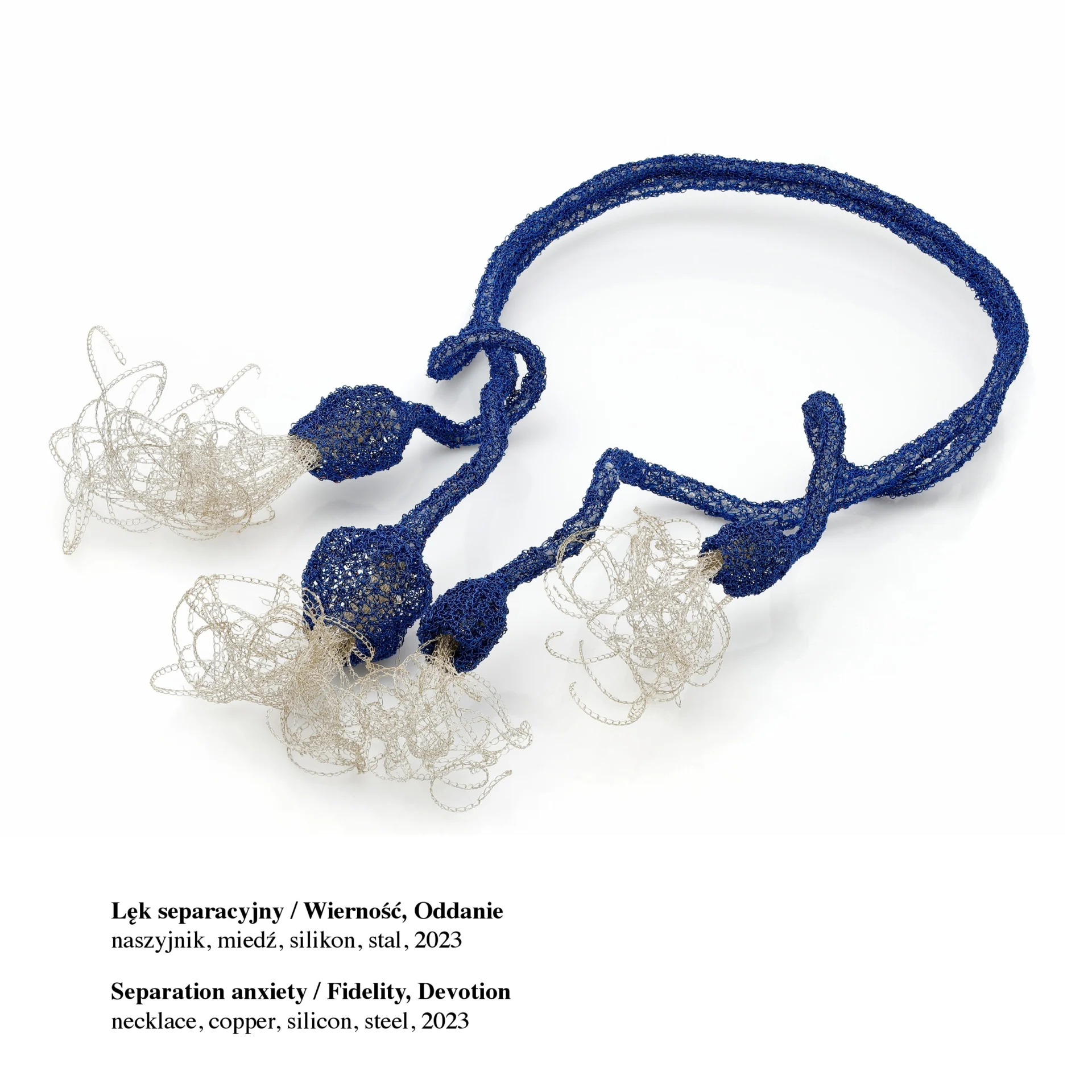
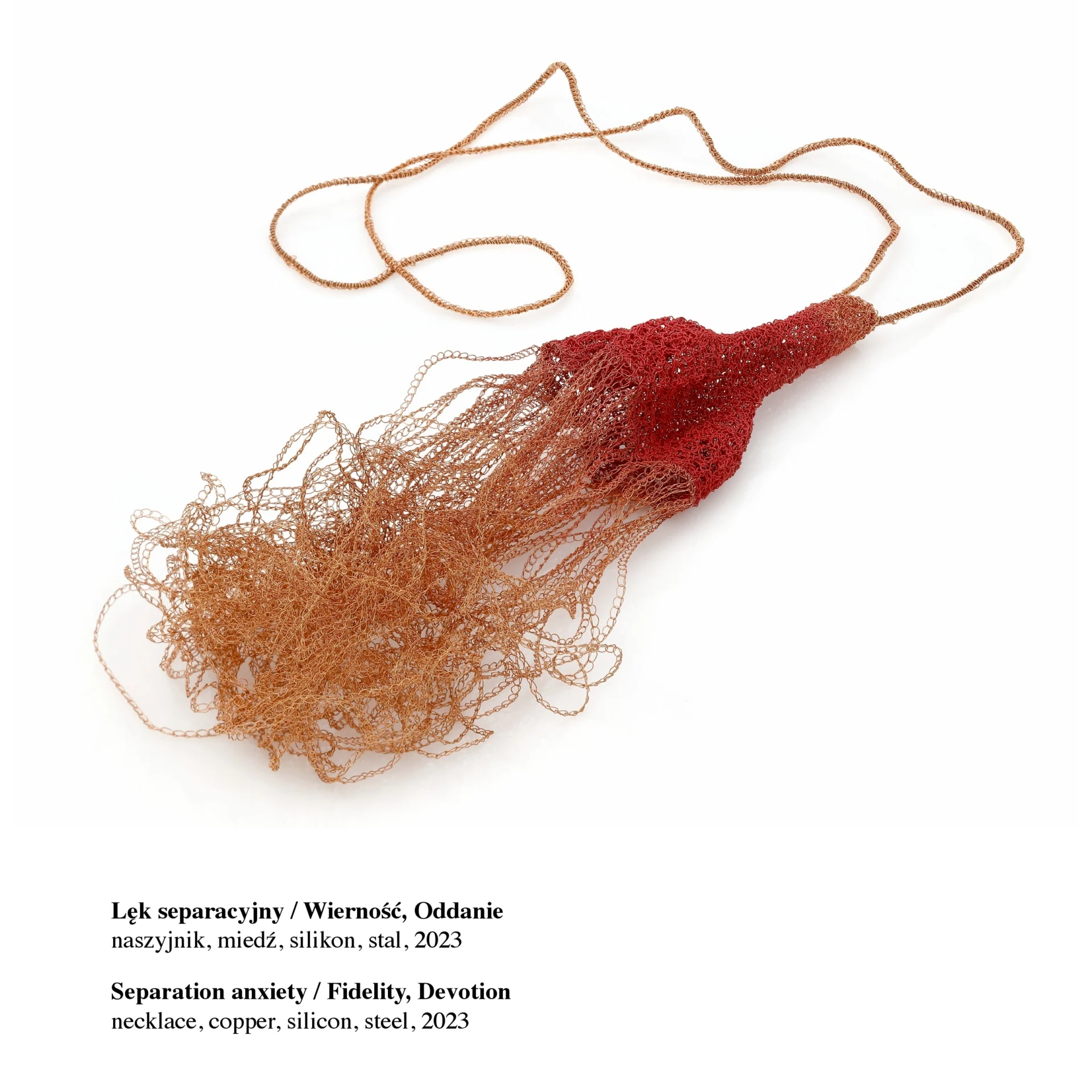
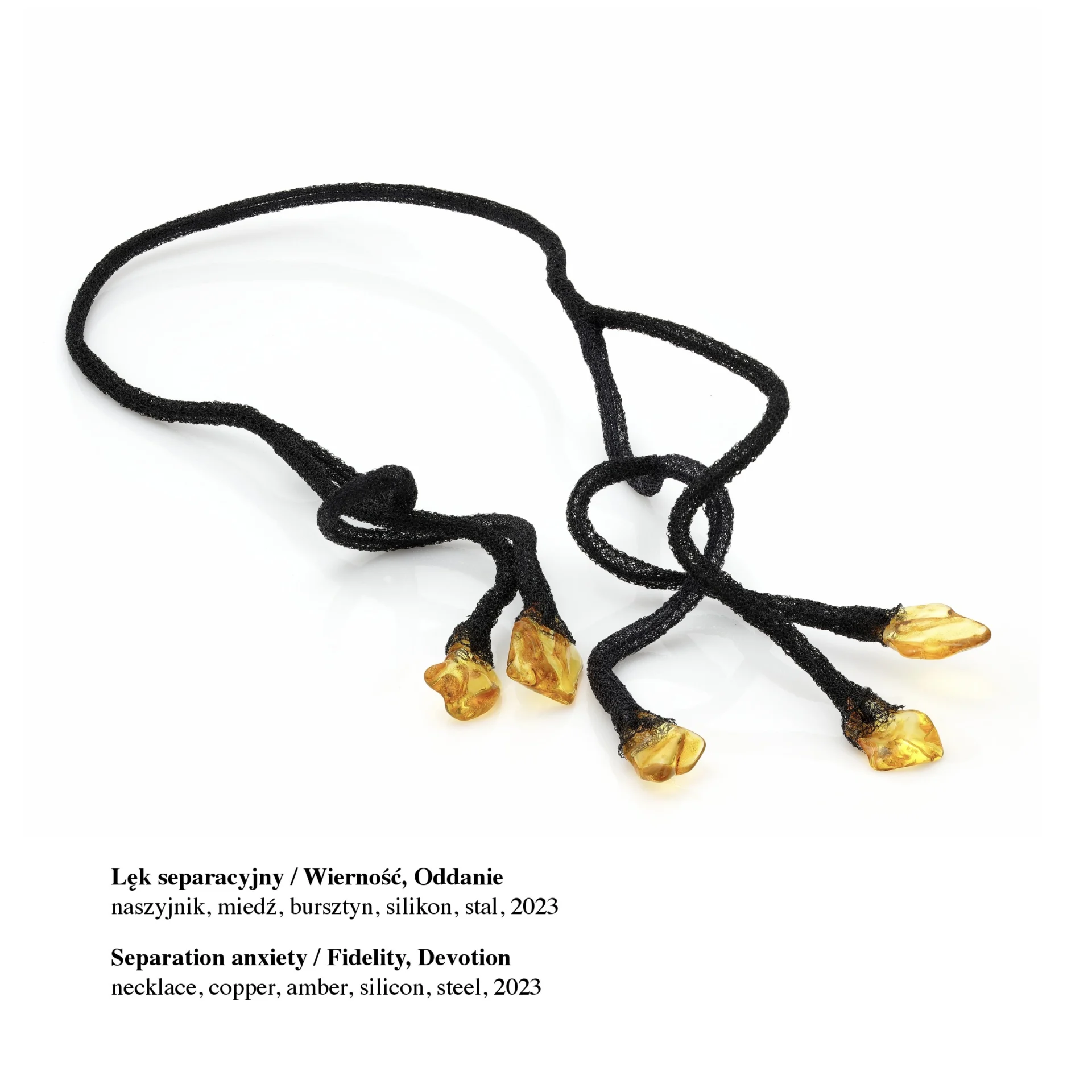
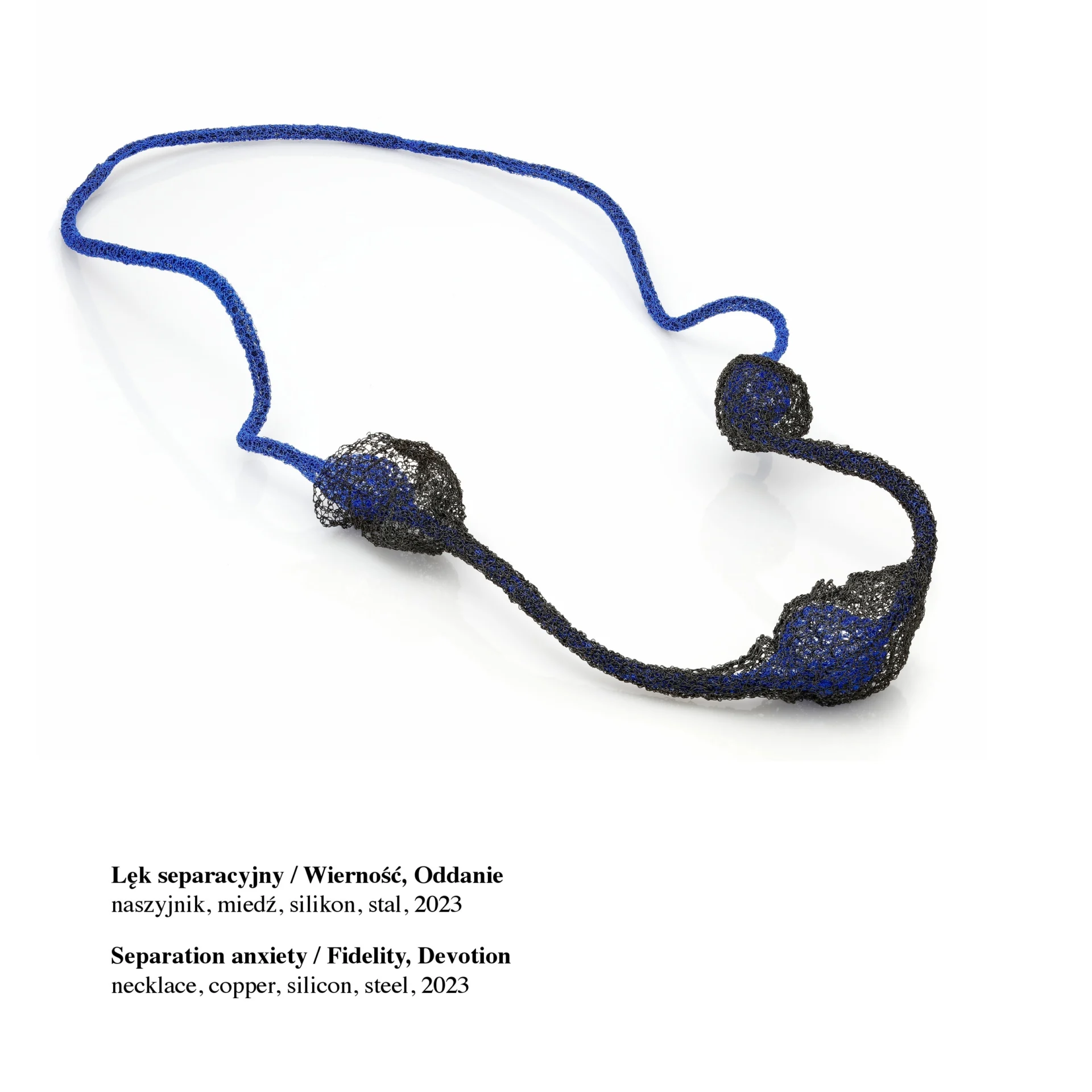
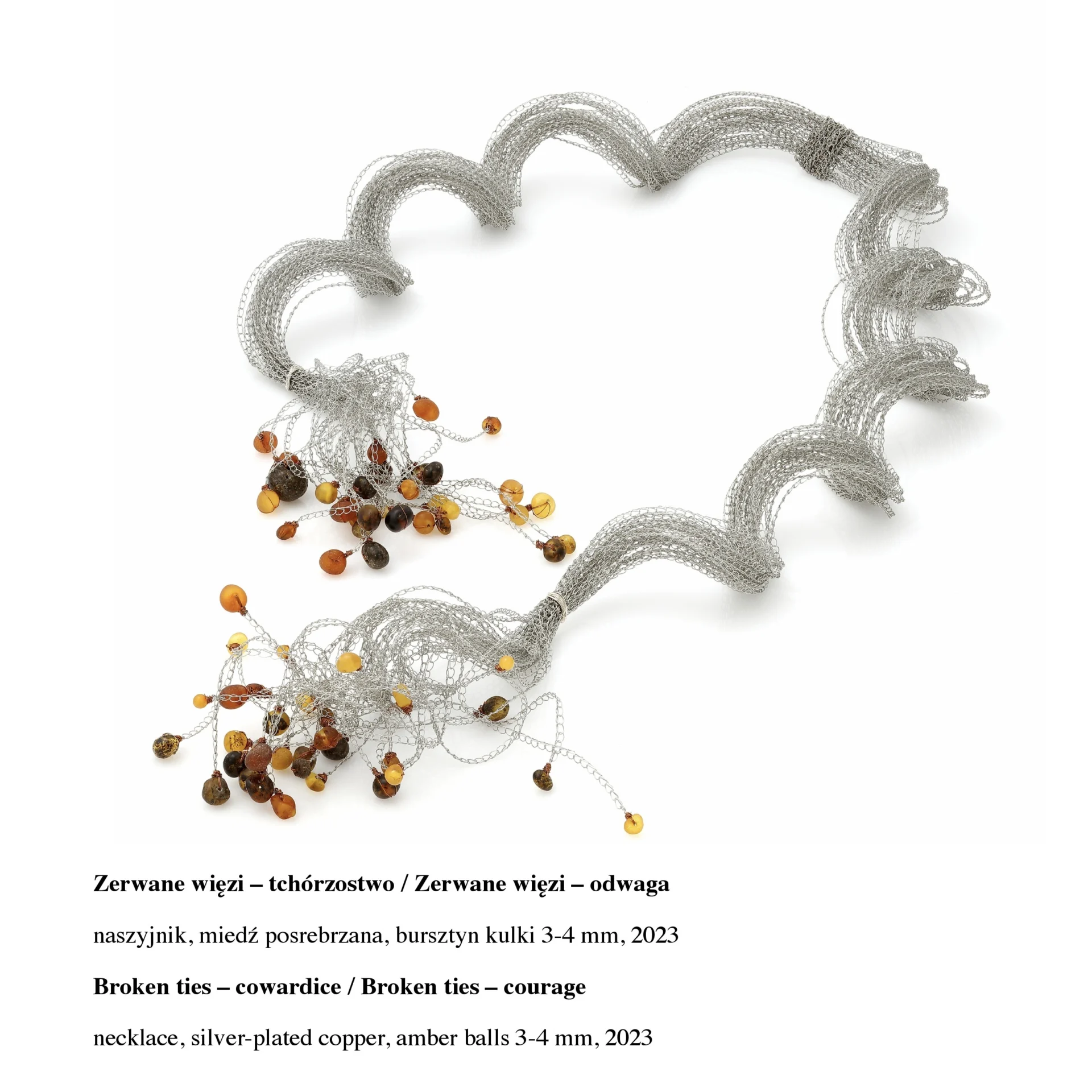
Actually, it was already the moment I found out about the prize I had been awarded. I submitted a brooch entitled „Perfection / Imperfection” to the Presentations competition. It was a piece about disagreeing with the patterns imposed on us to perceive the world, about how harmful it is to frosting reality, especially through social media. In this work, I wondered if what is perfect and ideal, or at least shown as such, really is so. And vice versa: whether something imperfect, with a flaw, can be original and valuable. This was the beginning of my reflections on relativism in the perception of reality. The Legnica exhibition is their continuation. It also so happened that I had a lot of stories around me recently that fitted perfectly with this theme and allowed me to think well about this exhibition. Although I can see examples of relativity in abundance, I ultimately limited myself to six themes: Cage/Shelter; Separation Anxiety/ Fidelity, Devotion; Bondage Breakdown - Cowardice / Bondage Breakdown - Courage; Social Anxiety / Comfort Zone; Mania / Creativity; Parasitism / Symbiosis. Each work has a title consisting of two parts - one positive and the other more dark.
I will therefore ask for an interpretation of this work.
This work is entitled „Cage / Shelter”. It tells the story of people who seem to live in a safe environment, isolated from all dangers. However, if we take a closer look at their lives we see that it is not a shelter, but a golden cage from which it is difficult to get out, which prevents them from living on their own terms.
And this brooch?
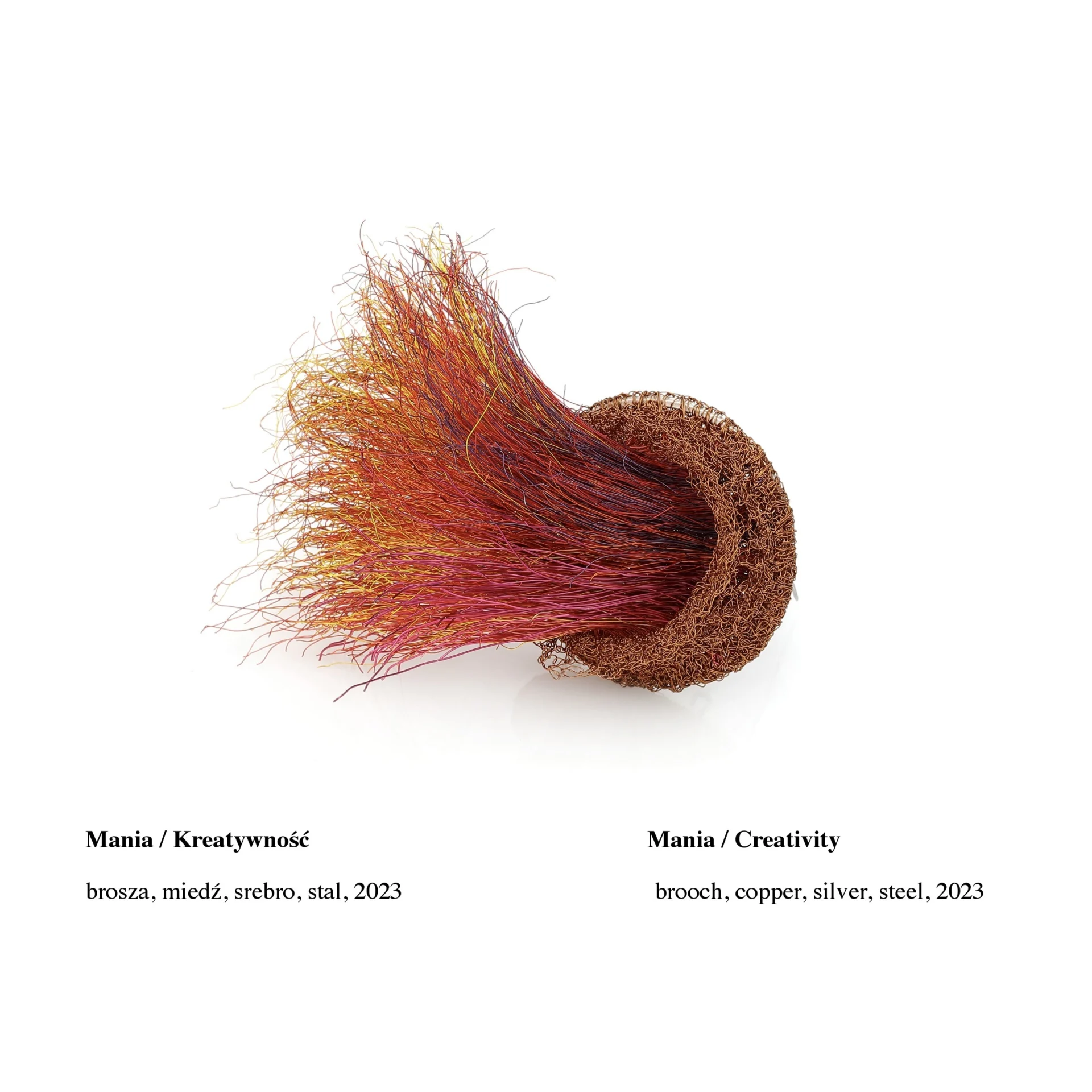
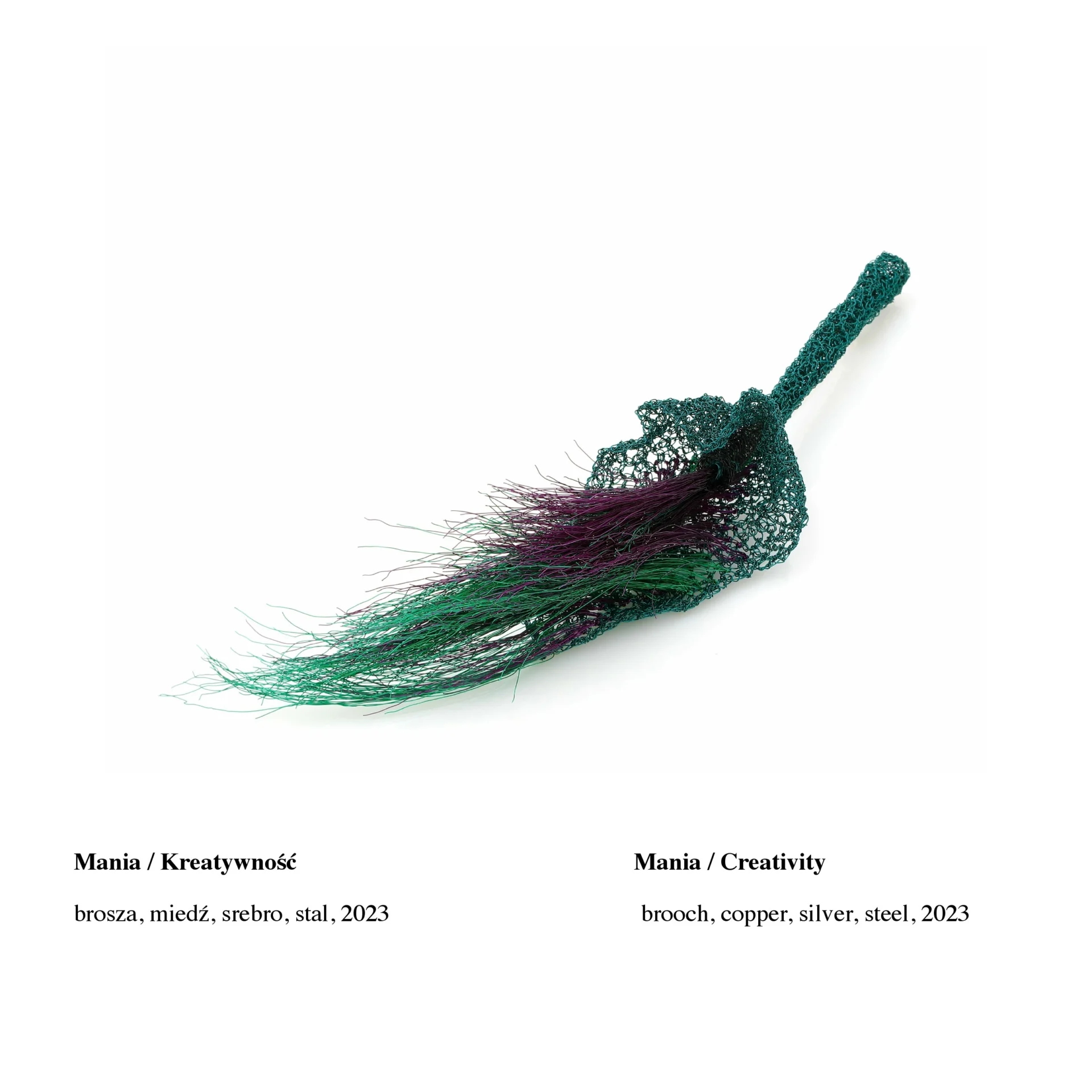
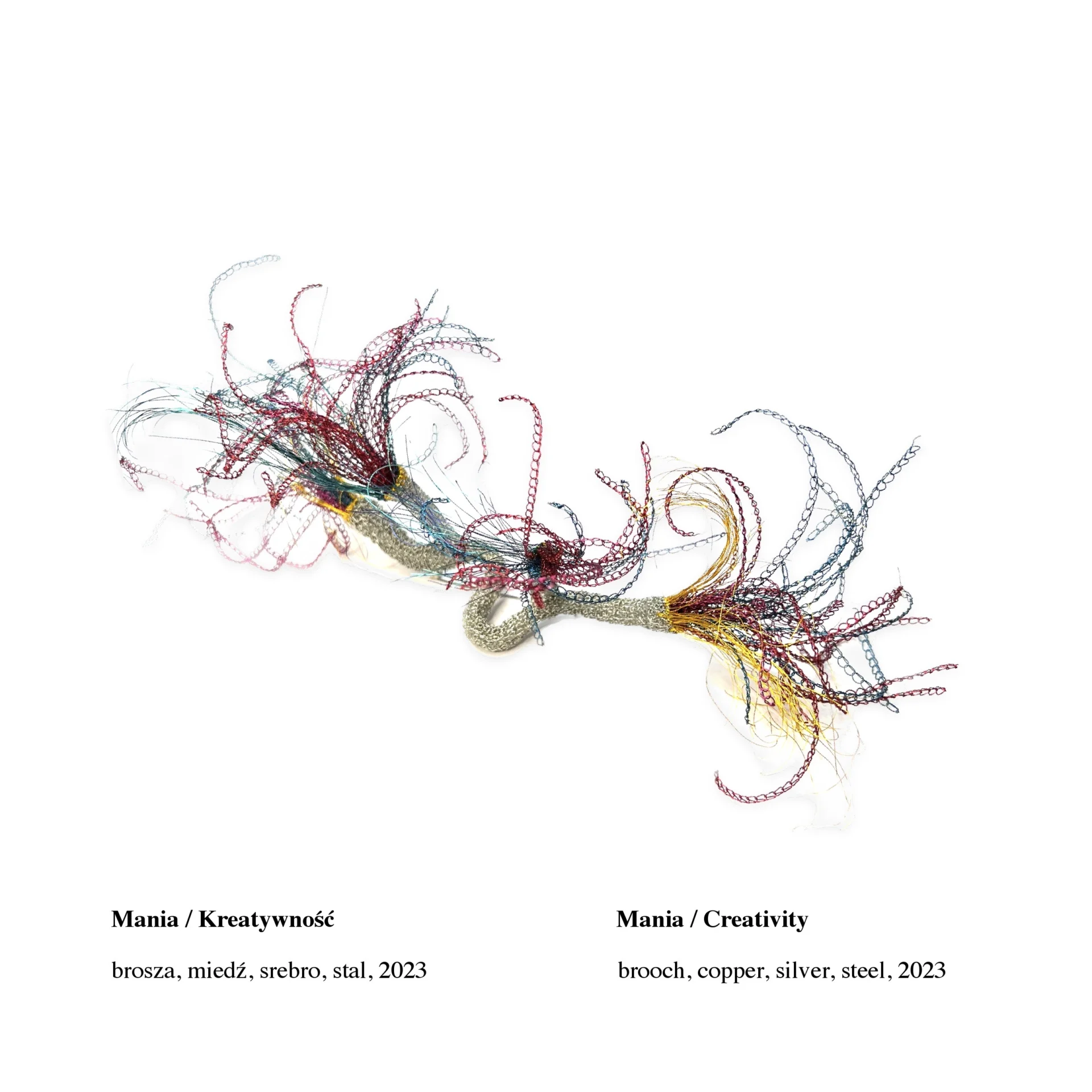
It was created for the theme „Mania / Creativity”. It was inspired by a story from my life: a friend of mine was having a great time, literally exploding with ideas, which I even envied her a little, until I found out she was being treated for bipolar disorder.
Very serious topics...
Yes. At first I had my doubts that jewellery would bear such difficult subjects... After all, we associate it as a pretty object that is supposed to be an ornament, a complement to an outfit. And then it occurred to me that, after all, that's what it is - ornate and lightweight, unless we know the context. This juxtaposition of heavy subject matter and lightness of form also intrigued me greatly - another relativism. In the next stage, there were doubts about the technique I was using - whether it was possible to tackle such serious subjects by making braids of coloured wire on a crochet hook. However, I came to the conclusion that this is, after all, my medium - I'm not a journalist, psychologist or even an influencer or celebrity, and I don't have the opportunity to speak in any other way about what affects me. Jewellery is the only way I can communicate what touches me, which is the result of my thoughts. Over the past few years I have had to deal with such difficult subjects, I have had to learn many things. It has made me very sensitive to other people and their individual situations. I had the feeling that the more I knew, the more I saw. It was as if my third eye had opened. I could see, for example, that behind the expensive clothes and the red lipstick on my friend's always smiling lips, there was deep depression. That the one I thought was a lifelong coward is actually a lifelong hero. That the person who seems to feel happy in their safe comfort zone is in fact unable to go „out to the people” and face new experiences. That a relationship that was an admirable symbiosis has turned into one in which only one person benefits, to the detriment of the other. I had a strong need to talk about these experiences, to get all these black thoughts out of my head. So it was a kind of self-therapy.
To encourage the public to actively participate in the exhibition, you gave them the opportunity to vote for one of the two title options. What were the results of this vote?
As each work has a title that consists of two parts, visitors to the exhibition can decide for themselves - by dropping a ball in the colour assigned to each of the two options into the glass containers set up by the display cases - which one better represents the object being viewed. The final outcome of the vote is less important to me than the inspiration to reflect on the discrepancy in perception of these objects. As we throw the balls into the glass container, we see that someone before us viewed the object and perceived it the same way we did, while someone else perceived it completely differently. And it was this moment that was meant to make us reflect on the discrepancies in our appreciation of the world around us.
You also allowed the audience to touch the jewellery, even play with it.
I wanted everyone to be able to touch the jewellery, try it on, see how they felt about it, so the showcases were open. Some of the necklaces can be shaped, bent and altered to your own liking. Some brooches - those made from thin wires using the wig-making method - can be combed and thus given a whole new shape. In these „wigukar” brooches, the haptic sensation is particularly important, as they evoke the softness of hair, whereas to the touch they are stiff, prickly. And here we have another relativism... I am very pleased that the audience at the opening reacted in line with my expectations. Almost all the visitors let themselves be drawn into my game: they touched, stroked, bent, rattled, looked inside, buckled, unbuckled, tried on, smiled at themselves in the mirror, took pictures of themselves. A collage of these photos is now part of the exhibition. In a word, they stayed longer with my works. And this is priceless for me.