
Your list of achievements in the field of applied design is long and impressive. Modern interiors, modern objects - and suddenly, out of nowhere, the amber that is considered not very modern.
My adventure with amber so far has been short and dynamic, although I embarked on the path that was to lead me to it a long time ago. The death of a loved one was such a turning point in my life, including my professional life - I became „bulletproof” and decided never to delay my plans again. It was then that I pulled out a somewhat dusty project called Migaloo Home, named after an albino whale that migrates along the east coast of Australia. This name seemed just perfect for a company whose designs are strongly nature-inspired and unique. I was able to raise funding for development and the first lines of furniture and lamps were quickly created. Some turned out to be an immediate commercial hit, such as the Stork lamp, which was presented at design exhibitions in Sofia, Zagreb and Milan. It always and everywhere raised a smile - so it was the perfect fulfilment of what I want to convey in my designs.
Although I specialise in space design, in fact the need to design a utilitarian object has always been dormant in me. This was happening, of course, but in an unconscious way: industrial design was often a hidden pretext for some projects, e.g. when I designed a hotel, I also designed fabric, and when I designed a house, furniture was also created on occasion. The preparation of the design was always preceded by an in-depth functional-utility study consisting above all of long conversations with the users. This is extremely important, especially because the objects we surround ourselves with express us, and as a designer I want to bring joy to people - I am optimistic about life and I really like it when people smile around me.
The next lamp was already with amber.
Yes, but first, completely by accident, I discovered resin. Already with the first sample - it was a cork board flooded with resin - I knew that this was exactly what I wanted to do. It took two years before we mastered the technology that allowed us to achieve the highest quality. After numerous trials, we managed to put together a proper offer and entered the Go to brand programme, which enabled us to show our designs at international trade fairs - even before we had shown anything on the Polish market. So we made our first business contacts abroad - and immediate success: our first customer was the luxury hotel chain Four Seasons Hotel!
Another important step was to be present at the non-commercial design exhibition in Venice, which is the main exhibition of the Biannale of Architecture in Venice. The fact that I was invited to participate was a huge success in itself - I'm the only Polish woman to have been invited so far! I wanted to show my best side, create something intriguing, innovative and at the same time interactive. And that's when amber appeared - a unique raw material from my home town of Gdansk. One of as many as five projects that were accepted for the exhibition was a lamp with an amber lampshade: modern, referring to the postmodern loft style. In it, amber was disenchanted from the spell of an old-fashioned, outdated form.
Encouraged by the success, you followed suit and created a table with a top in which ambers were embedded.
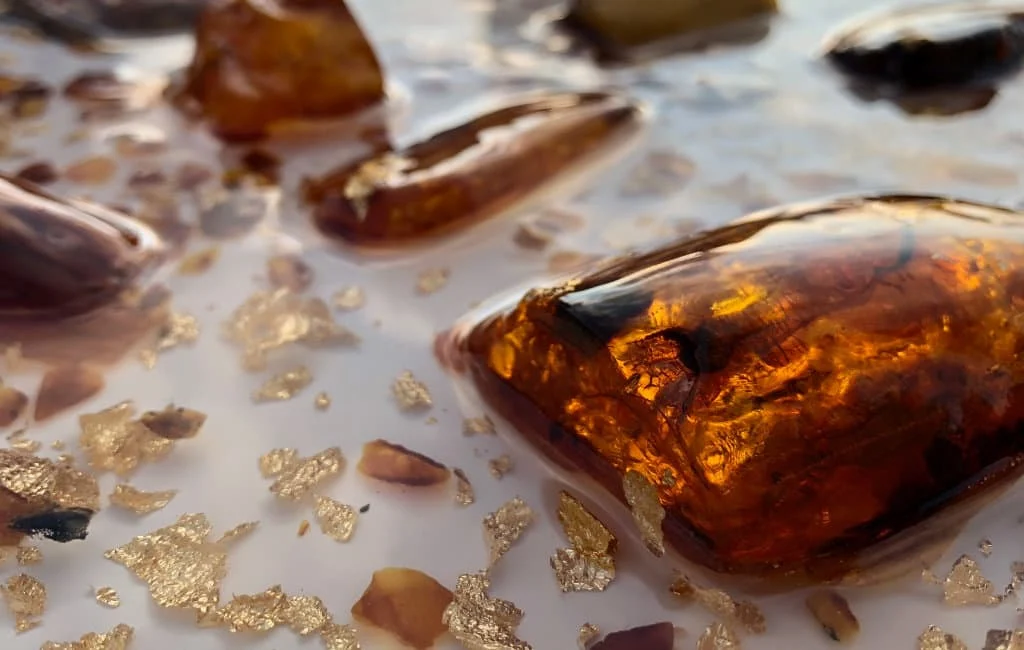
I had some of this amber left over, so I decided to use it for other projects. I was tempted to see what a table decorated with amber would look like. After pouring the resin, the stones protruded above the surface and were originally going to be sanded down, but at the last minute I changed my mind and they stayed just like that, protruding. Luckily, because this makes these tables even more eye-catching. One of them - a 60 x 60 cm table - turned out to be the hit of the Polish national stand at the Import Export Trades Shanghai fair last year: we experienced a real siege of interested parties! I was happy because, once again, interacting with my design made the recipients very happy. And I'm excited because I was able to create very modern objects with amber. I am positively surprising young people in particular, who associate amber with jewellery worn by older ladies. So far, I have already designed doorknobs, lamps, tables, handles, doorframes - proving that a lot of interesting objects, not only jewellery, can be made from amber. The longer I work with this raw material, the more clearly I see how great the need for a modern range is. The potential inherent in amber is enormous and I intend to continue to use it, thus contributing to its modern image.
Pairing natural amber with artificial resin? In the „species-purity”-conscious amber industry, this combination is invariably stigmatised. How do you deal with this?
I realise that the contrast between the artificial resin and the real one stings many people's eyes, but in my opinion it is this technology that brings out the beauty of amber. I don't do it to offend anyone's feelings or to shock, but because I strongly believe that this is a new, good way for amber. We should all look for new ways to show its uniqueness - everyone should have the chance and opportunity to do it their own way. I chose my own path and received many important signals from the outside that it was the right one: success at the Venice exhibitions and a very special success for me in Dubai, where we were the first Polish and the first non-Arab company to receive the audience award, and success at the Shanghai fair. Should I resent my customers for liking my designs? For them, it doesn't matter what I combine amber with, only that it evokes their positive emotions and they would like to own such objects. I love natural lumps - I consciously don't grind them down completely, and I also like to leave the „skin” - in this way I pay homage to the 40-million-year-old heritage, exposing it in new ways. It is my dream that amber in a modern version - whatever it may be - will appear in many noble salons. I have already started this trend and I hope that more pioneers ready to break the stereotypes will quickly appear.
It seems that we are all limited by them: not only the buyers, perceiving amber through the prism of grandma's beads, but also the producers themselves, attached to tradition and not accepting the combination of amber with modern materials..
Such thinking is unfortunately very limiting. It is a bit like resenting the progress of civilisation. Meanwhile, the rapid development of technology gives us many opportunities that it would be a sin not to take advantage of. I have repeatedly heard that I am „depreciating amber” and that „pouring nail polish over amber is awful”. I can even understand this attachment to tradition a little: one can spend a lifetime producing objects in accordance with a canon sanctified by tradition, but one can't help the fact that it is my objects that appeal to recipients all over the world. However, I am far from generalising, especially as I have also met on my way some sympathetic amber makers who felt that something interesting could come out of these ideas of mine and passed on words of support and amber for the first attempts. Mr Adam, Mr Wojtek - thank you very much!
I would not be surprised if, by breaking with past traditions, you charted new directions for the crisis-ridden amber industry. Like Nicolas Hayek, whose response to the crisis in the Swiss watchmaking industry was to launch... a plastic Swatch.
I use amber to design panels, paintings, furniture and other utilitarian objects; I do not deal in jewellery, so I am not and am unlikely to be in direct competition with jewellery manufacturers. But my products would be an interesting supporting product for those who have their own showrooms around the world and would like to use the power of my participation in the Venice Design Exhibition. While the average customer knows little about Poland, they will always associate the slogan Venice with art.

Amber designs by Monika Blaszkowska will be presented during the Amberif fair in Gdańsk (20-23 March) at the exhibition SMILE, IT'S AMBER! exhibition near the main entrance to Amber Expo.