You're not on the internet, not much is known about you - does that bother you?
No, not at all.
Because?
Generally speaking, it doesn't have much of a bearing on business, and being in the background also has its advantages. I observe people who care about their image and have a desire for glass, and I see that this often does not go hand in hand with business success.
You are not online, yet you are successful.
Do I know if these are successes...? Although I do make my living from jewellery, so I guess it's not too bad... (laughs). Generally, I've been working for years with mostly the same clients, with occasional new ones - for shorter or longer periods. That's good enough for me, because I have a small company, and I don't have very high expectations. I can't imagine what would happen if I had, say, 20 employees. Then I would probably have to take care of advertising on the Internet (laughs).
Retaining old customers is also quite a challenge.
One of my regular customers, when asked why a large amber jewellery shop in Warsaw had closed down, said: those who used to buy jewellery now buy medicine. So in that sense it is indeed quite a challenge (laughs). Fortunately, some time ago the Chinese came along and saved us.
They are also already buying less.
It is said that the Chinese market has saturated, but this is not entirely true. The Chinese are still buying jewellery with amber - especially those designs that they are not yet able to copy themselves (laughs).
You're not so simple to copy, are you?
In the age of 3D technology, everything is copyable, it just doesn't always pay off. It's just that these copies won't always sell in numbers that will satisfy the copyist.
The copier always has it easier, because it does not incur as much expense as the company that implemented the designs.
The Chinese market is quite specific. Design is of secondary importance, the quality of the amber is most important. I know loads of examples of Tricity companies that are quite good in terms of design, but they don't use the highest quality stone in their products, so they are not successful on the market there.
How is it in your case?
Generally, my design is strictly subordinated to good quality amber stones - that's how I would define it in the shortest way. I don't have any special ambitions, because I am aware that living and working in Poland as a jewellery maker, we have a chance to make a name for ourselves basically only in Poland and only thanks to amber - we have a lot of experience in this field and we are really very good. Now also in China, but only because there was a huge demand there, which we have a part in satisfying. I don't know of any Polish designer who has achieved spectacular - or at least any noticeable - success in the world by creating jewellery with, for example, diamonds. So we are doomed to amber.
Do you feel this as a strong constraint?
In a way, yes, because it would be nice to design and sell exclusive jewellery for a living. Like in China, where my necklaces reach very high prices indeed. But unfortunately only there (laughs). So I have exclusive lines and short series, but I also have designs that I actually mass produce - otherwise it would be difficult to live off jewellery. And I really like this job, because it gives me an enormous amount of satisfaction - even if it is often just plain tiring physical work. And it's much easier to make jewellery nowadays, because the access to the latest machines and tools is virtually unlimited. But I think I like to work hard - my co-workers laugh that the most important tools in my workshop are an angle grinder and a lathe (laughs).
Old school...
Yes, I learnt the profession from Maria and Paweł Fietkiewicz in the 1980s. Maybe profession is too much to say... Generally, I am self-taught and from Paweł Fietkiewicz I received some basic and at the same time valuable advice or tips such as how to melt metal, solder wire or sheet metal and polish a piece of amber with toothpaste (laughs). Today probably not many people know that at that time every amber jeweller had to make most of the tools himself. Also the polishing paste (laughs). Of course, the mere fact that I could be in the studio of such excellent artists from time to time and watch them at work was very inspiring. For those who don't know or don't remember, because it was a very long time ago: The Fietkiewicz family were among the forerunners of the use of amber as the main material in modern jewellery.
How popular was your new collection at Amberif?
There was no stunning success, but it is difficult to be stunned by anything at the moment. I am generally satisfied. In jewellery it is very difficult to come up with something new, especially when the stone determines the product. Every good idea is precious, and I'm getting on in years and getting fewer and fewer ideas. So I reheat the old ones that premiered many years ago (laughs). And as I am technically more experienced, ideas from more than 30 years ago get a new twist. It's easier now, too, thanks to technology: if you come up with a design line, you can continue it for several seasons. In the 1990s, when I was putting products into shops in the Gdansk Old Town every week or two, I kept hearing that this was already happening and that it was time to come up with something else. And I had to prepare these new designs every fortnight (laughs).
This means you now have a mine of „new” designs to offer!
Exactly! My former customers are probably already buying medicine, so no one will realise it's been done before (laughs).
And now seriously: however, you constantly surprise with innovative designs - you have received more than one award for this.
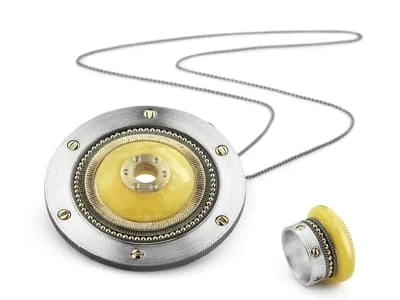
I'm the one who can seriously admit that when I started my adventure with jewellery, I was passionate about making these wire wraps - it was the fashion. It was a perfect example of form over substance (laughs). But I soon came to the conclusion that it was completely unprofitable from an economic point of view, and I embarked on the path of simple design, which I still follow today. This seems to really appeal - not only to the jurors in competitions, but also to the owners of amber companies: when I walk around Amberif, I have the irresistible impression that it has left a certain mark on the production of various exhibitors (laughs). The truth is that companies have multiplied, most of them do not create anything new, they just duplicate what others have invented, so it is rare to see something truly innovative.
You have had the opportunity to work with several large amber companies.
I used to actually make such attempts, because I had a lot of ideas that I wasn't able to „process” myself. But it probably won't come as a big surprise if I say that nothing came of it - for various reasons. There are no companies in Poland that are able to make money for both themselves and the designer. Well, okay, maybe there are a few, but they already have their own designers.
If someone came forward now, would you say no?
If it's Bulgari, I won't say no (laughs).