In accordance with the new Act of 9 June 2011 „Geological and Mining Law”, the prospecting and exploration of amber do not require a concession, as amber, as a gemstone, is not covered by mining ownership (only a geological works project is required). A concession is necessary for the exploitation of deposits.
Due to the stochastic, irregular forms of amber accumulation and the specific nature of the exploitation methodology, it would be advisable to conduct prospecting, exploration, and extraction work concurrently (Nieć et al., 2010). Therefore, the regulations of the „Geological and Mining Law” did not fully take into account the needs reported by geologists (Jurys et al., 2008) to adapt the law to the specificities of exploiting this mineral resource. Consequently, the problem of illegal, unauthorised extraction, which contributes to the devastation of forest areas and prevents the methodical, rational management of amber deposits, still remains unresolved.
In Poland, amber deposits are genetically linked to Palaeogene and Quaternary sediments. Due to the extensive nature of the subject, the regions with the largest currently documented and significant — known from historical records — amber reserves will be presented first. A compilation of all find sites and former amber mines in a catalogue and on maps, divided by voivodeship, was developed at the Museum of the Earth, Polish Academy of Sciences. The catalogue contains a list of 744 entries (Kosmowska-Ceranowicz, 2002). Research conducted by one of the authors (A.M.) into German-language literature and historical cartographic materials indicates the need for a further update of the catalogue.
Exploitation of Baltic amber deposits from Holocene sediments
Amber deposits accumulated in the Holocene occur on the surface of the earth or at shallow depths, primarily on the coast of the Bay of Gdańsk. Amber accumulations are also found on the bottom of the bay. Due to their widespread occurrence and relatively easy accessibility, succinite deposits redeposited in the Holocene were the earliest to be recognised and exploited. Initially, this was mainly the collection of amber nuggets accumulated during the coastal sedimentation process. The areas of historical and contemporary exploitation of amber deposits from Holocene sediments in Poland are the Vistula Spit and the Vistula Delta.
Amber has been permanently extracted in the coastal part of the Vistula Delta since the Neolithic period (Zalewska, 1971). The oldest traces of Baltic amber extraction inland from Holocene deposits date back to 2500-2200 BC and have been documented by archaeologists in the Vistula Marshes (Mazurowski, 2005). Amber accumulated in Holocene deposits on the Vistula Spit has been excavated at least since the 16th century (Kosmowska-Ceranowicz and Pietrzak, 1985).
Intense, industrial exploitation of amber in this region took place in the 19th and 20th centuries. At the beginning of the 19th century, the yield of mines built „on the Gdańsk shores” was high, according to the prominent naturalist of that period, A. Humboldt (1861), greater than that of Samlandian mines. In the vicinity of Wisłoujście, three amber mines were built in the second half of the 19th century; their exact location was presented on the Gdańsk sheet of the Geological Map of the Province of Prussia (Geologische Karte der Provinz Preußen) on a scale of 1:100,000 (Berendt, 1871). At that time, amber was also extracted in the villages of Brzeźno and Stegna (Klebs, 1883).
In 1868, intensive exploitation of Holocene deposits was carried out near Stegna by the company „Stantien & Becker”. Amber was extracted in a pine forest, about 1 km from the sea coast, from a depth of approx. 5 m. The walls of the excavation, about 4 m wide, were reinforced with wooden casing. After hitting the groundwater level, the water was removed using large wooden spades, and succinite was extracted from under the water using "kaszorki", which were special nets mounted on long poles (Zaddach, 1869).
In the early 20th century, large quantities of raw amber were accidentally discovered during construction work on the port of Gdynia. During the building and dredging activities carried out between 1924 and 1934, significant amounts of amber nuggets were recovered, some weighing as much as a couple of kilogrammes (Kosmowska-Ceranowicz, 2004).
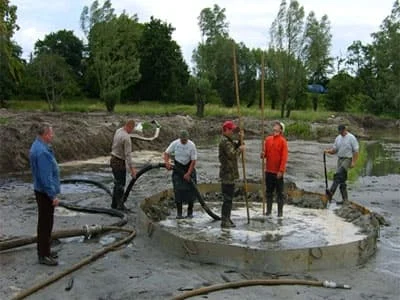
Systematic exploitation of Holocene deposits in the vicinity of Gdańsk resumed in the 1970s (Listkowski and Łazowski, 1975). In May 1972, 14 concessions for amber extraction were issued in Gdańsk (www.gdansk.pl). In the same year, during the exploitation of the „Wisłoujście” deposit, located in the Stogi district of Gdańsk, hydraulic methods were used for the first time for amber extraction (it was likely used for illegal amber exploitation as early as the 1960s). Hydromechanical technology currently represents the most efficient method for prospecting and extracting amber deposits (Jurys et al., 2008). This method involves creating „dynamic, travelling funnels” within a metal hoop using a strong stream of water directed vertically downwards. The water stream is supplied to the head via a flexible hose and is manually submerged into the sediments using manipulation rods. The water erodes and lifts the extracted material to the surface, where it is then retrieved using a sieve with a mesh size of 0.5 cm. The exploitation depth can reach up to several metres (Nieć, ed., 2010).
As a result of geological work carried out in the early 1970s, the Wisłoujście, Górki Zachodnie, Sobieszewo-Komary Pole1 and Sobieszewo-Komary Pole2 deposits were documented. In later years, documented in category C1 two loose deposit amber deposits: in 1996 the „Wiślinka” deposit located in Żuławy Wiślane (reserves 3.3 tonnes) and in 2009 the „Przeróbka” deposit located in the Gdańsk area (reserves 17 tonnes). These are currently undeveloped or partially developed deposits.
The largest documented Holocene amber deposit to date was the „Wisłoujście” deposit, which has now been depleted. For an area of 70 hectares, amber reserves were estimated at 178 tonnes (Jurys et al., 2008). Due to earlier exploitation of the raw material in this area in the 19th century, mentions of amber extraction in the accounts of 18th-century naturalists, and illegal mining in the 20th century, the reserves of the „Wisłoujście” deposit must have been considerably larger.
The area located in the Vistula Delta has currently been recognised as highly and moderately prospective, and in the Gdańsk region, exploration and appraisal works are being carried out on land owned by the District of Gdańsk City (Jurys et al., 2008; Nieć, ed., 2010).
Searches for amber deposits were also conducted on the bottom of the Gulf of Gdańsk, in the submarine part of the Vistula Delta. Since the late 70s of the last century, methodical amber searches have been undertaken several times in the coastal zone. One of the methods used was the hydromechanical method, applied in 2005 by Przedsiębiorstwo Robót Czerpalnych i Podwodnych sp. z o.o. from Gdańsk. The excavation of exploration workings was carried out using a cutter suction dredger, the work of which involved sucking up sediments from the bottom and discharging the spoil through a floating pipeline system to a working pontoon equipped with screens. The spoil from the dredger, after the mechanical separation of amber on sieves, was stored in a previously excavated working on the seabed (Jurys et al., 2008).
Historical exploitation of Baltic amber deposits from Pleistocene sediments
Deposits of Baltic amber genetically linked to the redeposition of palaeogene amber-bearing formations during the Pleistocene glaciations now have mainly historical significance. These are virtually entirely depleted deposits today, previously intensively exploited in the 18th and 19th centuries in areas including Kurpie, the Tuchola Plain, the Kashubian Lake District, the Kashubian Coast, and the Słowiński Coast. One of the oldest regions in Poland where amber was dug was presumably the outwash plains in Kurpie. German researchers believed that amber had been obtained in the vicinity of the Narew river as early as the time of Pliny the Elder (Klebs, 1883).
In the early 19th century, the extraction of amber deposits in Kurpiowszczyzna became organised, reaching its peak in the first half of the 19th century. The area where amber occurred was limited by lines connecting the towns of Nidzica – Szczytno – Ruciane – Pisz, Pisz – Kolno – Nowogród, Nowogród – Ostrołęka – Krasnosielc, and Krasnosielc – Chorzele – Janowo – Nidzica. To exploit the amber, numerous shafts were dug to a depth of up to 1 m below the surface. Between 1835 and 1836, 1,435 kg of amber was extracted in the Ostrołęka forest district alone. Amber extraction on private land was usually carried out by the landowners themselves. On government land, however, amber-bearing areas were leased through auction. Government mines in the Kurpie region were closed between 1827–1839, but the last legal mine in Ostrołęka was still leased in 1850. Between 1880 and 1900, amber was still commonly dug on private land. In the vicinity of Rżaniec, intensive extraction continued until the outbreak of World War I (Małka, 2010).
Historical mining areas in the Kurpie region were re-examined in the 1970s. In 1977 and 1979, initiated by the State Enterprise „Jubiler” in Sopot, the Geological Combine „Północ” in Warsaw, together with PP „Jubiler”, conducted geological prospecting works on the Kurpie Plain. The research covered three areas: the Rozoga river valley, the Omulew river basin in the Lelis municipality, and the Czarnia-Surowe region in the Myszyniec municipality. In total, 73 boreholes were drilled using the percussive-rotary method and 1397 hydraulic boreholes were sunk to a depth of up to 10 m. As a result, no amber deposits suitable for hydraulic mining were found, and the surveyed areas were assessed negatively (Gradys, 1981). This region currently plays no role in the amber raw material economy.
Another rich area for amber exploitation in the 18th and 19th centuries was the moraine region around Gdańsk and its surroundings. Pleistocene deposits were found within the present-day city of Gdańsk in Oliwa Forest, Trzy Naprzedy, Brętowo, and in the area of today's Gdańsk districts: Klukowo, Firoga, Bysewo, and Kokoszki. Succinite was also recovered in the present-day Gdańsk County in the villages: Kleszczewko, Różyny, Łęgowo, Kłodawa, Goszczyno, Bielkowo, Lublewo, Kowale, and also in Bąkowo on Bursztynowa Góra. Mining exploitation of amber deposits was mainly carried out using open-pit methods, and primitive underground mines were also built (reaching depths of up to about 20 m, so-called shored multi-shaft mines). In Klukowo, between 1869 and 1971, amber was extracted in four mines located near the village of Dreieck (Trzy Naprzedy) and Viereck (currently the Firoga district in Gdańsk). The exact location of these mines was shown on the Gdańsk sheet of the Geological Map of the Province of Prussia (Geologische Karte der Provinz Preußen) on a scale of 1:100,000 (Berendt, 1871).
Pleistocene amber deposits were also exploited in the 19th century in Bąków, on Bursztynowa Góra, and in nearby Lublewo. Pleistocene amber accumulations comprised entire packages of Paleogene amber-bearing sediments transported by the glacier in the form of glacial erratics, as well as dispersed grains and pebbles.
At the beginning of the 20th century, as part of cartographic work, geological surveys were carried out in the area, which allowed for the determination of the extent and nature of the deposits. In the explanations to the geological map of the Pruszcz Gdański sheet from 1903 (Wolff, 1903a,b), we find descriptions of Palaeogene amber-bearing deposits, the so-called „blue earth”. The age of these deposits was precisely determined for that time as the Lower Oligocene. These deposits were documented during geological mapping surveys, including at Bursztynowa Góra near Bąkowo. Geological surveys in the area of Lublewo, Kokoszki, and Klukowo were revisited in the 1970s – however, no amber nodules were found in the cored deposits (Sylwestrzak, 1975).
The only currently prospective area for amber occurrence in Pleistocene deposits is the Możdżanowo region on the Słowiński Coast. The amber deposit has been known here since the second half of the 18th century. Between 1782 and 1784, many mines founded by the merchant Liepmann were operated in the vicinity of Starkowo and Możdżanowo. These were usually shallow workings, reaching a maximum depth of 4 m below ground level (Małka, 2010). Further exploitation was abandoned after the groundwater table was reached.
Later, between 1950 and 1956, deep boreholes were drilled in Możdżanowo to explore the deposit, and in 1957, exploration work for amber deposits was carried out in the area. In the years 1974–1975, 13 boreholes were drilled to an average depth of 20 m and two deeper boreholes, M I to a depth of 173.5 m (this borehole reached the top of the Mesozoic formations) and M II to a depth of 70.3 m. Both mentioned boreholes reached the Paleogene layers lying in situ. Amber was documented in 11 boreholes. The research showed that a glacial erratic – a fragment of Upper Eocene sediments – is located shallowly beneath the surface at a depth of 2.5–6.0 m below ground level, within Quaternary deposits. The erratic deposits consist of silts, clays, sometimes xylite with lignite, and quartz sands with amber fragments. The Paleogene formations in the secondary deposit reach a thickness of 12.4–33.8 m. Amber occurs here in the form of unevenly distributed nests. The age of the Paleogene erratic deposits is determined as Upper Eocene, and the occurrence of amber is associated with the Połczyn horizon of the lower Mosina Formation (Błaszak, 1987; Kramarska et al., 2010).
The geological balance reserves of amber in the Możdżanów region have been estimated at 10 Mg (Szufilcki et al., eds., 2012). Due to a lack of investors, the deposit has not yet been developed.
Prospects for the exploitation of Baltic amber deposits from Palaeogene sediments
The Palaeogene Baltic amber deposits found in Poland have never been exploited and are not exploited to this day. The amber-bearing association of Palaeogene age occurs in two regions: in the area of northern Lublin Voivodeship and in the Władysławowo region. In northern Lublin Voivodeship, the occurrence of amber-bearing deposits is associated with the Siemien formation dated to the late Bartonian (Woźny, 1966) and Priabonian (Kasiński and Tołkanowicz, 2007). The cover of Palaeogene sediments in the discussed region is formed by Quaternary clastic deposits. Most often, these are yellowish-brown and grey fine- and medium-grained quartz and polymictic sands, sometimes silty, very fine-grained silty sands, and loess-like glacial clays.
In 2004, the „Górka Lubartowska” deposit was documented in category D. The estimated reserves were 1088 Mg with an average grade of 376.8 g/m2. The amber-bearing association in this area occurs at shallow depths (average elevation of 12 m), and the average thickness of the ore layer is approx. 10 m (Kasiński and Tołkanowicz, 1999). Due to a lack of investors, the deposit has not been developed to date.
Another area where amber occurs in Palaeogene sediments is the vicinity of Władysławowo. Amber-bearing sediments on the Kashubian Coast have been identified in the area of Kępa Swarzewska and Kępa Pucka and in the dividing Płutnica valley, reaching as far as the vicinity of Karwia and the Hel Peninsula. The amber-bearing formation occurring in the Władysławowo region of the Kashubian Coast represents the western extension of the rich Sambian deposit. The amber-bearing series is genetically linked to the Chłapowo-Sambian delta sediments, the so-called Palaeogene Gdańsk delta (Kosmowska-Ceranowicz et al. 1990; Kramarska et al., 2008).
The occurrence of amber in the Palaeogene deposits on Swarzewo Peninsula was identified during geological surveys of salt deposits between 1965–1972 (Marzec and Woźny 1972). In order to more accurately assess the quality and quantity of amber, three full-core geological exploration boreholes with a diameter of 132/112 mm were drilled between 1981–1983: Chłapowo I, II, and III. Based on the data from all boreholes, the extent and thickness of amber-bearing deposits were determined, and based on core analysis from the three boreholes drilled between 1981–1983, amber reserves and the concentration level of amber in the sediment were estimated (Olkowicz-Paprocka, 1983).
Paleogene and Neogene research conducted in subsequent years in the Baltic Sea and on its coast has shown that amber-bearing deposits continue eastwards onto the Hel Peninsula, where these formations were cored in 1992 in cartographic boreholes in Chałupy and Kuźnica (Kramarska et al., 2008). The Paleogene amber deposit at Chłapowo is not currently being exploited, and its potential future development will likely be linked to new discoveries in terms of effective technologies for exploiting this raw material from significant depths and the depletion of deposits located closer to the surface.
An interesting proposal for exploiting these deep Palaeogene deposits is the hydromechanical borehole technology, commonly used for extracting glass sands and phosphate sands mined deep underground and from the seabed (Nieć, ed., 2010). Perhaps this very method, in the future, after the depletion of surface and shallow amber deposits, will help to meet the raw material shortages on the market.
Literature
- Berendt G., 1871 – Geological Map of Prussia. Section 12 Danzig. Scale 1:100,000. Berlin. Neumann.
- Berendt G., 1866 – The Amber Deposits and their Extraction. W: Writings of the Royal Physico-Economic Society, 7107–130. Königsberg.
- Błaszak, M. 1987 – Amber in Tertiary deposits in the vicinity of Możdżanowo near Słupsk. Biul. Panstw. Inst. Geol. 356; 103-119, Warsaw
- Braun J.G. (ed.), 1802 – Über die Bernstein Gräbereien in Hinter-Pommern. Braun J.G, Berlin.
- Gradys A., 1981 – Report on geological and exploration studies of amber deposits in the middle Narew basin in the Kurpie Plain area in the communes of Lelis, Kadzidło, Myszyniec, Ostrołęka Voivodeship. CAG PIG, No. 29610
- Humboldt A., 1861– Travels of Alexander Humboldt, vol. II, Travels in European and Asian Russia, translated by M. Szyszko-Bohusz. Vilnius.
- Jurys L., Kramarska R., Oller M., Cylkowska H., 2008 – On the methodology of documenting and exploiting Holocene amber deposits in the Vistula River delta. Open-pit mining, 2–3: 111–118.
- Klebs R., 1883 – Extraction and Processing of Amber. 37, Hartungsche Buchdruckerei, Königsberg.
- Kasiński J., Tołkanowicz E., 2007 – Geological position of amber concentrations in South-East Poland. In: P.F. Gožik, V.M. Macuy, L.S. Galeckiy, S.O. Mačulina, G.V. Klūšina [eds.]: “Ukrainian Amber World” – Abstracts of the First International Conference, National Academy of Sciences
- Kasiński J., Tołkanowicz E., 1999 – Amber in the northern Lublin Region – origin and occurrence. In: B. Kosmowska-Ceranowicz, H. Paner [eds.]: Investigations into amber, 41-51, Archaeological Museum in Gdańsk, Gdańsk.
- Kosmowska-Ceranowicz B. & Pietrzak T., 1985 – From the history of the development of knowledge about amber finds and their presentation on historical and contemporary maps. Prof. Music of the Earth, 37: 27–60.
- Kosmowska-Ceranowicz B., Kociszewska-Musiał G., Musiał T., Müller C., 1990 – Tertiary amber-bearing deposits in the vicinity of Parczew. Museum of the Earth Works 41 seconds. 21 to 35.
- Kosmowska-Ceranowicz B. & Pietrzak T., 2002 – Finds and old amber mines in Poland. 158, Stacha Konwy Kurpie Library. Łomża.
- Kosmowska-Ceranowicz B., 2004 – Amber deposits in the Pomerania Province. Works of the Museum of the Earth,47, 63–72.
- Kramarska R., Kasiński J. R., Sivkov V., 2008 – Palaeogene amber in situ In Poland and neighbouring countries – Geology, exploitation, prospects. In: Open-pit mining, 2–3: 97–110, Wrocław.
- Listkowski W., Łazowski L., 1975 – Results of investigations of amber deposits in the vicinity of Gdańsk. Prz. Geol. 23, no. 8: 385–388.
- Małka A. 2010 – Former mines and methods of exploitation of Baltic amber deposits. Bulletin of the Polish Geological Institute, 439: 491–506. Warsawhttp://www.pgi.gov.pl Last visited 15.01.2013.
- Marzec M., Woźny E., 1972 – Lithology and stratigraphy of Tertiary deposits in the vicinity of Jastrzębia Góra near Puck. Przegl. Geol. 20:12; 562-570, Warsaw.
- Mazurowski R., 2005 – The role of Żuławy Wiślane in the development of prehistoric amber production and exchange networks with the interior. W: (red. Kosmowska-Ceranowicz, Gierłowski) „Amber views, opinions. Materials from the Amberif seminars 1994–2004”. 111–118, MSB, Gdańsk.
- Nieć M., Kramarska R., Sałaciński R., 2010 – Prospects for amber deposits exploration in Poland. In: Scientific Papers. Mineral and Energy Economy Research Institute of the Polish Academy of Sciences, no. 79. 345-361.
- Nieć M. (ed.), Jurys L., Kasiński J. R, Klich J., Kramarska R., Listkowski W., Łazowski L., Małka A., Mucha J., Sałaciński R., Saternus A., Urbański P., Zieliński K., 2010 – Principles for the exploration and documentation of amber deposits. Methodological recommendations. Warsaw.
- Olkowicz-Paprocka I., 1983 – Amber prospecting in Tertiary deposits of the Chłapowo region. State Geological Institute, 62 p., CAG PIG. Warsaw.
- Sylwestrzak U., 1975 – Geological ruling on the occurrence of amber deposits in the vicinity of Sobieszewo-Komary village, Gdańsk Voivodeship. CAG PIG, no. 3128/55.
- Szufilcki M., Malon A., Tymiński M., (eds.), 2012 – Balance of mineral resources deposits in Poland as of 31 XII 2011. 90–91. PIG–PIB. Warsaw.
- Wolff W. 1903a – Geological map of Prussia and adjacent federal states. Scale 1:25,000. Sheet Praust. Royal Prussian Geological Survey and Mining Academy. Berlin.
- Wolff W. 1903b – Explanations to the Geological Map of Prussia and adjacent federal states. Sheet Praust. Royal Prussian Geological Survey and Mining Academy. 5-6; 39. Berlin.
- Woźny E., 1966 – Phosphorites and amber from Siemień near Parczew. Przegl. Geol., 14:6; 277-278, Warsaw.
- Zaddach E.G., 1869 − Observations on the occurrence of amber and the extent of the Tertiary mountains in West Prussia and Pomerania. WeatherWritings of the Royal Physico-Economic Society, 101–82. Königsberg.
- Zalewska Z., 1971 - Baltic amber and its deposits. Universe January 10, 261- 265.
- http://www.gdansk.pl/ Last visited 15.01.2013
The article appeared in a publication summarising the International Symposium of Amber Researchers “Deposits – Collections – Market” during the Amberif 2013 trade fair.