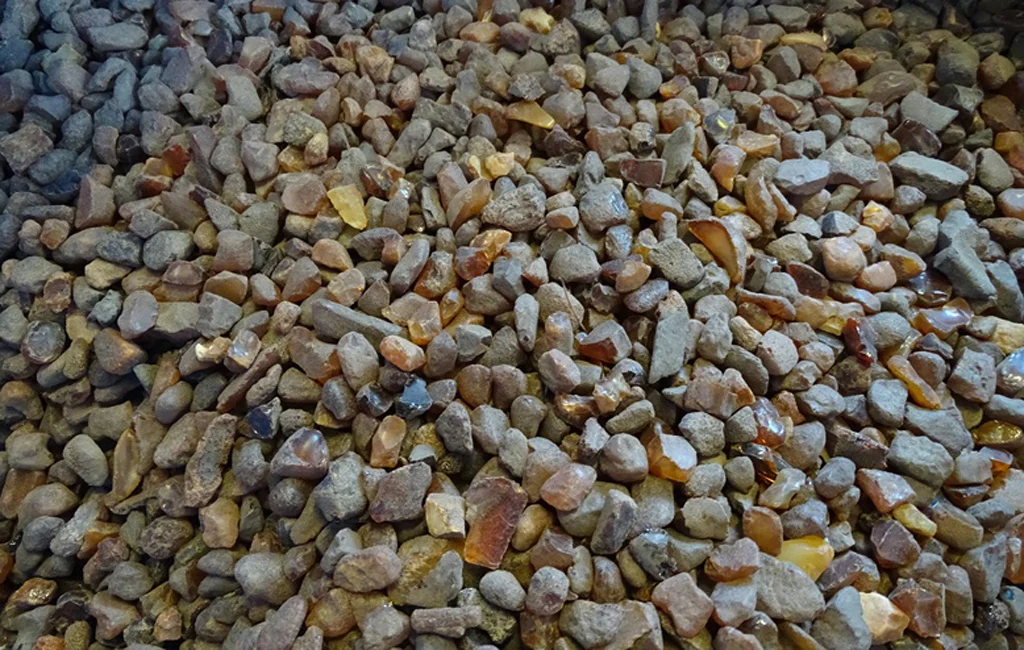
The concentrations of amber in Poland are linked to Palaeogene (in situ accumulations) and Quaternary (secondary accumulations) formations. Upper Eocene amber-bearing deposits occur under a considerable overburden on the Baltic Coastal Plain and in the area of northern Lublin Voivodeship. Dispersed concentrations in Quaternary deposits are associated with fossil and modern beach deposits on the Baltic coast. Their formation is linked to the redeposition of Palaeogene amber-bearing formations during the Pleistocene glaciations. According to legal requirements (in force from 01.01.2002), the maximum depth for documenting amber deposits is 30 m, and the minimum yield for balanced reserves is 80 g/m.2 and for off-balance sheet items – 40 g/m2.
The geological balance reserves at the end of 2011 amounted to 1,118 tonnes of amber documented in four deposits: Górka Lubartowska, Możdżanowo, Wiślinka I and Przeróbka-SL. The Górka Lubartowska deposit (Lublin Voivodeship), identified in category D, comprises silty-sandy deltaic sediments of the upper Eocene containing amber. The amber-bearing layer occurs at a considerable depth, below a deposit of building sand with an average thickness of 12.4 m. Over an area of 295.88 ha, the amber reserves were established at 1,088 tonnes with an average grade of 376.8 g/m.2.
The occurrence of amber in the Możdżanowo region is associated with a small glacial erratic - a fragment of Upper Eocene sediments within Quaternary deposits. 10 tonnes of amber have been documented in the deposit. Prospective resources within the entire erratic are estimated at over 20 tonnes. The Wiślinka I deposit is of a disseminated type in Quaternary sediments. Its exploitation has been abandoned, and remaining resources amount to 2.7 tonnes. The Przeróbka-SL deposit, documented over an area of 12.8 ha, is also of a disseminated origin. Amber accumulations are also found on Baltic beaches from Kołobrzeg to the state border on the Vistula Spit, where it occurs in fossil and modern beach sediments. The yield of amber collected on beaches is estimated at several (4-6) tonnes annually - officially it comes from purchases from collectors.
Degree of recognition of amber resources and the state of mineral deposit development:
Source: Polish Geological Institute – National Research Institute, www.pgi.gov.pl